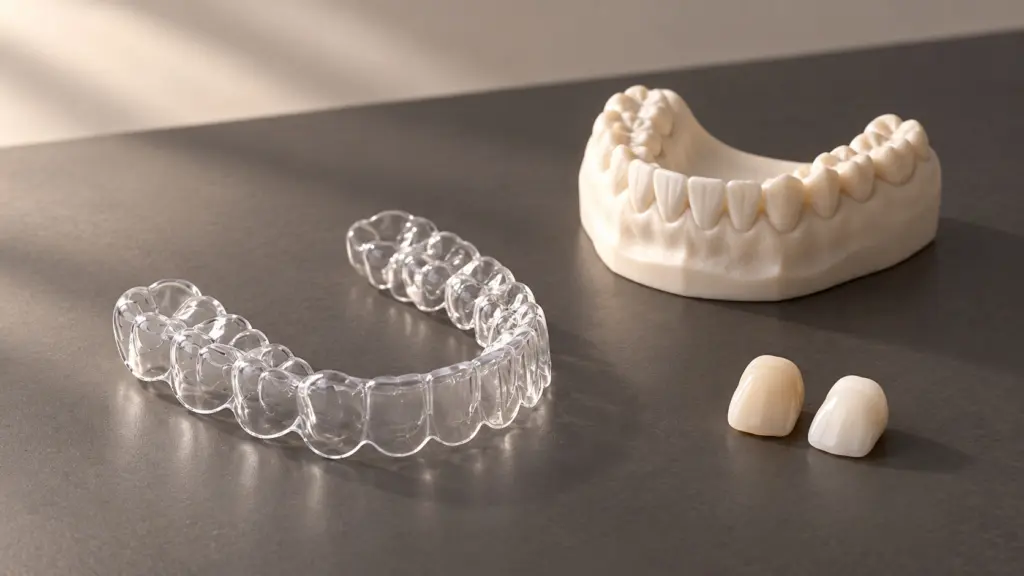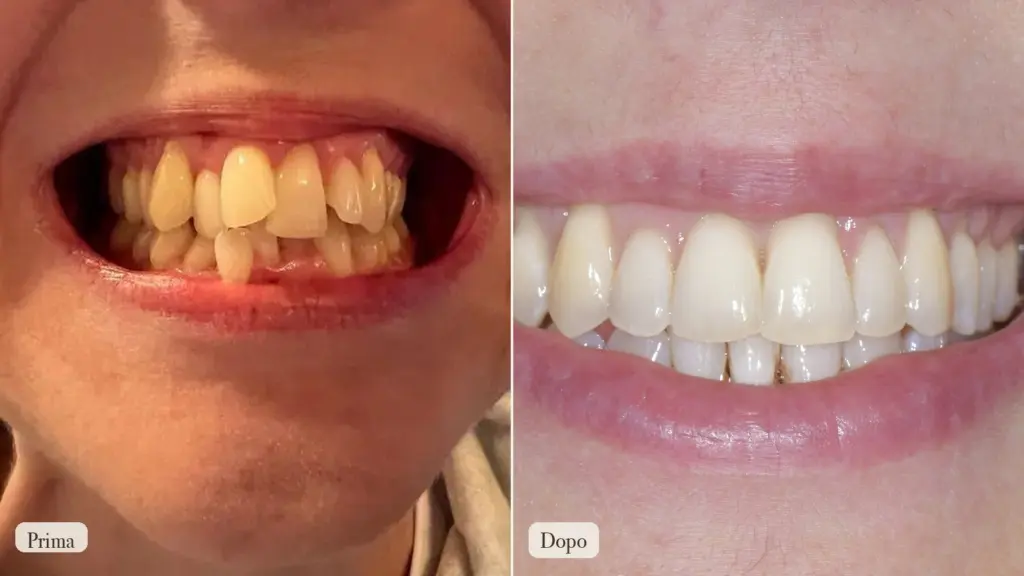
Clear aligners can be considered at 50 and beyond. Age alone does not determine suitability: the health of teeth and gums, the movements needed, treatment goals and the ability to attend check-ups and maintain the result all matter. Invisalign is one option; the choice of appliance follows the diagnosis.
Orthodontics at 50: what really needs assessment
Crowding, a gap between teeth or relapse after earlier treatment may prompt an adult to seek an assessment. The wish to align the smile needs to be considered alongside the clinical situation, without assuming either that it is too late or that aligners are always suitable.1
The assessment considers bone and gum support, tooth decay, restorations, missing teeth and the relationship between the upper and lower teeth. Active periodontal disease needs to be managed before orthodontic tooth movement; even after stabilisation, the plan and check-ups must take account of the available support.1
The goal may be targeted alignment or a broader course of treatment. When restorations are planned, the team assesses whether the teeth should be repositioned first: not every problem with shape or spacing needs to be addressed directly with veneers or crowns.
Practical benefits and the commitment involved
Aligners are removed for eating and oral hygiene and are relatively discreet. However, small composite attachments on the teeth, elastics or other procedures may be needed: “clear” does not always mean unnoticeable.
Patient cooperation is part of treatment. The clinician specifies wearing hours and the sequence of aligner changes; reducing wear time or moving through the sequence faster on your own may compromise treatment. Discussing habits, work, travel and foreseeable difficulties during the assessment helps identify a practical option.1
When fixed braces or combined treatment may be preferable
A systematic review compared aligners and fixed appliances across eight studies, two of which were randomised. Both approaches can treat malocclusions, but some findings on control of tooth inclination and occlusal contacts favoured fixed appliances. The review does not establish equivalence in every case and covers techniques and samples studied up to 2018.2
Significant rotations, complex movements and discrepancies between the upper and lower teeth require an individual plan. Refinements, auxiliaries or a different form of treatment may be needed. The percentages of tooth movement achieved in a study are not an individual’s probability of success and should not be used to promise a result.
How the plan is developed at Studio Buniato
The first visit in Turin starts with expectations, medical and dental history, and a clinical examination. Photographs, an intraoral scan with 3Shape TRIOS 6 and investigations when indicated support the assessment. A digital simulation shows a plan to discuss; it does not certify that every movement will occur exactly as it appears on screen.
Dr Sofia Preatoni provides orthodontic and paediatric dental care at the practice. When a case involves periodontal health or restorations, the different stages are coordinated within the treatment plan. The page on orthodontic treatment with aligners describes the process; the profile of Dr Gianluca Maria Buniato presents his training background.
Before starting, the goal, alternatives, limitations, check-ups and retention should be clear. Mentioning any fear of the dentist allows it to be addressed during the assessment.
Timing and check-ups: why there is no standard duration
Treatment duration is estimated after diagnosis and may change according to the movements needed, the clinical response, consistency of wear and the need for refinements. Limited treatment and a complex correction do not follow the same course. Scheduled appointments allow progress to be checked and the plan adjusted when necessary.
If you live far away, visit frequency should be discussed before starting. Travel needs do not replace clinical check-ups. Patients travelling from Switzerland can find contact details on the dedicated page.
Managing initial discomfort
A feeling of pressure may occur at the start of treatment or after changing an aligner. Responses vary: marked or persistent pain, sores or an aligner that does not fit require contact with the practice. Do not alter aligners or the planned sequence yourself; a check-up helps distinguish normal adjustment from a problem that needs attention.4
Retention is part of treatment
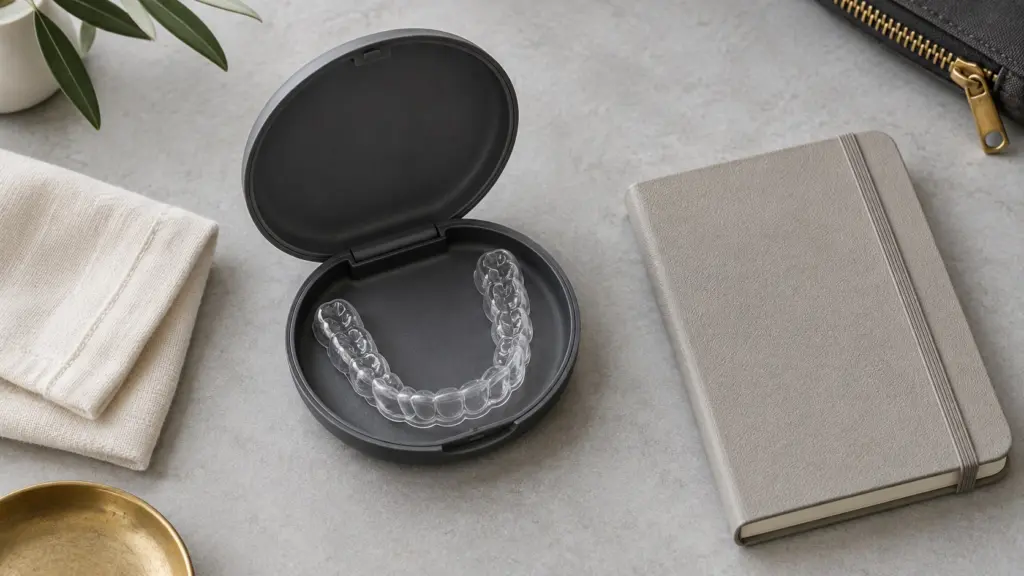
Teeth can change position after the active phase. Removable retainers, fixed retainers or a combination are chosen according to the case; the clinician defines wear, hygiene and review requirements. Maintenance is long term and should not be stopped without clinical advice.3
A retainer that is broken, detached or no longer fits requires contact with the practice. Completing the active aligner phase is therefore a stage in the process, not the end of all check-ups.
Frequently asked questions
Is 50 too late for Invisalign?
No, age alone does not rule out treatment. Tissue health, the movements needed and the ability to follow the plan must be assessed. Not every adult is a candidate for aligners.


He works with great attention to patients’ needs.
Show less
I have known the Buniato dental practice for several years, after various experiences at other practices! I have always had a good experience: the doctor and his colleagues are knowledgeable, kind and precise. He has always advised me tactfully but professionally, and I must say that, although I am quite afraid of the dentist, I feel calm with him. He works with great attention to patients’ needs. Thank you again. Elisabetta
Do aligners work like fixed braces?
They can achieve appropriate goals in selected cases, but they are not equivalent to fixed braces for every movement. The choice depends on the diagnosis and may include auxiliaries or combined treatment.

From the start, the doctor was very helpful and courteous and clearly explained the work he would need to do.
Show less
I did not know Dr Buniato and found him through an internet search. My old bite splint had broken, and I was looking for a practice that used cutting-edge techniques to make a new one. From the start, the doctor was very helpful and courteous and clearly explained the work he would need to do. Once the splint had been made, we had to meet several times so that he could adjust it to fit my teeth as well as possible. Now I have a splint that does its job perfectly. Above all, I greatly appreciated his human warmth, helpfulness, courtesy, calm manner and ability to explain the various steps that would follow. The reception staff are excellent too. The practice is clean, modern and well cared for. What can I say: these days, a doctor like this is almost a rarity. So I recommend him and thank him sincerely.
Can treatment duration be known before the visit?
Goals can be discussed and records prepared. A clinical estimate requires an examination and relevant investigations; the initial number of aligners does not guarantee treatment duration.

their kindness in welcoming patients and their helpfulness in arranging appointments.
Show less
Dr Buniato and his entire team stand out for their great professionalism and expertise, as well as for their kindness in welcoming patients and their helpfulness in arranging appointments. A dental practice I absolutely recommend!!
Are check-ups still needed after treatment?
Yes. Retention and its ongoing review are part of the plan, alongside the health of teeth and gums.

the reception team is well organised when it comes to information, appointments and email reminders for them.
Show less
The practice has a very welcoming waiting room, and all the rooms are bright and clean. The staff are professional, and the reception team is well organised when it comes to information, appointments and email reminders for them. The dentists are professional and attentive to each patient’s particular sensitivities. In conclusion, I am fully satisfied with the treatment and the result achieved.
If you would like to consider tooth alignment as an adult, you can request a first visit at Studio Buniato in Turin, bringing any examination records and information about previous treatment. The discussion of options starts with your goals and clinical situation.
Sources
- American Association of Orthodontists. Adult Orthodontics.
- Ke Y, Zhu Y, Zhu M. A comparison of treatment effectiveness between clear aligner and fixed appliance therapies. BMC Oral Health. 2019;19:24. DOI: 10.1186/s12903-018-0695-z.
- American Association of Orthodontists. Will I Need to Wear Retainers?
- American Association of Orthodontists. Clear Aligners.