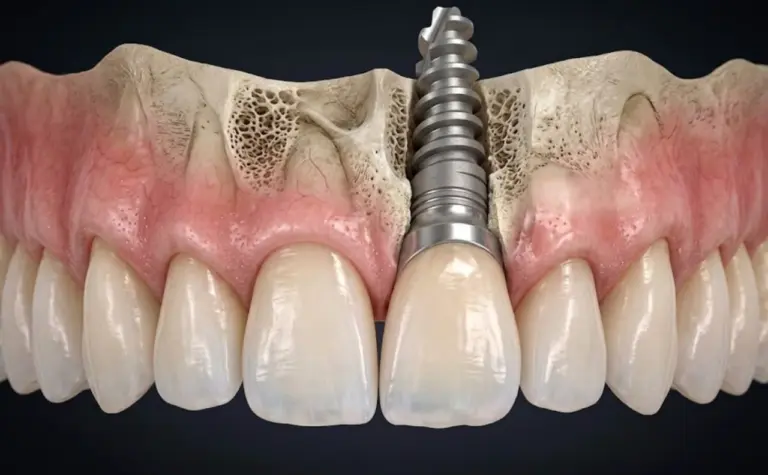
Nobel Biocare Implantology.
Function, Stability, Clarity.
"An implant is not a screw that replaces a tooth. It is a foundation on which to rebuild function, aesthetics and self-confidence."
When Implantology Really Makes Sense
Implantology comes into play when a tooth is no longer recoverable, when one or more elements are missing or when a mobile prosthesis no longer offers adequate function, stability and quality of life. The point is not to "place an implant", but to decide whether it is the correct choice, in what sequence and with what level of invasiveness.
The Dr. Buniato sets each case as a clinical and biomechanical project: quantity and quality of the bone, three-dimensional position, gingival aesthetics, occlusion, healing and maintenance times. Training a Zurich and in the Global Symposia Nobel Biocare serves this purpose: to make even complexity legible.
Training in the tissues around implants also includes the three-day Modern Soft Tissue Management at Implant Sites course offered by Harvard School of Dental Medicine, attended and completed from 8 to 10 October 2026. It is part of Dr Buniato’s continuing education in surgery.

How We Decide the Right Path
Before the technique comes the clinical decision: what to save, what to replace, when to regenerate and when to stop and clarify.
Single Tooth or Multiple Elements
We evaluate whether the problem concerns a single element, a feature of the mouth or a broader situation. The goal is to choose the most stable solution without unnecessarily extending the treatment.
Preserve or Replace a Tooth
When there is a doubt between recovery and replacement, the diagnosis is explored in depth before proposing an irreversible path. Implantology must be a motivated choice, not an automatic one.
Sufficient Bone or Regeneration
If the bone volume is reduced, we first clarify whether the case requires regeneration, sinus lift or a different strategy. Planning serves precisely to avoid surgical surprises.
Second Opinion on Complex Cases
When you have already been offered an implant, an All-on-4® or a multiple extraction, the added value is understanding priorities, alternatives, times and real limitations of the case.
Computer Guided Surgery
Digital planning transforms surgical complexity into a more readable, more precise and less improvised operation.
How It Works
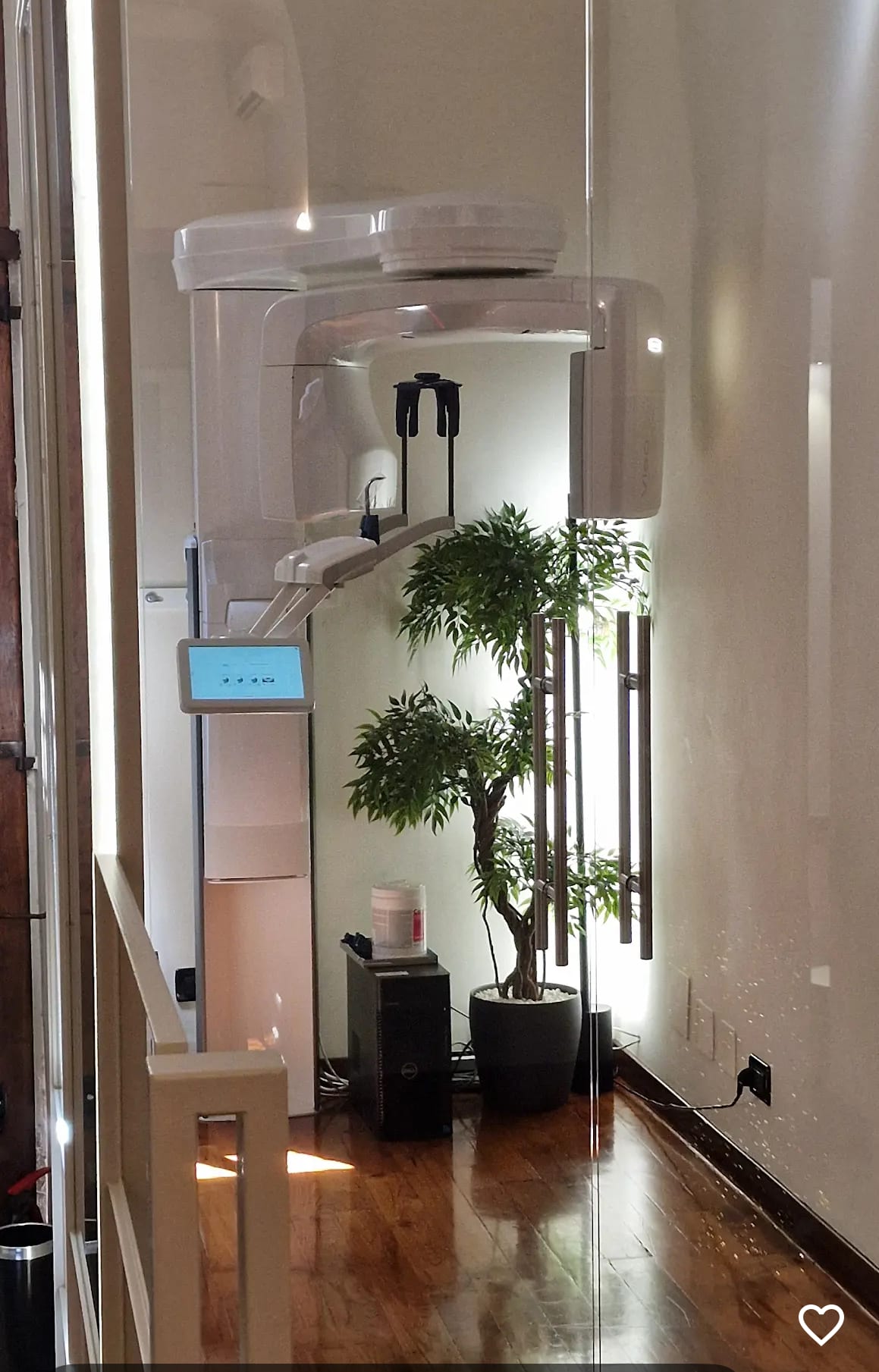
The Planmeca CBCT acquires a 3D model of your anatomy. On this model, Dr. Buniato virtually plans the position, angle and depth of each implant. A 3D printed surgical guide guides the procedure with submillimeter precision.
The advantages for you: shorter, less invasive intervention, reduced healing times, predictable result. In many cases, the fixed temporary prosthesis is applied on the same day as the operation (immediate loading).
Advanced Bone Regeneration
When the bone volume is not enough, the first useful thing is to clarify whether and how to reconstruct it in a manner consistent with the final objective.
GBR, Block Grafts, Sinus Lift
Training with the Dr. De Stavola (Khoury technique, SafeCut computer-guided bone harvesting) allows you to tackle complex bone defects that many practices consider intractable. Guided bone regeneration (GBR) rebuilds the hard tissues needed to support stable, long-lasting implants.
Maxillary sinus lift — one of Dr. Buniato's main specializations — allows the positioning of implants in the upper posterior sector even when the available bone volume is minimal.
Which Path May Be Suitable for Your Case
Single Implant
When a single tooth is no longer recoverable, the focus is on restoring function and aesthetics without unnecessarily altering the rest. Guided surgery helps to be more precise and more conservative.
Bridge on Implants
When several contiguous elements are missing, rehabilitation on implants allows you to re-establish comfort and chewing with a fixed, cleanable solution designed for the specific case.
All-on-4® / Full Arch
When the problem concerns an entire arch, we evaluate whether a full-arch fixed solution is really indicated, with what number of implants and with what conditions for immediate loading.
Immediate loading
Immediate loading is not a commercial automatism: we propose it only when primary stability, bone and biomechanics allow a safe and controlled result.
Results
Rebuild function, rediscover the safety of a complete smile.

Before

After
Why Nobel Biocare
Nobel Biocare is an implant system with over 50 years of published clinical research. We exclusively use Nobel Biocare implants due to their documented biocompatibility, precision prosthetic connection and depth of published scientific documentation.
Dr Buniato’s training includes Global Symposia and programmes within the Nobel Biocare network. For restorative work, collaboration with Oral Design laboratories supports the choice of shapes, materials and details of the restoration.
When a Second Opinion is Worthwhile Before Proceeding
When you have already been offered an extraction, complete rehabilitation or major regenerative surgery, the point is not just to confirm or deny. The point is to understand what is really necessary, in what order and with which alternatives.
A serious second opinion in implantology clarifies whether the case really requires implants, whether less invasive solutions exist, whether immediate loading is realistic and what maintenance will be needed over time.
To Learn More Before Deciding
Three useful readings to understand the indications, times and limits of implantology before arriving at the final choice.
Immediate loading in Turin: When indicated
Immediate loading allows you to place a fixed prosthesis on the implants within 24-48 hours after surgery, but it is not a suitable solution for…
Maxillary Sinus Lift in Turin: Complete Guide to Bone Regeneration
The maxillary sinus lift is the regenerative surgery procedure that allows the insertion of dental implants where the bone is not enough. Rate of…
How long does a dental implant really last? Times, protocols and technology in Turin
Healing times after a dental implant in Turin vary from 2 to 6 months, depending on the bone quality,…
Frequently Asked Questions about Implantology
How long does a Nobel Biocare implant last?
Long-term data document implant survival rates of 95.6% at 5 years and 93.1% at 10 years for implants supporting fixed prostheses (Pjetursson et al., Clinical Oral Implants Research, 2012; DOI: 10.1111/j.1600-0501.2012.02546.x). Nobel Biocare implants, the most documented system in the scientific literature, show results consistent with these values in multicenter follow-ups. A correct home maintenance and hygiene protocol is the most relevant factor for longevity.


He works with great attention to patients’ needs.
Show less
I have known the Buniato dental practice for several years, after various experiences at other practices! I have always had a good experience: the doctor and his colleagues are knowledgeable, kind and precise. He has always advised me tactfully but professionally, and I must say that, although I am quite afraid of the dentist, I feel calm with him. He works with great attention to patients’ needs. Thank you again. Elisabetta
Is immediate loading safe? What do the studies say?
Immediate loading on implants with adequate primary stability (≥35 Ncm) has success rates comparable to the conventional 2-phase protocol. A Cochrane systematic review by Esposito et al. (Cochrane Database of Systematic Reviews, 2013; DOI: 10.1002/14651858.CD003878.pub5) on 26 randomized studies showed no statistically significant differences in the failure rate. Dr. Buniato applies immediate loading when biomechanical conditions allow it, using Planmeca CBCT planning to verify pre-operative bone volume and density.

attentive and always willing to explain every stage of treatment.
Show less
I began treatment with Dr Gianluca Buniato to straighten my teeth as an adult — I am 40 — and I can say it was one of the best decisions I could have made. Thanks to a carefully planned course of orthodontic treatment lasting less than two years, I achieved results I would never have thought possible: my smile has changed completely and I finally feel confident showing it!
Dr Buniato is extremely precise, attentive and always willing to explain every stage of treatment. The entire team is also kind, welcoming and very well organised. The practice, on Corso Francia in Turin, is carefully designed down to the smallest detail and immediately gives you a sense of trust and calm.
Although I live quite far from the practice, the excellent reviews persuaded me to put my trust in the doctor, and I can confirm that it was the right choice.
I absolutely recommend this practice to anyone who wants to improve their smile with professionalism, technology and plenty of personal attention.
Is maxillary sinus lift risky?
Sinus lift is a well-documented procedure with post-graft implant survival rates of 92-100% at 3-5 years (Del Fabbro et al., International Journal of Periodontics & Restorative Dentistry, 2004; PMID: 15626319). The most common complication is perforation of the sinus membrane (incidence 10-35%), which can be managed intraoperatively without compromising the result. 3D CBCT allows you to evaluate the thickness of the membrane and the anatomy of the septa before surgery, significantly reducing the risk.

Both in preparation and during procedures, he puts the patient at ease and looks after their wellbeing.
Show less
Dr Buniato is a serious professional who pays meticulous attention to the details of procedures and to the treatment plan agreed with the client. Both in preparation and during procedures, he puts the patient at ease and looks after their wellbeing. The assistants are also very professional and friendly, and overall they ensure a relaxed atmosphere in the practice. I highly recommend Dr Buniato to anyone looking for a serious, professional dentist who puts the patient’s wellbeing at the centre of every visit.
Does bone regeneration (GBR) work?
Systematic reviews confirm that GBR with membranes and biomaterials allows implant placement in otherwise untreatable bone defects, with 5-year implant survival rates of 95.6% (Aghaloo & Moy, International Journal of Oral & Maxillofacial Implants, 2007; PMID: 18437791). Dr. Buniato is trained in the Khoury technique (autologous bone harvesting with oscillating saw and split-bone technique), learned directly from Dr. De Parolala.

From the very first appointment, I was impressed by the care and clarity with which solutions were proposed to me
Show less
I contacted Dr Gianluca Buniato’s dental practice for advice and a possible estimate to address my many complex dental problems. From the very first appointment, I was impressed by the care and clarity with which solutions were proposed to me, and I was soon able to see how effective they were. I feel I should thank Dr Buniato and his team not only for the professionalism with which they work in a dental practice using excellent technology, at very reasonable prices, but also for their ability to put patients at ease at all times.
Is guided surgery really more precise?
A meta-analysis by Tahmaseb et al. (Clinical Oral Implants Research, 2018; DOI: 10.1111/clr.13346) on 2,238 implants documented an average deviation of 1.2mm at the entry point, 1.4mm at the apex and angular deviation of 3.5° with guided surgery. The study concludes that guided surgery is significantly more accurate than freehand positioning. The Planmeca CBCT from Studio Buniato allows three-dimensional planning and printing of the surgical guide for each implant case.

He explains what he is doing and what you may feel before each step
Show less
I’m writing a little more than I usually would because I know how difficult it can be to find a dentist you genuinely feel comfortable with — especially when you are looking for treatment abroad. I came to Turin for dental treatment and honestly could not be happier that I found Dr. Buniato.
What impressed me from the beginning was how thorough and transparent everything was. He takes the time to do a proper assessment, with detailed images and analysis, and then explains clearly what is going on, what the different options are, which one he recommends and what each option would cost. You are never left in the dark or simply expected to trust that someone knows what is best for you. You understand what is being done, why it is being done and what to expect.
That same care continues throughout the treatment. He explains what he is doing and what you may feel before each step, so you are never caught by surprise. You can tell that he is incredibly precise and genuinely cares about getting every detail right.
And the result exceeded my expectations. I had virtually no pain afterwards, despite expecting quite the opposite. The work looks excellent, but even more importantly, it feels completely natural. After dental work, there is usually some adjustment period — you notice that something has changed, or your bite may feel different. With Dr. Buniato, I had none of that. Everything felt completely natural from the moment I left the chair.
I was also genuinely impressed by the technical standard of the practice. The equipment and technology are on a level I have rarely seen, and it is clear that they are used with real expertise rather than simply being there for show.
The whole team is warm, attentive and professional, and you get the feeling that they are willing to take the time needed to do things properly.
I would genuinely recommend Dr. Buniato to anyone looking for excellent dental care in Turin. I’m very happy I found him and will definitely be back for my future treatment.
Reserve your space
The first step towards your transformation.
Our Patient Care is at your disposal
To start your personalized journey, use our Patient Care, contact us by phone or email. We handle requests with the highest priority and discretion. In case of urgency, we recommend immediate telephone contact.
Opening Hours
Monday - Thursday: 08:30 - 19:00
Friday: 08:30 - 16:00
Saturday - Sunday: Closed
Direct Contacts
Practice phone: +39 011 437 3857
Email: reception@buniato.it
WhatsApp Patient Care (Info/Appointments): +39 342 509 6364
WhatsApp Medical Emergencies: +39 329 473 8155
Reviews and Official Profiles
If you prefer to check before contacting us, you can read the Google reviews or open the practice's official profile on AlfaDocs.
Address
Dental practice Dr. Buniato Gianluca Maria
Corso Francia 30, 10143 Turin (TO), Italy
In central Turin, within easy reach. The nearest metro stop is Principi d’Acaja, a few minutes from Porta Susa, Piazza Statuto and the Cit Turin neighbourhood.