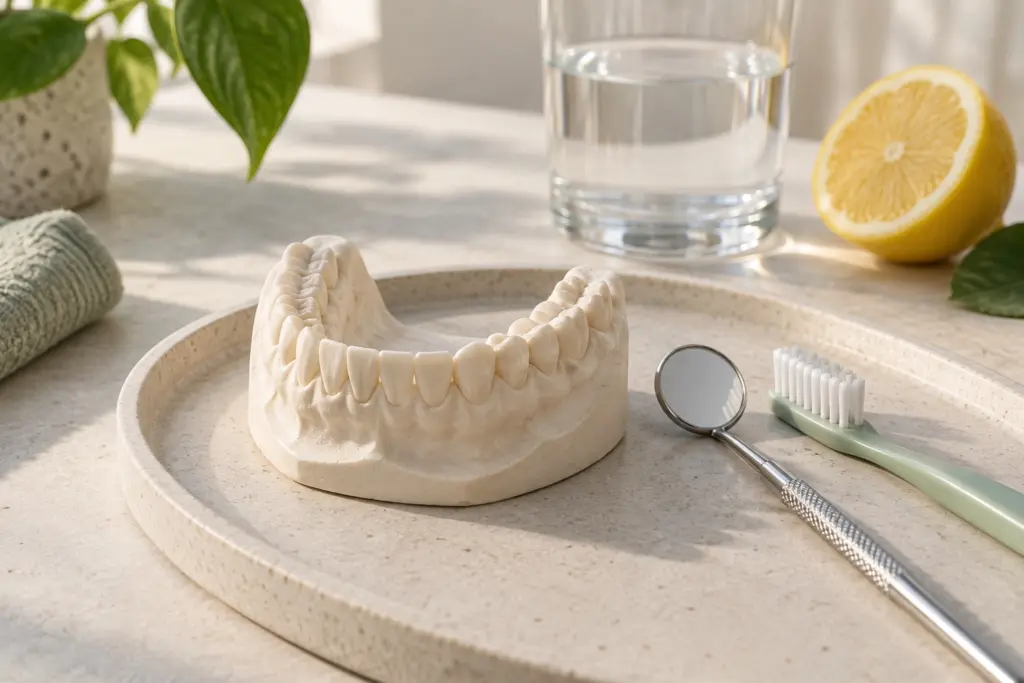
A clinical lead for a treatment plan is identified by their responsibility for the overall course of care: they explain the diagnosis and alternatives, coordinate the professionals involved and update the plan when circumstances change. Clinical history and maintenance matter even in straightforward care; complex treatment requires explicit handovers between professionals.
Who particularly needs a clearly identified clinical lead
People facing a complex course of dental care need to understand who brings the decisions together. Periodontal therapy, saving a tooth and prosthetic rehabilitation may require different professionals with complementary roles. What needs clarifying is how their assessments fit into the overall plan: who gathers the findings from appointments, who explains the alternatives and who reassesses the sequence if a problem arises. Several professionals can work within a coordinated course of care. Patients should know which clinician to ask for an explanation and how to contact the practice between stages, without having to piece together the purpose of every step themselves.
A clinician whose name, role and training can be verified
The first criterion is an identified clinician responsible for the treatment plan. The question to ask at the first appointment is simple: who designs the overall plan and who signs it. The answer should identify a person and a clinical role, rather than an administrative function, together with verifiable training, dates, institutions and public references: where they studied, at which schools, with which teachers and through which continuing education programmes. Continuing education is a selection criterion in its own right. A verifiable professional record is more useful than general adjectives. The same principle applies to the practical criteria for choosing a dentist: objective information patients can check before relying on an impression.
A written plan that can be read before making a decision
A coordinated treatment plan describes the diagnosis, the alternatives considered, the order of treatment and its clinical rationale, the anticipated timescales, the professionals involved and the planned maintenance. Patients should be able to read it at their own pace and ask questions before deciding. It may include separate documents or estimates: separation alone does not indicate a lack of coordination. What matters is that they form part of an understandable course of care and that any changes are explained and documented. If a tooth can be retained with an acceptable prognosis, patients should understand that possibility and its limitations, together with the reasons for any proposed replacement. A written plan helps them revisit those reasons after the appointment.
How we coordinate specialists within the plan
A complex plan may require expertise in periodontology, endodontics, implant surgery and orthodontics. Treatment may be carried out by different professionals, each responsible for their own intervention, within shared objectives and sequences. At the practice at Corso Francia 30 in Turin, near Principi d'Acaja metro station, Dr Buniato coordinates the treatment plan; his training is publicly documented. The professionals involved contribute according to the needs of the case. At the first appointment, it is useful to clarify who will oversee each stage and to whom check-up findings will be reported. The clinical lead can then discuss any changes to the course of care with the patient, without confusing coordination with personally carrying out every procedure.
Recall appointments tailored to individual risk
Coordination also includes reassessment after treatment. A 2009 review of recall and monitoring describes the choice of interval as a decision based on individual risk, oral health and patient needs. A 2020 Cochrane review of adults attending routine dental check-ups found little or no difference between risk-based recall and six-monthly check-ups for caries, gum bleeding and oral-health-related quality of life over four years. These findings concern routine check-ups: they do not establish postoperative intervals or those for complex periodontal or implant maintenance. The schedule should be agreed and updated according to the case.
For people who live far away, including in Switzerland, it is useful to clarify before starting which check-ups require attendance at the practice, who will perform them and how any problems should be communicated. Remote contact can help organise the next step, but does not replace an appointment when one is needed. The practical information for patients from Switzerland explores this aspect further. Travel and personal availability are considered in the organisation of care, while clinical indications, protocols and biological healing times remain the basis for the treatment sequence.
Coordination varies with the complexity of the case
The amount of coordination needed varies from case to case. Treatment involving several disciplines requires explicit handovers between professionals; a single dental cleaning, restoration or implant may fit into a simpler arrangement. These procedures still require attention to clinical history, current conditions and subsequent check-ups. There is no need to change practice or organisational model if responsibilities are already clear and information is shared appropriately. The useful criterion is not how many people are involved, but whether the patient understands who oversees the overall decision, who performs individual treatments and whom to contact when reassessment is needed. A well-coordinated team can also support continuity of care.
Frequently asked questions
How can I find out at the first appointment who is responsible for my plan?
You can ask who coordinates the course of care, which professionals will oversee each stage and how any changes will be discussed. The answers should help you connect the diagnosis, alternatives and treatment sequence. It is useful to receive a readable plan and know whom to contact for clarification, even when there is more than one document or estimate.
I only need one implant: is coordination still necessary?
Yes. Even a single implant should be assessed in the context of oral health, clinical history, neighbouring teeth and maintenance. Coordination may be simpler than for extensive rehabilitation, but it is still useful to know who oversees treatment and check-ups. If you already have a dentist, you can ask how relevant information will be shared.
Does the clinical lead have to carry out every check-up personally?
No. Check-ups and treatment may be assigned to different professionals according to their expertise and the needs of the case. Patients should be able to identify their respective responsibilities and understand how findings feed back into the overall plan. Continuity also depends on documentation, communication and agreed reassessments, without requiring every appointment to be with the same person.
For an individual assessment of your case, Dr Buniato is available for an initial dental consultation with a comprehensive diagnostic assessment.
Sources
- Clarkson JE, Amaechi BT, Ngo H, Bonetti D. Recall, reassessment and monitoring. Monogr Oral Sci. 2009;21:188-198. doi:10.1159/000224223. PMID: 19494686.
- Fee PA, Riley P, Worthington HV, et al. Recall intervals for oral health in primary care patients. Cochrane Database Syst Rev. 2020;10:CD004346. doi:10.1002/14651858.CD004346.pub5. PMID: 33053198.