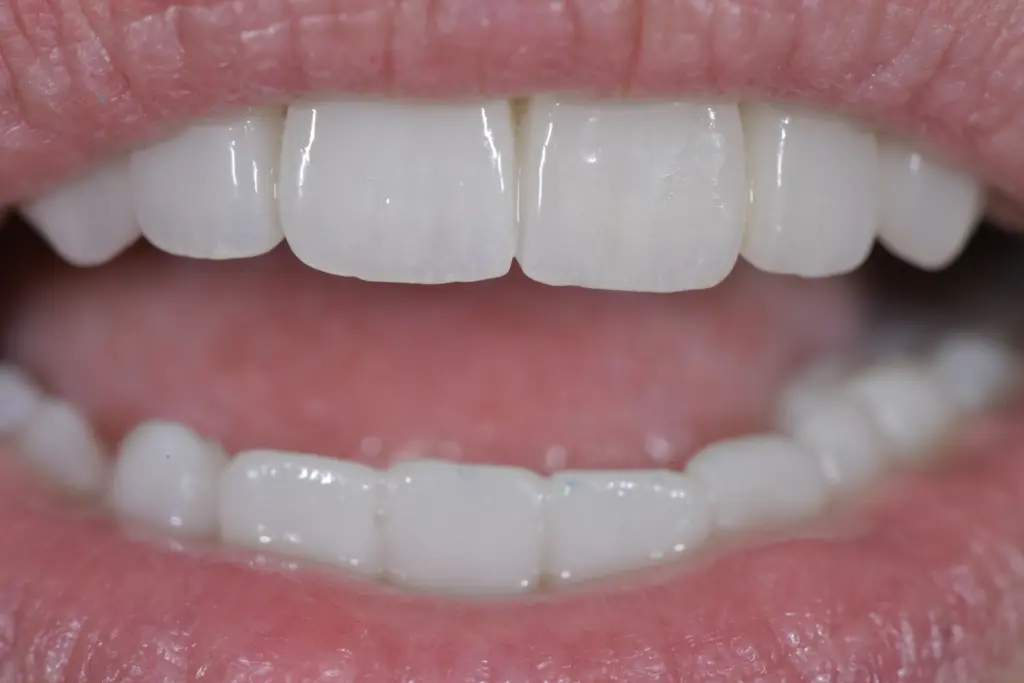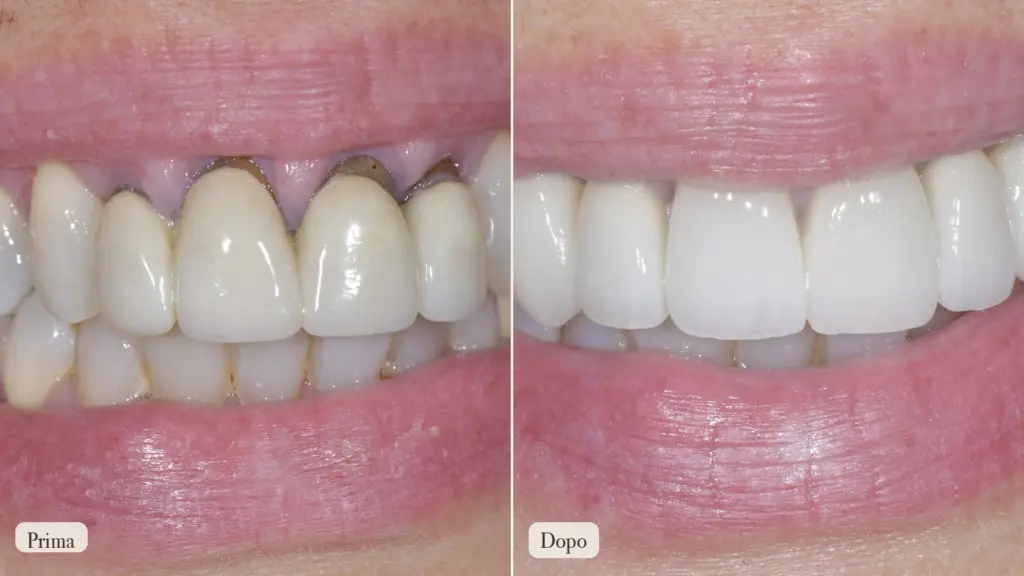
Veneers are used when the colour, shape or proportions of the front teeth cannot be corrected in a simpler way and the case allows a conservative approach. They should not be forced if they make the smile artificial or sacrifice a healthy structure without a proportionate and shared clinical benefit.
Who are veneers really for?
Dental veneers are an aesthetic treatment indicated when the problem mainly concerns the visible part of the smile: shape, proportions, small surface defects, some discolorations or asymmetries of the front teeth. The correct question, however, is not just whether they improve the smile. It's whether they improve it in the most prudent way for that patient.
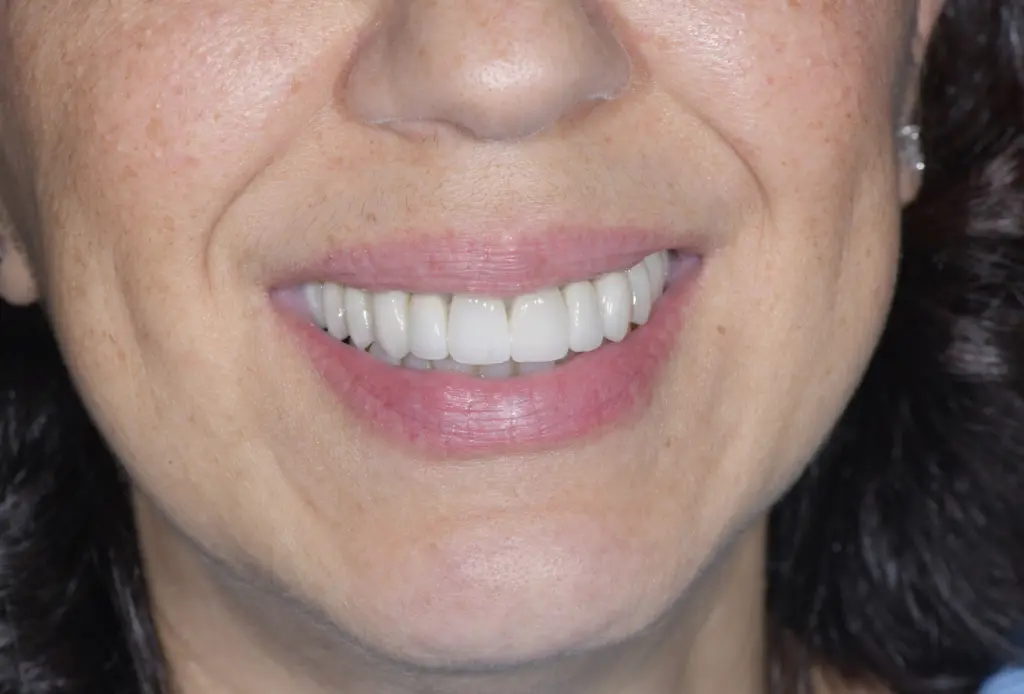
For a patient who is highly exposed in professional or social life, the most desirable outcome is often not the most obvious one. It is a credible smile, consistent with the face, age, way of speaking and personality. For this reason, at the Buniato Dental Practice in Turin, the aesthetic evaluation must remain first and foremost a clinical evaluation: we don't start from the ceramic, we start from the diagnosis.
The literature on minimally invasive veneers confirms an important principle: case selection is part of the treatment. No-prep or minimally invasive veneers can be conservative, but they are not automatically suitable for everyone. They work when space, color, tooth position and patient expectations make a proportionate design possible.
When veneers can be a conservative choice
Veneers can make sense when they allow you to correct a real aesthetic defect with minimal preparation or, in selected cases, without tooth preparation. A retrospective evaluation of no-prep porcelain veneers reported, at 36-60 months, a survival of 97.4% and an overall success of 91.0%, with 2 absolute failures out of 78 veneers evaluated. They are useful data, but should not be read as an individual promise: they describe a protocol and a selection of cases.
The clinical point is this: a conservative veneer is not an aesthetic shortcut. It is a choice that requires control of thickness, color, margins, adhesion, occlusion and hygiene over time. If to achieve the desired effect it would be necessary to remove healthy structure disproportionately, the plan must be discussed again.
For this reason the mockup is a decision-making tool, not a scenographic passage. It helps to see a possible direction before touching the tooth structure. It allows the patient to understand if the smile remains his, if the proportion is credible and if the aesthetic objective really deserves that type of treatment.
When it is better not to force them
Veneers are not indicated when the request is a uniform, very white or standardized smile that does not respect the face, function and identity. They are not the automatic response to every aesthetic dissatisfaction. If the main problem is the position of the teeth, a veneer may only partially mask the defect and risk becoming more invasive than necessary. If the problem is color, it may be useful to first think about non-prosthetic conservative options, when clinically appropriate.
They should not be forced even when gums, hygiene, function or occlusal stability are not under control. An unstable mouth can compromise even a well-designed aesthetic project. In these cases the most serious choice is to stop, order priorities and decide whether the aesthetic treatment can come later.
The patient's desire remains central, but is not enough on its own. Good dental aesthetics does not simply carry out a request: it interprets it, measures it and, when necessary, reformulates it. This is especially important for those who are looking for natural veneers in Turin and do not want a result that changes their public image too much.
Alternatives to veneers: when it makes sense to talk about it
The literature reminds us that not every aesthetic correction requires a ceramic veneer. In select cases, direct composite build-ups can correct shape, small gaps or profiles of anterior teeth with a non-invasive or minimally invasive approach. A 5-year study of 176 direct composite restorations recorded no complete losses and reported an overall survival of 84.6% at 60 months.
This does not mean that composite is always preferable, nor that ceramic is always excessive. It means that the decision must start from the specific problem. Small spaces, slightly irregular margins or proportions to be refined may require a different strategy than very discolored teeth, extensive previous restorations or more structured aesthetic needs.
To delve deeper into the topic of naturalness, it may also be useful to read the article dedicated to feldspar ceramic veneers and natural smile. The question always remains the same: what is the most proportionate treatment to obtain a stable, credible and respectful improvement of the dental structure?
How we decide before touching healthy structure
A correct aesthetic evaluation is not limited to observing the front teeth. Consider the face, lips, smile exposure, color, symmetries, gums, masticatory function, existing restorations and patient expectations. The clinical review on minimally invasive veneers underlines the need for a complete clinical and aesthetic examination, with indications and contraindications evaluated before the definitive plan.
In the decision-making process, the first specialist visit serves to sort information. It's not just about whether veneers can be done. It helps to understand if they are the right choice, if there is a more conservative alternative, which limits need to be clarified and which risks can be reduced with more careful planning.
Dr. Gianluca Maria Buniato works in a context in which aesthetics and function are assessed together. The training of Dr. Buniato and the approach taken at the practice support a sober approach: less effect, more coherence; less standardization, more patient identity.
What to expect and how to maintain the result
After an aesthetic evaluation, the patient should come away with clear answers: which aspects can be improved, which are not worth changing, which alternatives are realistic and what maintenance will be necessary. Veneers, when indicated, require careful hygiene, periodic checks and attention to functional habits. The result is not only protected on the day of delivery: it is protected over time.
More conservative decisions help precisely this: reducing overly invasive treatments, avoiding inconsistent results with the face and preserving as much tooth structure as possible. In Turin, the Buniato Dental Practice is located in Corso Francia 30, near the Principi d'Acaja metro, and has a 5.0 rating with 136 verified reviews updated as of May 4, 2026. It is useful public data, but the clinical choice always remains individual.
For a personalized assessment of your case, Dr. Buniato is available for an initial specialist visit with complete diagnostic analysis. You can also use the online booking or contact the practice on 011 437 3857.
Frequently asked questions
When not to do veneers?
It is better not to force veneers when the desired result would require an excessive sacrifice of healthy structure, when the smile risks appearing artificial or when existing gums, function, hygiene or restorations must first be stabilized.


From the start, the doctor was very helpful and courteous and clearly explained the work he would need to do.
Show less
I did not know Dr Buniato and found him through an internet search. My old bite splint had broken, and I was looking for a practice that used cutting-edge techniques to make a new one. From the start, the doctor was very helpful and courteous and clearly explained the work he would need to do. Once the splint had been made, we had to meet several times so that he could adjust it to fit my teeth as well as possible. Now I have a splint that does its job perfectly. Above all, I greatly appreciated his human warmth, helpfulness, courtesy, calm manner and ability to explain the various steps that would follow. The reception staff are excellent too. The practice is clean, modern and well cared for. What can I say: these days, a doctor like this is almost a rarity. So I recommend him and thank him sincerely.
Can veneers be natural?
Yes, but naturalness depends on the selection of the case, the aesthetic project and the coherence with the face, color, proportions and personality. It is not an automatic property of the material: it is the result of a well-guided clinical decision.

The result was excellent, as the four teeth look identical to how they did before the accident.
Show less
After my four upper incisors were damaged in an accident, I went to Dr Gianluca Maria Buniato’s dental practice. He was very helpful in seeing me promptly, the following day, to check that there were no serious injuries and carry out an initial temporary repair of the damaged teeth, so that I could use my four incisors again. After several visits to check and assess the stability of the injured area, the definitive procedure was carried out: all-ceramic veneers were fitted to the four incisors with extreme precision. The result was excellent, as the four teeth look identical to how they did before the accident. I am extremely satisfied with the final result and with Dr Gianluca Maria Buniato’s helpfulness and professionalism. I highly recommend him to anyone who needs a dentist for any kind of appointment or procedure.
Are there alternatives to veneers?
In some cases yes. The literature describes conservative alternatives such as direct composite build-ups for small spaces or shape modifications. The choice must not be standardized: it depends on the diagnosis, aesthetic objective, biological limits and expected maintenance.

From the very first appointment, I was impressed by the care and clarity with which solutions were proposed to me
Show less
I contacted Dr Gianluca Buniato’s dental practice for advice and a possible estimate to address my many complex dental problems. From the very first appointment, I was impressed by the care and clarity with which solutions were proposed to me, and I was soon able to see how effective they were. I feel I should thank Dr Buniato and his team not only for the professionalism with which they work in a dental practice using excellent technology, at very reasonable prices, but also for their ability to put patients at ease at all times.
Is a no-prep veneer always better?
No. The term no-prep indicates a potentially conservative approach, but does not automatically make it appropriate. You need sufficient space, compatible color, correct function and a realistic aesthetic goal. Otherwise you may need to rethink your plan.

He explains what he is doing and what you may feel before each step
Show less
I’m writing a little more than I usually would because I know how difficult it can be to find a dentist you genuinely feel comfortable with — especially when you are looking for treatment abroad. I came to Turin for dental treatment and honestly could not be happier that I found Dr. Buniato.
What impressed me from the beginning was how thorough and transparent everything was. He takes the time to do a proper assessment, with detailed images and analysis, and then explains clearly what is going on, what the different options are, which one he recommends and what each option would cost. You are never left in the dark or simply expected to trust that someone knows what is best for you. You understand what is being done, why it is being done and what to expect.
That same care continues throughout the treatment. He explains what he is doing and what you may feel before each step, so you are never caught by surprise. You can tell that he is incredibly precise and genuinely cares about getting every detail right.
And the result exceeded my expectations. I had virtually no pain afterwards, despite expecting quite the opposite. The work looks excellent, but even more importantly, it feels completely natural. After dental work, there is usually some adjustment period — you notice that something has changed, or your bite may feel different. With Dr. Buniato, I had none of that. Everything felt completely natural from the moment I left the chair.
I was also genuinely impressed by the technical standard of the practice. The equipment and technology are on a level I have rarely seen, and it is clear that they are used with real expertise rather than simply being there for show.
The whole team is warm, attentive and professional, and you get the feeling that they are willing to take the time needed to do things properly.
I would genuinely recommend Dr. Buniato to anyone looking for excellent dental care in Turin. I’m very happy I found him and will definitely be back for my future treatment.
Sources
- De Angelis F, D’Arcangelo C, Angelozzi R, Vadini M. Retrospective clinical evaluation of a no-prep porcelain veneer protocol. The Journal of Prosthetic Dentistry. 2023. PMID: 34059296. https://pubmed.ncbi.nlm.nih.gov/34059296/
- Frese C, Schiller P, Staehle HJ, Wolff D. Recontouring teeth and closing diastemas with direct composite buildups: a 5-year follow-up. Journal of Dentistry. 2013. PMID: 23954577. https://pubmed.ncbi.nlm.nih.gov/23954577/
- Strassler HE. Minimally invasive porcelain veneers: indications for a conservative esthetic dentistry treatment modality. General Dentistry. 2007. PMID: 18069513. https://pubmed.ncbi.nlm.nih.gov/18069513/