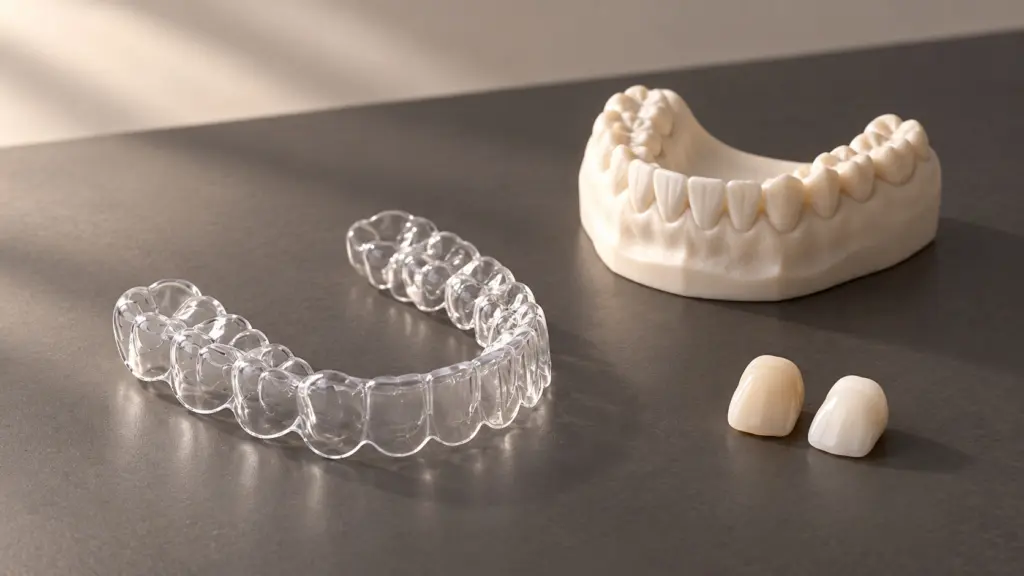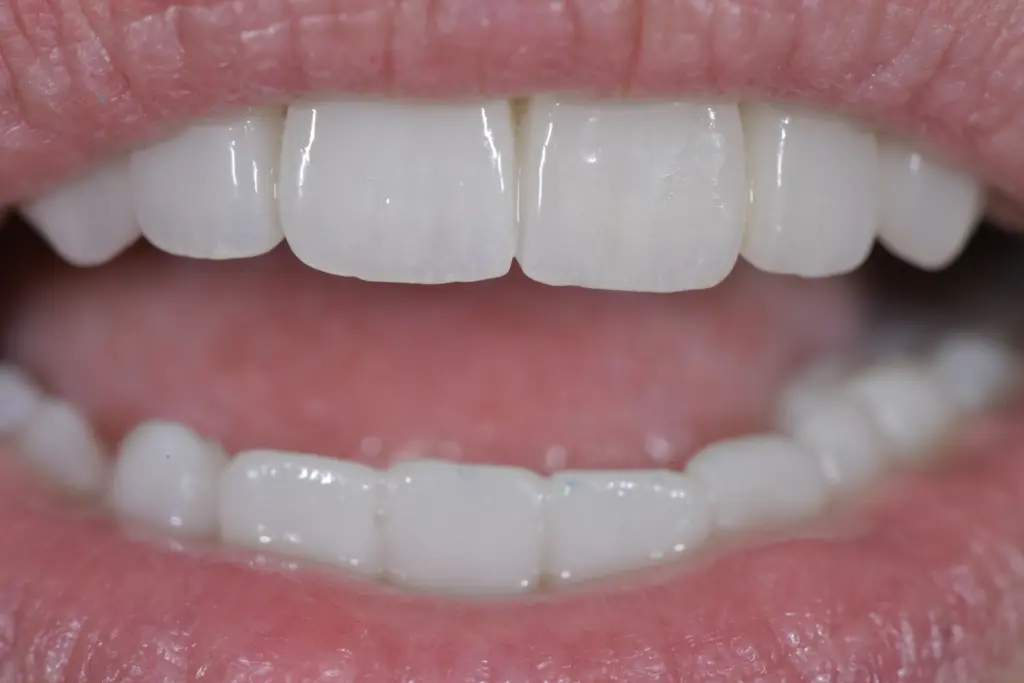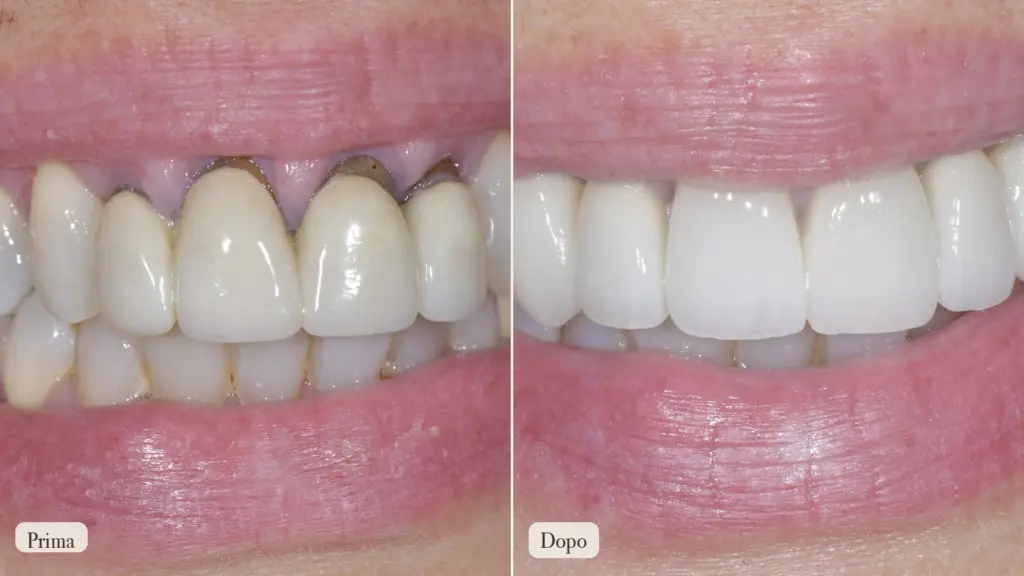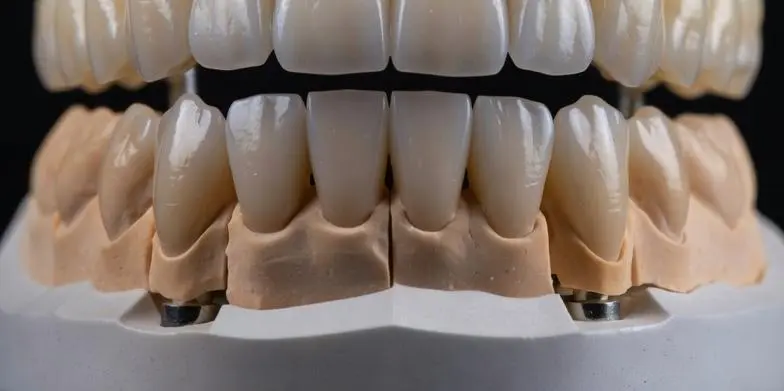
Feldspathic ceramic veneers can correct the shape, proportions and some colour changes of front teeth. The choice depends on the enamel available, tissue health, how the teeth meet and the treatment goal. Alternatives that preserve more tooth tissue should also be considered before veneers are proposed.
What a veneer changes
A veneer is a thin restoration applied to the visible surface of a tooth. It is different from a crown, which covers the tooth more extensively, and it does not move teeth as orthodontic treatment does. Changing a tooth’s shape does not correct the cause of misalignment.
At Studio Buniato in Turin, hand-layered feldspathic ceramic is one option for an individual aesthetic treatment plan. Layering allows the ceramist to adjust colour and translucency. The material alone does not determine the outcome: suitability, preparation, bonding and maintenance all matter.
Feldspathic ceramic, lithium disilicate and composite: how to choose
- Feldspathic ceramic: allows customised aesthetic layering. It requires adequate support and a suitable bonding plan; a thin veneer does not automatically mean that no tooth preparation is needed.
- Lithium disilicate: is a glass-ceramic with different mechanical properties and processing methods. The choice takes account of available space, the colour of the underlying tooth and expected loads, rather than a universal ranking of materials.1
- Direct composite: is shaped directly on the tooth and can provide a conservative, repairable and also definitive restoration when indicated. It may need polishing or repairs over time; it is not solely a temporary material.2
An observational study of ceramic and composite veneers found greater longevity for ceramic veneers in the sample studied. This finding does not make ceramic the necessary choice for everyone, nor does it guarantee how long an individual restoration will last.3
When to consider veneers and when to choose another option
An assessment may address changes in shape, small defects or gaps, and discolouration that less invasive options cannot adequately resolve. The first step is to understand the desired change and its biological cost.
- If the main concern is colour, consider whitening when indicated.
- If it is tooth position, consider orthodontics before changing the shape of the teeth.
- For limited corrections, discuss direct composite.
- If the teeth are healthy and the expected benefit does not justify intervention, consider no treatment as well.
Tooth decay, gum inflammation and problems with supporting tissues need attention before aesthetic treatment. Limited remaining enamel, extensive restorations or significant clenching can affect suitability and risk. Preparation, when necessary, is irreversible: the term no-prep describes selected cases, not a general promise.1,2,4
From the first visit to trying out the proposed design
The first visit is used to discuss expectations and medical and dental history, examine teeth and gums, and consider alternatives. Photographs, an intraoral scan with 3Shape TRIOS 6 and, where useful, FaceScan help document and communicate the plan. Investigations are selected according to need.
A mock-up, which allows the proposed design to be tried in the mouth when indicated, makes it possible to discuss proportions and dimensions before fabrication. It is an assessment tool, not a guarantee of the final result. The amount of preparation is decided individually: there is no single thickness for everyone, nor any certainty that preparation will always remain entirely within enamel.
The next stages involve communication with the laboratory, checking the veneers and adhesive cementation. The assessment establishes which teeth to include, whether preliminary treatment is needed, which try-ins to carry out and how to coordinate the stages with the laboratory. These factors also inform the treatment estimate. For information about the practice’s professional background, see the profile of Dr Gianluca Maria Buniato.
Longevity, limitations and check-ups
Veneers may need repair or replacement because of fracture, debonding, tooth decay or tissue changes. Study results describe groups of restorations under specific conditions and follow-up arrangements; they are neither an expiry date nor a personal guarantee.1,3
Home oral care, agreed check-ups and management of biting forces are part of treatment. Where bruxism is present, the possible use of a night guard should be assessed individually: it does not eliminate every risk.4
For daily maintenance:
- Brush your teeth and clean between them using the tools recommended by your clinician.
- Avoid using your teeth to open packaging or bite hard objects.
- Follow your individual schedule for professional cleaning and check-ups.
- Report chips, a loose veneer or persistent discomfort, without attempting repairs at home.
Frequently asked questions
Do veneers always require teeth to be filed down?
No, but avoiding preparation is possible only in selected cases. Available space, the initial shape, colour and how the teeth meet determine how much tissue needs to be altered.


From the start, the doctor was very helpful and courteous and clearly explained the work he would need to do.
Show less
I did not know Dr Buniato and found him through an internet search. My old bite splint had broken, and I was looking for a practice that used cutting-edge techniques to make a new one. From the start, the doctor was very helpful and courteous and clearly explained the work he would need to do. Once the splint had been made, we had to meet several times so that he could adjust it to fit my teeth as well as possible. Now I have a splint that does its job perfectly. Above all, I greatly appreciated his human warmth, helpfulness, courtesy, calm manner and ability to explain the various steps that would follow. The reception staff are excellent too. The practice is clean, modern and well cared for. What can I say: these days, a doctor like this is almost a rarity. So I recommend him and thank him sincerely.
Is feldspathic ceramic always preferable to composite?
No. The materials serve different needs. The comparison includes preservation of the tooth, the expected result, repair options and maintenance.

attentive and always willing to explain every stage of treatment.
Show less
I began treatment with Dr Gianluca Buniato to straighten my teeth as an adult — I am 40 — and I can say it was one of the best decisions I could have made. Thanks to a carefully planned course of orthodontic treatment lasting less than two years, I achieved results I would never have thought possible: my smile has changed completely and I finally feel confident showing it!
Dr Buniato is extremely precise, attentive and always willing to explain every stage of treatment. The entire team is also kind, welcoming and very well organised. The practice, on Corso Francia in Turin, is carefully designed down to the smallest detail and immediately gives you a sense of trust and calm.
Although I live quite far from the practice, the excellent reviews persuaded me to put my trust in the doctor, and I can confirm that it was the right choice.
I absolutely recommend this practice to anyone who wants to improve their smile with professionalism, technology and plenty of personal attention.
What should I prepare before the visit?
It helps to identify which aspects of your smile you would like to change and to mention existing restorations, sensitivity or clenching. You can bring any examinations and records you already have: the clinician will assess whether they are sufficient.

the reception team is well organised when it comes to information, appointments and email reminders for them.
Show less
The practice has a very welcoming waiting room, and all the rooms are bright and clean. The staff are professional, and the reception team is well organised when it comes to information, appointments and email reminders for them. The dentists are professional and attentive to each patient’s particular sensitivities. In conclusion, I am fully satisfied with the treatment and the result achieved.
How can I plan a visit if I live in Switzerland?
The page for patients from Switzerland provides the channels for an initial contact. This contact helps prepare for the visit; treatment suitability and timing require a clinical assessment.

their kindness in welcoming patients and their helpfulness in arranging appointments.
Show less
Dr Buniato and his entire team stand out for their great professionalism and expertise, as well as for their kindness in welcoming patients and their helpfulness in arranging appointments. A dental practice I absolutely recommend!!
To find out whether veneers or a conservative alternative could suit your smile, you can request a first visit at Studio Buniato in Turin. The appointment allows you to discuss goals, options and the stages of treatment.
Sources
- Komine F, et al. Clinical performance of laminate veneers: A review of the literature. Journal of Prosthodontic Research. 2024;68(3):368–379. DOI: 10.2186/jpr.JPR_D_23_00151.
- Araujo E, Perdigão J. Anterior Veneer Restorations – An Evidence-based Minimal-Intervention Perspective. J Adhes Dent. 2021;23(2):91–110. DOI: 10.3290/j.jad.b1079529.
- Mazzetti T, et al. 10-year practice-based evaluation of ceramic and direct composite veneers. Dent Mater. 2022;38(5):898–906. DOI: 10.1016/j.dental.2022.03.007.
- American Dental Association. Veneers.