An implant-supported prosthesis is maintained through professional recall appointments and management of risk factors. The frequency is defined for the individual case and reviewed over time; any radiographic comparison is considered alongside the clinical assessment and images already available.
Why the tissues around an implant react differently
An osseointegrated implant lacks the periodontal ligament which, on a natural tooth, acts as a biological filter and as an early signal of inflammation. Around the implant the tissues react differently: peri-implant mucositis, the first and reversible stage, can progress to peri-implantitis with bone loss if the biofilm is not removed professionally and on an ongoing basis.
The consensus of the Academy of Osseointegration and the American Academy of Periodontology published in 2025, built on systematic reviews and an expert panel, places structured prevention at the centre of long-term peri-implant health, while acknowledging that the evidence remains less solid on reconstructive surgical protocols than on the non-surgical maintenance phase. In practical terms, an implant prosthesis combines biology and a mechanical component: its durability over the years depends on the continuity of the monitoring programme, not only on the quality of the initial surgery.
Who a dedicated maintenance programme is useful for
A structured recall is indicated for those who have an implant prosthesis whether recent or already in function for years, regardless of the practice where the surgery was performed. The priority increases when risk factors with a documented impact on peri-implant health come into play: a history of periodontitis, smoking, uncontrolled diabetes, obesity, insufficient biofilm control. Local variables also matter, such as implant malposition, unfavourable prosthetic design and the characteristics of the soft tissue around the implant.
A twenty-year prospective study of implant patients with and without a history of periodontitis showed that adherence to an individualised supportive programme preserves the implants over time, whereas non-adherence to recalls is associated with a significantly higher risk of implant loss. An intensive programme is not needed, however, for those with a single implant on tissues that are stable on probing, with no risk factors and with an unchanged bone level at check-ups: in that case recalls become less frequent and the appointment becomes simpler.
What happens during a maintenance appointment
The appointment dedicated to the implant patient is not the same as a routine hygiene appointment. It involves a clinical assessment of the peri-implant tissues with gentle probing, a check for bleeding and suppuration, and a check of the stability of the prosthesis and its contact points. When the clinical picture or the case history requires it, an intraoral periapical radiograph makes it possible to compare the bone level with previous images.
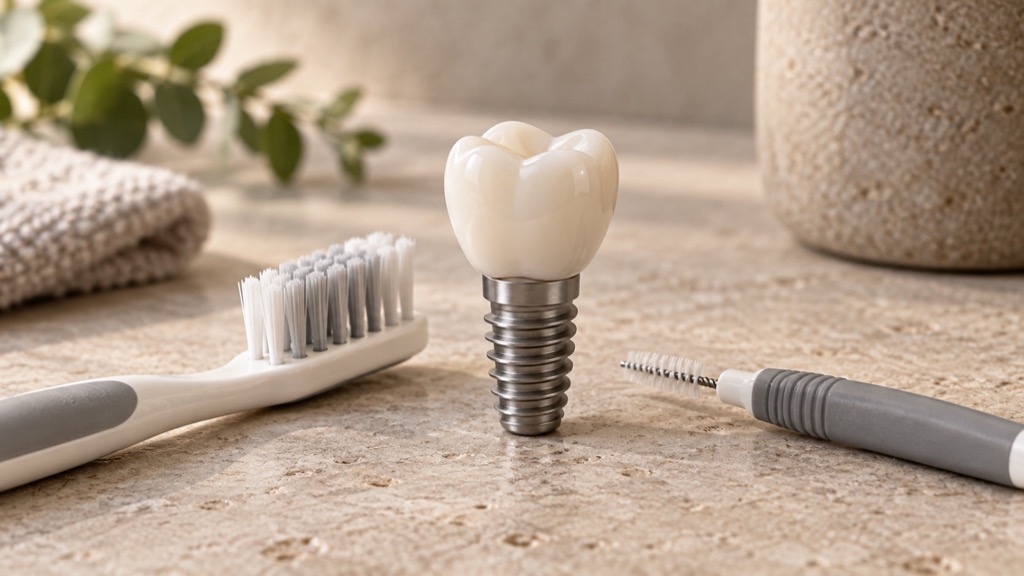
This is followed by professional removal of the biofilm with instruments dedicated to implants, chosen so as not to scratch the implant surface or the neck of the abutment. The appointment closes with reinforcement ofhome oral hygiene, calibrated to the type of prosthesis: interdental brushes, single-tuft toothbrush, dedicated floss, often with a practical demonstration in the chair. The recall schedule starts with closer intervals in the first year and is then adapted to the individual risk profile.
Signs to report before the scheduled recall
Between one check-up and the next, some signs call for an early assessment rather than waiting. The first is repeated gum bleeding around the prosthesis during brushing or the use of interdental brushes: it is the initial sign of peri-implant mucositis, the inflammatory stage that is reversible if treated early.
Persistent swelling of the gum around the implant, the onset of localised halitosis, a sensation of a loose screw or of slight movement of the crown, and the perception of a step or of food that always gets stuck in the same spot also warrant a phone call. A visible recession of the gum margin around the prosthesis also requires a dedicated check-up and, in some situations, an in-depth periodontal assessment. If the recall is already scheduled but in the meantime the patient changes systemic therapies, for example for diabetes, or begins a periodontal treatment pathway, it may make sense to bring the session forward.
When less frequent recalls are enough
Not every implant patient needs an intensive programme. Those with a single implant on tissues that are stable on probing, without bleeding, without a history of periodontitis, who do not smoke and have effective biofilm control, can space out recalls and postpone the radiograph until the clinical picture changes.
In these cases the session is simpler: probing, checking the prosthesis, reinforcing hygiene. Intensifying check-ups without a risk factor that justifies it adds sessions, not safety. The frequency goes back up only if a new sign appears or the risk profile changes, for example with the onset of diabetes or a return to smoking.
When maintenance alone is not enough: mucositis and peri-implantitis
Not every clinical picture resolves with professional hygiene. If peri-implant mucositis emerges at the check-up, the first step is non-surgical professional cleaning (debridement) combined with control of risk factors: in most cases the inflammation regresses and the maintenance programme resumes.
When, by contrast, peri-implantitis is already established, with radiographically documented bone loss, treatment requires a stepwise approach. The 2025 AO/AAP consensus confirms the sequence: first the non-surgical phase, then, if necessary, an individualised surgical procedure: flap access to decontaminate the implant surface, resective or reconstructive techniques depending on the anatomy of the defect. A 2026 narrative review on the prosthetic emergence profile highlighted how unfavourable prosthetic designs or contact points that are difficult to clean can fuel inflammation even in cooperative patients: in these cases revising the prosthetic component is part of the treatment plan and, when the bone defect needs to be measured in three dimensions for re-planning, the CBCT Planmeca VISO G3 documents it. Gum health remains the common thread, as described in the article on periodontal maintenance.
Frequently asked questions
How often should I have my implants checked?
There is no universal frequency. In the first year the intervals tend to be closer together to verify tissue stabilisation, then the schedule adapts to your profile. Smoking, diabetes, a history of periodontitis, prosthesis design and the ability to control biofilm are the factors that shift the frequency. The decision is made together after the first peri-implant assessment.


the reception team is well organised when it comes to information, appointments and email reminders for them.
Show less
The practice has a very welcoming waiting room, and all the rooms are bright and clean. The staff are professional, and the reception team is well organised when it comes to information, appointments and email reminders for them. The dentists are professional and attentive to each patient’s particular sensitivities. In conclusion, I am fully satisfied with the treatment and the result achieved.
My implant surgery was carried out at another practice, can I come here for maintenance only?
Yes. An implant placed elsewhere can be followed for the maintenance phase alone at the practice in Corso Francia 30, Turin. The first session is a complete peri-implant assessment: probing, prosthetic check, baseline radiograph when indicated, assessment of systemic and local risk factors. From there a personalised recall programme is built and the aspects to be reassessed over time are agreed.

He works with great attention to patients’ needs.
Show less
I have known the Buniato dental practice for several years, after various experiences at other practices! I have always had a good experience: the doctor and his colleagues are knowledgeable, kind and precise. He has always advised me tactfully but professionally, and I must say that, although I am quite afraid of the dentist, I feel calm with him. He works with great attention to patients’ needs. Thank you again. Elisabetta
I have a single implant and have never had problems: do I still need dedicated check-ups?
Yes, but with a light programme. A single implant on stable tissues, without bleeding on probing and without risk factors, requires a peri-implant check with probing and verification of the prosthesis at each recall, with a radiograph only if the picture changes. The programme is intensified if bleeding, recession, crown mobility or a new risk factor appear.

Dr Buniato and his team are professional, patient and empathetic, listening carefully and answering my questions.
Show less
The clinic’s appointment system is very convenient, and booking online is simple and quick. The treatment environment is clean, tidy and comfortable, with advanced facilities and a warm, relaxing waiting area that effectively eases the tension of visiting the dentist. Dr Buniato and his team are professional, patient and empathetic, listening carefully and answering my questions. Communication entirely in English was effortless. It was a wonderful dental experience, and I highly recommend it to friends and family!
Do I need a radiograph every time I come for a check-up?
No. The intraoral periapical radiograph is taken when the clinical picture, probing or history suggest it, to compare the bone level over time. It is not a routine examination at every session. CBCT remains reserved for selected cases: a bone defect to be measured in three dimensions or new surgical planning.

From the very first appointment, I was impressed by the care and clarity with which solutions were proposed to me
Show less
I contacted Dr Gianluca Buniato’s dental practice for advice and a possible estimate to address my many complex dental problems. From the very first appointment, I was impressed by the care and clarity with which solutions were proposed to me, and I was soon able to see how effective they were. I feel I should thank Dr Buniato and his team not only for the professionalism with which they work in a dental practice using excellent technology, at very reasonable prices, but also for their ability to put patients at ease at all times.
Sources
- Wang HL, Avila-Ortiz G, Monje A, et al. AO/AAP consensus on prevention and management of peri-implant diseases and conditions: Summary report. Journal of Periodontology. 2025. doi:10.1002/JPER.25-0270. PMID: 40501397
- Roccuzzo A, Imber JC, Marruganti C, et al. Clinical outcomes of dental implants in patients with and without history of periodontitis: A 20-year prospective study. Journal of Clinical Periodontology. 2022. doi:10.1111/jcpe.13716. PMID: 36054302
- Perussolo J, Donos N. Maintenance of peri-implant health in general dental practice. British Dental Journal. 2024. doi:10.1038/s41415-024-7406-8. PMID: 38789755
- Sun TC, Chen CJ, Gallucci GO. Prevention and management of peri-implant disease. Clinical Implant Dentistry and Related Research. 2023. doi:10.1111/cid.13206. PMID: 37042296
- Pirc M, Esquivel J, Patrizzi A, et al. Emergence Profile Angle Matters-Restoring Peri-Implant Health by Adjusting Prosthetics-A Narrative Review. Journal of Esthetic and Restorative Dentistry. 2026. doi:10.1111/jerd.70109. PMID: 41618482