Gingival bleeding becomes a clinical fact when it is frequent, recurrent or associated with recessions, mobility, family history or complex treatment plans. Before deciding on therapy, maintenance, restorations or implantology, the periodontal risk must be measured and understood whether the situation is stable or active.
Gums are not a hygienic detail
Many patients arrive at the office with a seemingly innocuous phrase: "my gums are bleeding a little". The most important part, often, is precisely that "a little". The symptom is perceived as a minor annoyance, a brushing defect or something to be resolved with a more thorough hygiene session.
Sometimes it really is like that. Other times, however, that bleeding is the first visible sign of a changing biological balance. The difference cannot be understood by eye: it is measured.
For this reason the useful question is not just "do I need a periodontist?". The more correct question is: "does this bleeding change the clinical decisions on my case?". If the gums bleed regularly, recede, the teeth seem less stable or fragmentary diagnoses have already been given, the signal can no longer be interpreted as a generic hygiene problem.
Periodontitis, often called pyorrhea, can remain quiet for years. It doesn't always cause pain, it doesn't always warn clearly. In a longevity-oriented dental journey, gums are not an accessory: they are a part of the diagnosis.
When bleeding becomes measurable
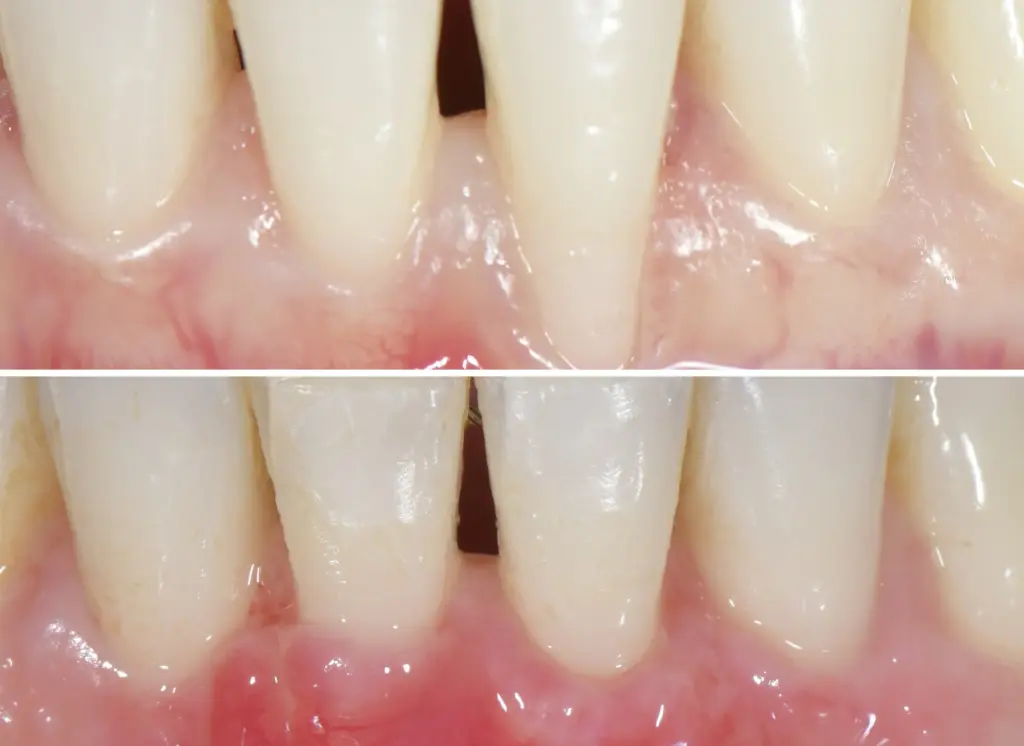
Occasional bleeding does not automatically mean periodontitis. It may be due to superficial inflammation, incorrect use of dental floss, plaque accumulation or small local changes. But when bleeding becomes frequent, affects multiple areas or is associated with recessions, gum pockets, tooth mobility or bad breath, it must be investigated.
The European guidelines on periodontitis indicate that a correct diagnosis must evaluate severity, extent, complexity and individual risk. Translated into practice, it is not enough to observe whether a gum is red. It is necessary to understand how much dental support is still present, whether there is loss of attachment, whether the situation is stable or reactivating and which risk factors can accelerate the worsening.
Bleeding should not be dramatized, but nor should it be trivialized. It is used to decide whether to maintain, treat, reevaluate or pause other interventions until the biological health of the mouth is sufficiently clear.
For whom a periodontal evaluation is essential
Search for a periodontist in Turin becomes sensible when the patient notices frequent bleeding, visible recessions, teeth that appear longer, mobility, family history of periodontal disease, or an unclearly explained previous diagnosis.
The evaluation is even more important when you are about to face a complex treatment plan: extensive aesthetic restorations, crowns, veneers, implantology or complex rehabilitations. In these scenarios the point is not to do more. It's deciding better.
Building an implant, crown or aesthetic project on inflamed and unstable tissue increases the uncertainty of the result. Before investing time, energy and expectations in a treatment plan, it makes sense to understand whether the biological foundations are stable.
At Buniato Dental Practice in Turin, the evaluation starts from clinical data, millimetric measurements, patient history and sharing of priorities. The patient must understand not only what is being proposed, but why it is being proposed at that moment.
Maintenance or therapy: the difference that protects the result
Gum maintenance is not a teeth cleaning done more often. It is a control strategy when the picture has been diagnosed, stabilized and made readable over time.
It becomes a strong choice when the parameters are stable, the individual risk has been identified and the patient follows home instructions consistent with his profile. In this sense, supportive periodontal therapy is a part of the treatment, not a minor phase.
Maintenance protects what has been stabilised. People seeking help for their gums should not settle for a routine recall if the problem has never been measured. First, it is necessary to establish whether the condition is under control; only then can the frequency and aims of maintenance be decided.
When it is not prudent to stop at the recall
If the gum pockets are deep, recessions advance, bleeding persists or teeth lose stability, limiting yourself to routine hygiene can waste diagnostic time. Not because every case requires surgery, but because without diagnosis it is not known which path is proportionate.
A comprehensive periodontal screening is often more useful than a quick and superficial intervention. It allows you to distinguish gingivitis, periodontitis, localized instability, systemic risk or simple need for more targeted maintenance. Above all, avoid treating biologically different situations in the same way, with times and objectives that would not be proportionate.
For those who wish to understand how a diagnosis is constructed before deciding on a plan, it may also be useful to read the guide to first visit to the dentist in Turin.
How we decide: risk, proportion and tools
A serious periodontal path proceeds in steps: accurate diagnosis, control of risk factors, reduction of inflammation, non-surgical therapy when indicated, re-evaluation and maintenance. Surgery, when needed, occurs in selected cases and with a precise clinical reason.
The value lies in the proportion. Don't turn every bleeding into a complex case, but don't leave a signal undiagnosed that can affect future restorations, implants or treatment plans. Technology is only useful if it answers a clear clinical question.
When relevant, the studio has technologies such as Planmeca CBCT, Leica Operating Microscope, 3Shape TRIOS 6 intraoral scanner with FaceScan and Laser Lambda. They are useful tools, but they do not replace the clinical criterion: they make it more documentable when additional data is needed.
What to expect at Studio Buniato
The Buniato Dental Practice is located in Corso Francia 30 in Turin, near the Principi d'Acaja metro stop. Those looking for a periodontal evaluation are not just looking for therapy: they are looking for clarity. He wants to understand if that bleeding is a temporary disorder or something that changes the treatment plan.
The path is sober and orderly: listening, measurements, reading the risk, explaining priorities and making decisions proportionate to the case. The goal is not to push towards a treatment, but to make the most sensible choice understandable.
When the plan involves implants or restorations, gum health becomes even more important. The page dedicated toimplantology shows how predictability also depends on the biological quality of the context in which one works. This is even more true in large cases.
Frequently asked questions
Do bleeding gums always indicate periodontitis?
No. Bleeding indicates inflammation, but alone is not enough to diagnose periodontitis. It is necessary to evaluate probing depth, loss of support, recessions, mobility and risk factors.


He works with great attention to patients’ needs.
Show less
I have known the Buniato dental practice for several years, after various experiences at other practices! I have always had a good experience: the doctor and his colleagues are knowledgeable, kind and precise. He has always advised me tactfully but professionally, and I must say that, although I am quite afraid of the dentist, I feel calm with him. He works with great attention to patients’ needs. Thank you again. Elisabetta
When should I look for a periodontist in Turin?
When bleeding is frequent, recessions or mobility appear, there is a family history of periodontitis, a previous diagnosis is unclear or before tackling complex implants and restorations it is necessary to understand if the biological picture is stable.

The dentists are professional and attentive to each patient’s particular sensitivities.
Show less
The practice has a very welcoming waiting room, and all the rooms are bright and clean. The staff are professional, and the reception team is well organised when it comes to information, appointments and email reminders for them. The dentists are professional and attentive to each patient’s particular sensitivities. In conclusion, I am fully satisfied with the treatment and the result achieved.
Is gum maintenance enough?
Yes, but only when the condition is stable, has been measured and can be controlled through recall appointments and personalised instructions. Maintenance must not replace active treatment if periodontal disease is progressing.

friendly and willing to listen
Show less
Clean and always tidy premises Excellent staff The doctor is always friendly and willing to listen and find solutions for every need The paediatric dentist is very pleasant and wonderful with children and teenagers The nurses complete the team with excellence and professionalism
Why do gums matter before implants or restorations?
Because natural teeth, restorations and implants need healthy and controlled tissues to last. If the inflammation is not governed, the uncertainty of the treatment plan increases over time.

Dr Buniato and his team are professional, patient and empathetic, listening carefully and answering my questions.
Show less
The clinic’s appointment system is very convenient, and booking online is simple and quick. The treatment environment is clean, tidy and comfortable, with advanced facilities and a warm, relaxing waiting area that effectively eases the tension of visiting the dentist. Dr Buniato and his team are professional, patient and empathetic, listening carefully and answering my questions. Communication entirely in English was effortless. It was a wonderful dental experience, and I highly recommend it to friends and family!
For a personalized assessment of your case, Dr. Buniato and the team are available for an initial specialist visit with complete diagnostic analysis.
Buniato Dental Practice – Smile Architecture, Corso Francia 30, Turin. Online booking: book a visit.
Sources
- Sanz M, Herrera D, Kebschull M, Chapple I, Jepsen S, Berglundh T. Treatment of stage I-III periodontitis-The EFP S3 level clinical practice guideline. Journal of Clinical Periodontology. 2020. PubMed.
- Kwon T, Lamster IB, Levin L. Current Concepts in the Management of Periodontitis. International Dental Journal. 2021. PubMed.
- Dannewitz B, Holtfreter B, Eickholz P. Periodontitis-therapy of a widespread disease. Bundesgesundheitsblatt, Gesundheitsforschung, Gesundheitsschutz. 2021. PubMed.