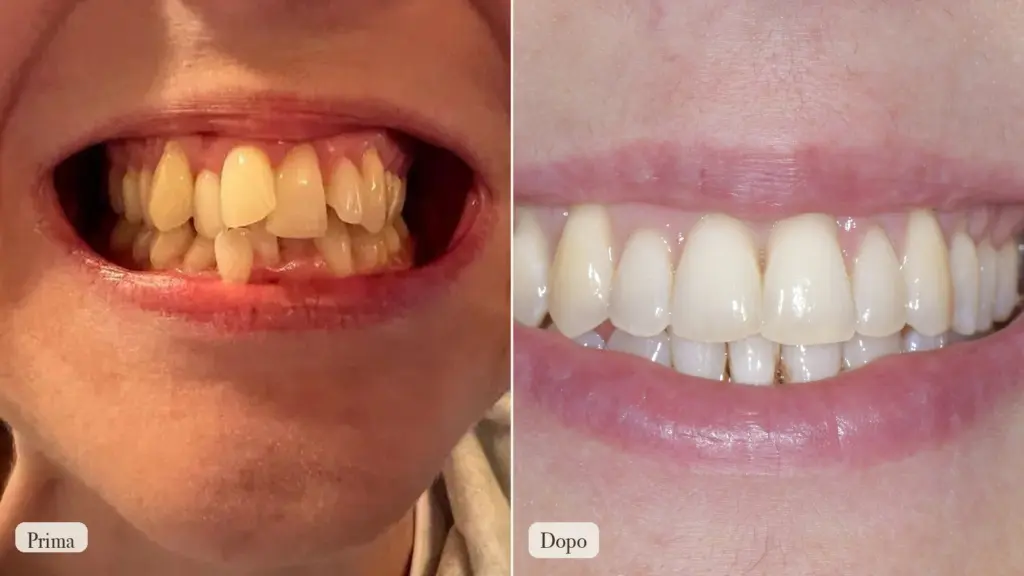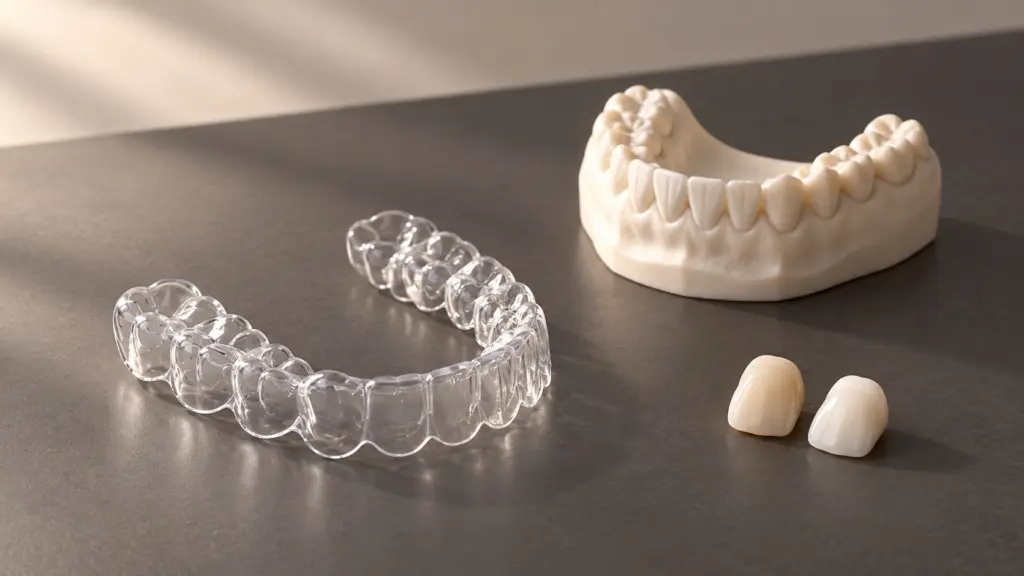
Before changing the shape and colour of teeth, it may be useful to assess their position. In selected cases, orthodontic treatment creates more favourable conditions for restoration and may limit the tooth preparation needed. It is not a mandatory step: the indication, alternatives and sequence depend on the diagnosis and the agreed goals.
Position, shape and colour are different questions
A smile perceived as uneven may be due to rotations, gaps, proportions, wear or colour. These aspects may coexist, but they are not necessarily corrected with the same treatment. Asking for a veneer or an aligner straight away risks anticipating the solution before the problem has been defined.
The assessment considers the teeth, gums, relationships between the dental arches and the patient's expectations. A photograph can help explain what is disliked; however, it does not show all the information needed to decide how to proceed. The amount of healthy tooth tissue to preserve is also part of the discussion.
An understandable plan distinguishes what moving the teeth can achieve from what may require a restoration. If colour or shape remain inadequate after alignment, orthodontics alone might not meet the original goal. Likewise, covering an unfavourable position with a restoration may involve compromises that need to be assessed beforehand.
When orthodontics can make a restoration easier
The literature on pre-prosthetic orthodontics describes situations in which correcting tooth position helps prepare for subsequent restorative work. The distribution of spaces, the inclination of the teeth and the relationships between the dental arches can affect the possibilities of the plan. These are indications for selected cases, not proof that a combined treatment pathway is always superior.
One example concerns a space distributed unfavourably for the proportions of a future restoration. Another concerns a tilted tooth that makes reconstruction more complex. In both cases, the benefits, limits and commitment required need to be assessed: describing a technical possibility does not mean that it is indicated for every patient.
The conservative principle involves comparing options against the actual situation, including the possibility of not intervening when appropriate. It does not mean promising veneers without preparation or reducing every choice to the fewest possible appointments. An additional step can make sense only if the expected benefit justifies the time and complexity.
Health is checked first, then the sequence is planned
The presence of tooth decay, gum inflammation or problems with the supporting tissues may change the priorities. Before planning movements or definitive restorations, it is necessary to understand which conditions need to be treated or stabilised. An aesthetic request does not make these aspects less important.
The sequence is not always simply “orthodontics first, then restorations”. Some procedures may be needed before or during alignment; others are defined after checking the position achieved. Interdisciplinary planning also helps clarify which decisions can be made immediately and which require reassessment.
It is useful for the patient to know who coordinates the treatment pathway, which checks are planned and how information is shared among the professionals involved. The initial plan must be open to revision when new information emerges. Keeping a record of the reasons for decisions helps maintain continuity if treatment takes place in several phases.
Aligners, fixed braces and alternatives
The appliance is chosen according to the movements needed, the clinical conditions and the cooperation possible. Aligners are not a universal solution, and fixed braces are not an outdated choice. The detailed article on adult orthodontics helps distinguish expectations from the actual limits of treatment.
The comparison may also include a restorative solution without orthodontics, a more limited intervention or maintaining the existing situation, when clinically acceptable. Each alternative should be explained in terms of the tissues to preserve, function, maintenance and aesthetic compromises, not just the result displayed in an image.
A simulation can facilitate discussion about proportions, but it is not a biological or technical guarantee. Before deciding, it is worth asking which parts of the result can realistically be achieved and which depend on the individual's response. Timing and the need for any corrections are discussed for the individual case, avoiding deadlines imposed by a personal event.
From planning to maintaining the result
Once alignment is complete, the restorative assessment checks needs and proportions again. Not all the restorations envisaged at the outset will necessarily still be needed, nor can every detail necessarily be defined without further try-ins. For ceramic veneers, the indication and preparation must remain proportionate to the individual tooth.
The programme also includes orthodontic retention, hygiene and check-ups. A restoration does not automatically replace retention; the presence of appliances and new tooth shapes requires coordinated management. It is useful to clarify how the position will be maintained while the restorative phases are completed and which appliance will be indicated afterwards.
For those travelling to Turin from afar, including patients from Switzerland, arrangements can be prepared carefully. Available documents, goals and availability help with scheduling appointments. However, logistics must not compress biological timeframes, remove necessary checks or turn an initial estimate into a promise of completion.
Before starting, a summary of the alternatives helps explain what changes when choosing a combined treatment pathway. The central question remains practical: what benefit does it offer in my case, what commitment does it involve and how will that benefit be checked during treatment? A clear answer enables a more informed decision than simply choosing a technique.
Frequently asked questions
Are braces always needed before veneers?
No. Orthodontics is considered when the position of the teeth makes a preliminary or integrated step useful. In other cases, a restoration may be appropriate without alignment, or intervention may not be necessary. The choice requires an assessment of health, function, tooth tissue and goals, not an identical rule for everyone.


From the very first appointment, I was impressed by the care and clarity with which solutions were proposed to me
Show less
I contacted Dr Gianluca Buniato’s dental practice for advice and a possible estimate to address my many complex dental problems. From the very first appointment, I was impressed by the care and clarity with which solutions were proposed to me, and I was soon able to see how effective they were. I feel I should thank Dr Buniato and his team not only for the professionalism with which they work in a dental practice using excellent technology, at very reasonable prices, but also for their ability to put patients at ease at all times.
Does aligning teeth always make it possible to avoid preparation?
No. In some cases, it may reduce the preparation needed or improve the conditions for the restoration, but it does not guarantee treatment without tissue removal. Shape, colour, final position and the characteristics of the tooth must be assessed together. A promise of veneers without preparation cannot precede examination of the case.

attentive and always willing to explain every stage of treatment.
Show less
I began treatment with Dr Gianluca Buniato to straighten my teeth as an adult — I am 40 — and I can say it was one of the best decisions I could have made. Thanks to a carefully planned course of orthodontic treatment lasting less than two years, I achieved results I would never have thought possible: my smile has changed completely and I finally feel confident showing it!
Dr Buniato is extremely precise, attentive and always willing to explain every stage of treatment. The entire team is also kind, welcoming and very well organised. The practice, on Corso Francia in Turin, is carefully designed down to the smallest detail and immediately gives you a sense of trust and calm.
Although I live quite far from the practice, the excellent reviews persuaded me to put my trust in the doctor, and I can confirm that it was the right choice.
I absolutely recommend this practice to anyone who wants to improve their smile with professionalism, technology and plenty of personal attention.
Can all the phases be concentrated into a short trip?
The sequence depends on the planned movements, checks and tissue conditions. Preparing documentation well and coordinating appointments can simplify the pathway, but does not eliminate the time needed. The schedule is built around clinical needs and updated when the individual's response requires it.

their kindness in welcoming patients and their helpfulness in arranging appointments.
Show less
Dr Buniato and his entire team stand out for their great professionalism and expertise, as well as for their kindness in welcoming patients and their helpfulness in arranging appointments. A dental practice I absolutely recommend!!
For a personalised assessment of your case, Dr. Buniato is available for an initial dental consultation with a complete diagnostic analysis.
Sources
- Alfallaj H. Pre-prosthetic orthodontics. Saudi Dent J. 2020;32(1):7–14. PMID: 31920273; DOI: 10.1016/j.sdentj.2019.08.004.
- Kokich VG, Spear FM. Guidelines for managing the orthodontic-restorative patient. Semin Orthod. 1997;3(1):3–20. PMID: 9206469; DOI: 10.1016/S1073-8746(97)80036-9.