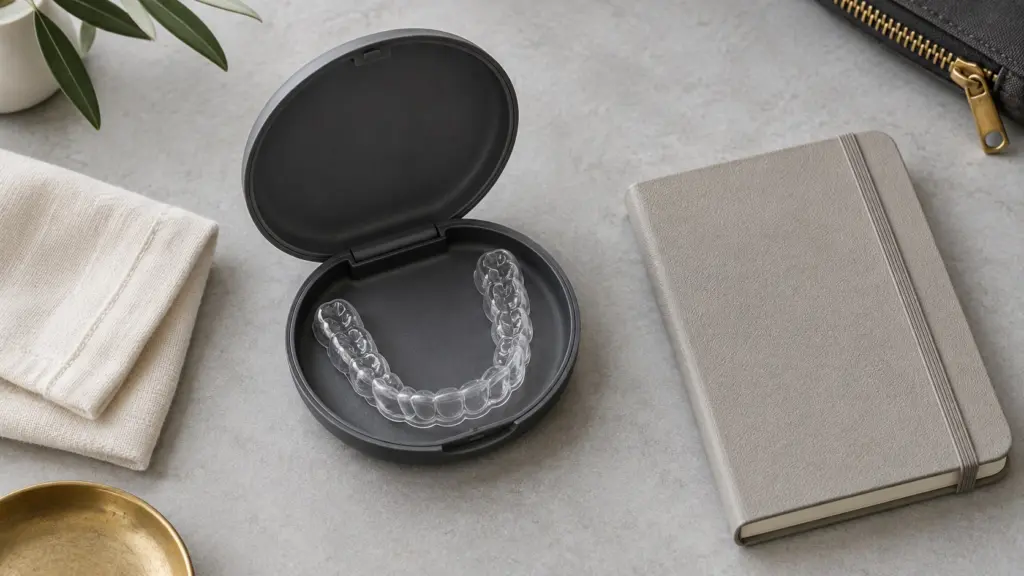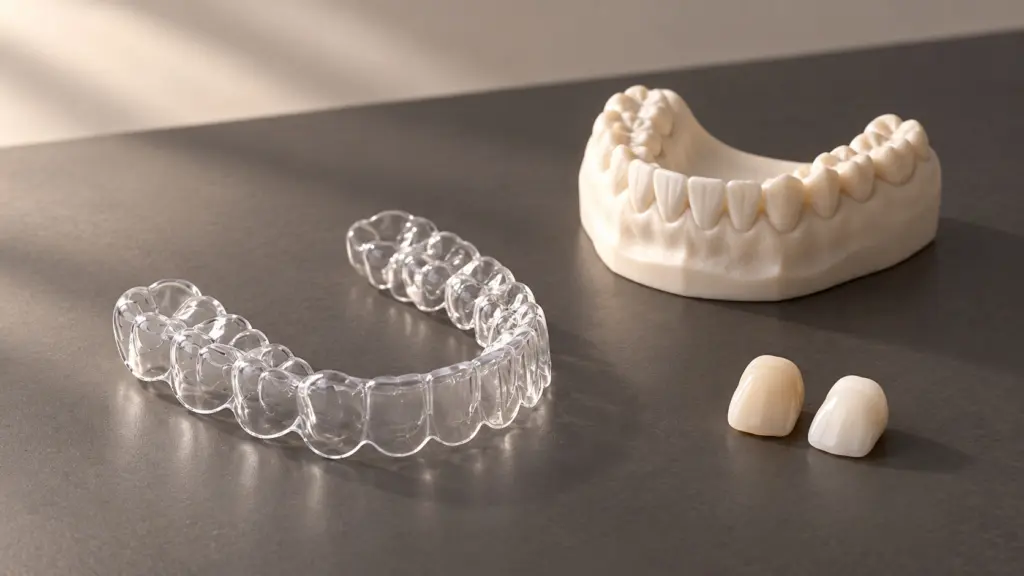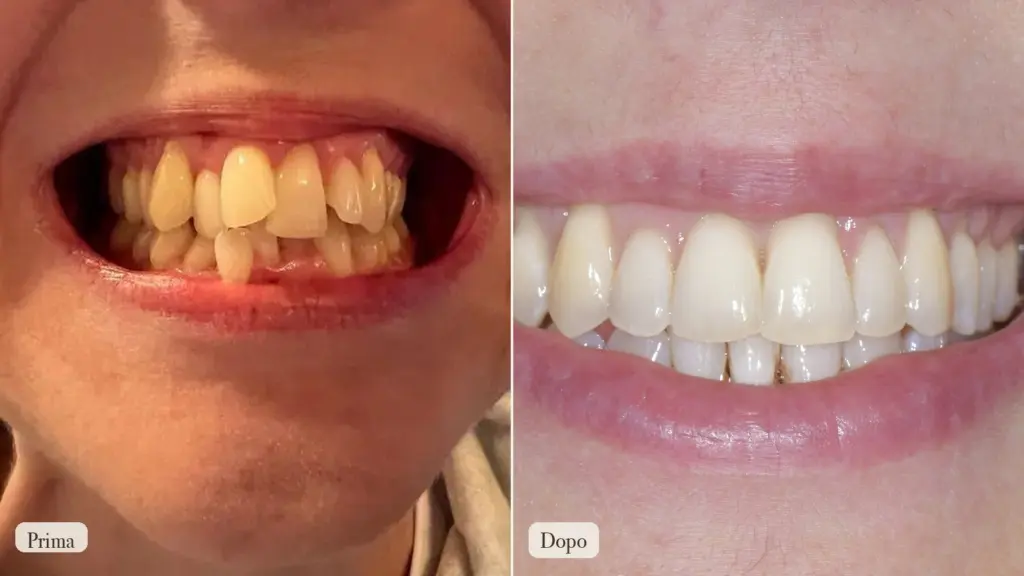
In adults, invisible aligners are indicated for moderate crowding, mild diastemas, relapses and pre-prosthetic phases; fixed braces remain more predictable for marked rotations, space closure after extractions and skeletal corrections. The choice follows the type of movement, the health of roots and bone and the expected compliance, not aesthetics.
Why aesthetics alone is not enough to choose the technique
When an adult considers orthodontic treatment, the first concern often relates to appearance: visible or invisible braces. It is a legitimate question, especially in exposed professional and social settings. Reducing the decision to an aesthetic criterion, however, risks steering the choice towards a technique less suited to the specific case. A well-designed aligner is discreet, but if the case requires movements that this technique does not handle well, the result may take a long time, be incomplete or require a finishing phase with fixed braces. Clarifying first which movements are needed makes it possible to choose the technique suited to the case.
Who invisible aligners make sense for
Clear aligners have a broad but not universal range of indications. In adults they are a solid choice for correcting moderate crowding, mild diastemas, some Class I malocclusions and post-orthodontic relapses in which the teeth have become misaligned again after a previous treatment. They are also often indicated in the pre-prosthetic phase, to reposition teeth before veneers or restorations, so as to work more conservatively on enamel and residual tooth structure.
A practical advantage is removability, which makes oral hygiene at home easier than with fixed braces and reduces the risk of mucosal lesions. A 2020 systematic review on perceived pain, critically appraised in Evidence-Based Dentistry, found on average less discomfort in the first days of treatment with aligners than with fixed braces, with a difference that tends to diminish in the following weeks and overall low certainty of evidence. For a broader overview of invisible orthodontics in Turin, see the page dedicated to the Invisalign treatment.
When fixed braces remain more predictable
There are situations in which fixed braces, in their modern versions, remain the most predictable technique. Extensive tooth movements, significant skeletal corrections, marked rotations of premolars and canines, cases requiring extractions with complex space closure, some Class II and III malocclusions: these are scenarios in which the three-dimensional control of the archwire allows movements that the aligner, on its own, handles with greater difficulty.
The correction of anterior open bite in adults can also be addressed with aligners, but almost always requires dedicated biomechanical auxiliaries, good compliance from the person and often finishing phases, because digital planning software tends to overestimate the movements that can actually be achieved. A 2025 scoping review on adult anterior open bite treated with aligners confirmed that the movements predicted by the digital simulation do not automatically translate into the clinical result and require an explicit biomechanical plan. Proposing fixed braces when they are indicated is not a fallback: it reduces the risk of lengthy or incomplete treatments.
Effects on roots and bone during tooth movement
One of the parameters that weighs on the choice is the health of the roots and alveolar bone during movement. A 2023 randomised study on adults with open bite measured the intrusion of the maxillary molars comparing aligners and fixed braces with dedicated biomechanical auxiliaries, finding at six months a root resorption roughly halved in the group treated with aligners. A 2026 randomised trial, conducted on three-dimensional CBCT models, instead found in non-extraction Class I cases with moderate crowding a similar apical resorption of the incisors between aligners and fixed braces, with the upper lateral incisors as the most vulnerable teeth in both techniques.
A 2025 comparative CBCT study on 120 Class I adults treated with and without extractions showed that in extraction cases fixed braces induce more bone remodelling and greater root resorption, while aligners better preserve the buccal bone, without however eliminating bone loss. No technique is free of biological effects: the difference is made by case selection and periodic monitoring.
How we structure the orthodontic assessment of adults
In the practice, the orthodontic assessment of adults starts from a complete analysis: clinical and aesthetic photographs, intraoral scanning with 3Shape TRIOS 6, panoramic radiograph and, in cases where a three-dimensional reading of root relationships or bone availability is needed, a CBCT with Planmeca VISO G3. On the basis of these data we discuss the case, the movements to be achieved, the risks to be monitored and the realistic expectation of treatment duration.
When the assessment is integrated with an aesthetic or pre-prosthetic project, the digital workflow makes it possible to see a simulation of the result before deciding, a central step in digital smile design. Aligners are not always indicated and fixed braces are not always indicated: sometimes one or the other technique is proposed, or a hybrid approach, or it is suggested not to intervene orthodontically when the expected benefit does not justify the treatment. Even when the person arrives with an already formed preference, the alternatives are discussed with their limits, fixed braces included: it is part of the criterion by which a practice is judged.
Retention and stability after treatment
In adults the active phase, with aligners or with fixed braces, does not conclude the treatment: the tissues tend to bring the teeth back towards the starting position and retention must be planned before starting, not afterwards. The two techniques do not differ in a documented way in medium-term stability: what makes it sustainable is an initial choice proportionate to the case, which avoids movements at the limit of the technique and repeated finishing. The maintenance plan, with fixed or night-time retention and check-ups at a defined interval, is agreed at the end of the active phase and adapted to the response of the tissues.
Frequently asked questions
Does it still make sense to get braces at my age?
There is no chronological age that closes the door to orthodontics. What matters is the condition of the supporting tissues, that is bone and gums, the absence of active periodontal inflammation and the stability of the teeth involved. Even in mature age one can be a candidate for treatment, often targeted and integrated with a prosthetic or restorative project. The assessment starts from a periodontal examination and a realistic discussion of the benefits and limits of the case.


I began treatment with Dr Gianluca Buniato to straighten my teeth as an adult — I am 40
Show less
I began treatment with Dr Gianluca Buniato to straighten my teeth as an adult — I am 40 — and I can say it was one of the best decisions I could have made. Thanks to a carefully planned course of orthodontic treatment lasting less than two years, I achieved results I would never have thought possible: my smile has changed completely and I finally feel confident showing it!
Dr Buniato is extremely precise, attentive and always willing to explain every stage of treatment. The entire team is also kind, welcoming and very well organised. The practice, on Corso Francia in Turin, is carefully designed down to the smallest detail and immediately gives you a sense of trust and calm.
Although I live quite far from the practice, the excellent reviews persuaded me to put my trust in the doctor, and I can confirm that it was the right choice.
I absolutely recommend this practice to anyone who wants to improve their smile with professionalism, technology and plenty of personal attention.
How much do aligners hurt compared with fixed braces in the first days?
In the first days, those wearing aligners report on average lower perceived pain than those wearing fixed braces, but the difference tends to diminish in the following weeks. Comfort also depends on individual tolerance, the presence of attachments, the frequency of aligner changes and the ability to follow the instructions on removal during meals and on daily hours of wear.

although I am quite afraid of the dentist, I feel calm with him.
Show less
I have known the Buniato dental practice for several years, after various experiences at other practices! I have always had a good experience: the doctor and his colleagues are knowledgeable, kind and precise. He has always advised me tactfully but professionally, and I must say that, although I am quite afraid of the dentist, I feel calm with him. He works with great attention to patients’ needs. Thank you again. Elisabetta
If I choose aligners, will I still need to have teeth removed?
Not necessarily. In many cases of moderate crowding, correction is achieved with limited interproximal stripping, without extractions. When instead significant space needs to be created, for example in Class II cases with marked protrusion or severe crowding, extractions remain an option to be considered. The decision depends on the availability of space, the lip profile, the position of the incisors and the treatment objectives, not on the chosen technique alone.

He explains what he is doing and what you may feel before each step
Show less
I’m writing a little more than I usually would because I know how difficult it can be to find a dentist you genuinely feel comfortable with — especially when you are looking for treatment abroad. I came to Turin for dental treatment and honestly could not be happier that I found Dr. Buniato.
What impressed me from the beginning was how thorough and transparent everything was. He takes the time to do a proper assessment, with detailed images and analysis, and then explains clearly what is going on, what the different options are, which one he recommends and what each option would cost. You are never left in the dark or simply expected to trust that someone knows what is best for you. You understand what is being done, why it is being done and what to expect.
That same care continues throughout the treatment. He explains what he is doing and what you may feel before each step, so you are never caught by surprise. You can tell that he is incredibly precise and genuinely cares about getting every detail right.
And the result exceeded my expectations. I had virtually no pain afterwards, despite expecting quite the opposite. The work looks excellent, but even more importantly, it feels completely natural. After dental work, there is usually some adjustment period — you notice that something has changed, or your bite may feel different. With Dr. Buniato, I had none of that. Everything felt completely natural from the moment I left the chair.
I was also genuinely impressed by the technical standard of the practice. The equipment and technology are on a level I have rarely seen, and it is clear that they are used with real expertise rather than simply being there for show.
The whole team is warm, attentive and professional, and you get the feeling that they are willing to take the time needed to do things properly.
I would genuinely recommend Dr. Buniato to anyone looking for excellent dental care in Turin. I’m very happy I found him and will definitely be back for my future treatment.
If I cannot wear the aligners all day, is it still worth trying them?
No. Aligners only work if they stay in the mouth for at least 22 hours a day, removed for meals and for hygiene. Those who expect not to meet this commitment, because of work or habits, obtain incomplete movements and longer treatment times: in these cases fixed braces, which do not depend on daily compliance, are the most appropriate indication. The same applies to marked rotations and closure of wide spaces, where fixed braces remain more predictable.

Dr Buniato and his team are professional, patient and empathetic, listening carefully and answering my questions.
Show less
The clinic’s appointment system is very convenient, and booking online is simple and quick. The treatment environment is clean, tidy and comfortable, with advanced facilities and a warm, relaxing waiting area that effectively eases the tension of visiting the dentist. Dr Buniato and his team are professional, patient and empathetic, listening carefully and answering my questions. Communication entirely in English was effortless. It was a wonderful dental experience, and I highly recommend it to friends and family!
For a personalized evaluation of your case, Dr. Buniato is available for one specialist first visit with complete diagnostic analysis.
Buniato Dental Practice · Invisible orthodontics in Turin · Corso Francia 30, Turin (Principi d'Acaja metro) · 011 437 3857
Sources
- Withayanukonkij W, Chanmanee P, Promsawat M, et al. Root resorption during maxillary molar intrusion with clear aligners: a randomized controlled trial. The Angle Orthodontist. 2023. doi:10.2319/010723-14.1. PMID: 37922387
- Al-Somairi MAA, Yan Y, Alhammadi MS, et al. Three-dimensional alveolar bone changes and root resorption in Class I malocclusion treated with extraction and non-extraction protocols: a comparative study of fixed appliances and clear aligners. BMC Oral Health. 2025. doi:10.1186/s12903-025-07435-8. PMID: 41350867
- Bespalez-Neto R, Mattos CT, Cevidanes LHS, et al. Quantifying Root Resorption on the Incisors After Clear Aligner and Fixed Appliance Therapy Using Artificial Intelligence Tool Based CBCT Surface Models: Randomized Clinical Trial. Orthodontics & Craniofacial Research. 2026. doi:10.1111/ocr.70082. PMID: 41467333
- Mheissen S, Khan H, Aldandan M. Limited evidence on differences between fixed appliances and clear aligners regarding pain level. Evidence-Based Dentistry. 2020. doi:10.1038/s41432-020-0140-4. PMID: 33339979
- Olteanu ND, Romanec C, Cernei ER, et al. Scoping Review-The Effectiveness of Clear Aligners in the Management of Anterior Open Bite in Adult Patients. Medicina (Kaunas). 2025. doi:10.3390/medicina61061113. PMID: 40572801