In summary. After the loss of a single tooth, the implant replaces the missing element without touching the neighboring teeth, while the fixed bridge rests on the two adjacent teeth, which must be filed to accommodate the anchoring crowns. With the same favorable case, both solutions have high documented survival at five and ten years; the choice is decided on the health of the abutment teeth, the available bone volume and the general clinical conditions. The bridge remains indicated when the adjacent teeth are already prosthetic or when there are contraindications to implant surgery.
Single implant or bridge: what is the choice criterion after the loss of a tooth?
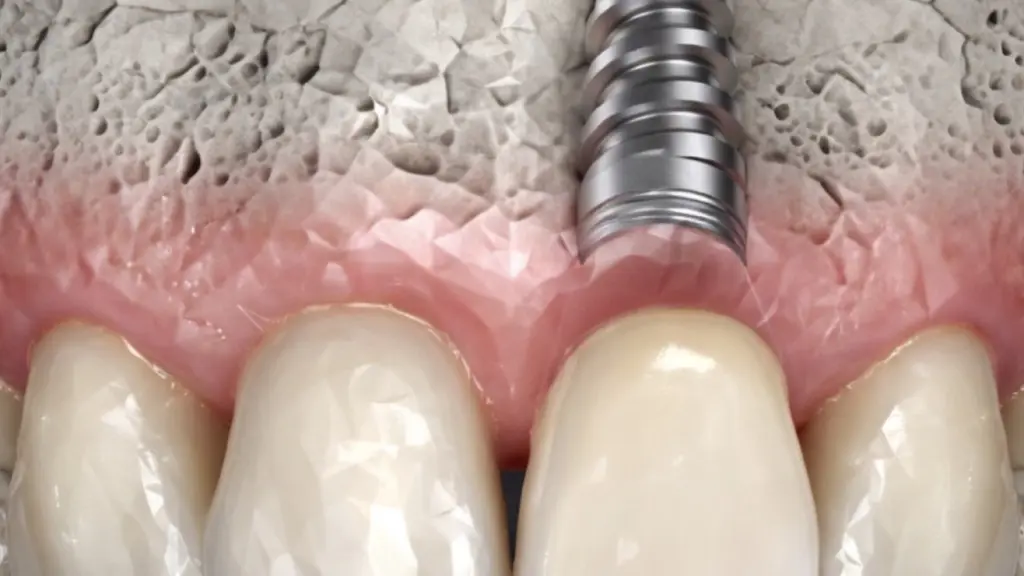
The guiding criterion is the preservation of healthy tissue. The single implant is an artificial root made of titanium inserted into the bone, onto which a crown is screwed: it replaces the missing tooth in an isolated way, without involving neighbouring teeth. The fixed bridge, on the other hand, is a structure of at least three units that uses the two adjacent teeth as abutments: to anchor the crowns to them, the surface must be reduced with a preparation. The key difference is here: when the teeth next to the gap are healthy and intact, preparing them for a bridge means removing dental tissue that didn't need any intervention. The decision, therefore, does not start from the lost tooth, but from the state of the remaining teeth.
What does the bridge mean for neighboring teeth?
The bridge requires filing the abutment teeth, and the amount of tissue removed is not negligible. An experimental study by Edelhoff and Sorensen quantified with gravimetric analysis the tissue removed for the different types of preparation: for a complete crown with total coverage the reduction was equal to approximately 63-72% of the anatomical crown on the anterior teeth and 67.5-75.6% on the posterior teeth. In practice, a crown preparation removes approximately two-thirds of the visible part of the tooth. On a healthy tooth this is a choice that has consequences: the more tissue you remove, the closer you get to the pulp, with possible loss of vitality over time. It is no coincidence that in revisions on traditional bridges, the most frequent biological complications of abutment teeth include tooth decay and loss of vitality. The single implant completely avoids this step: it works in the edentulous space and leaves the neighboring teeth as they are.
Why bone matters: what changes under a bridge and around an implant
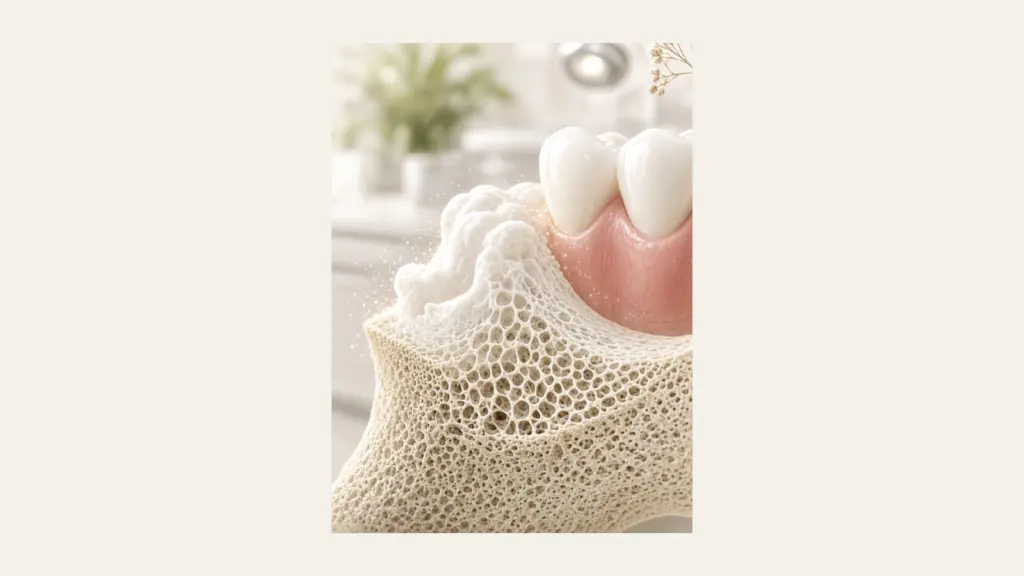
The most significant difference in the long term concerns the bone. After the extraction of a tooth, the bone crest that housed it tends to reshape and shrink. A prospective study by Schropp and colleagues, following the sites for twelve months after the extraction of a premolar or a molar, documented that the major changes in bone contour and soft tissue occur in the first year. Under the suspended portion of a bridge, which does not transmit load to the underlying bone, this resorption process does not find a functional contrast. The implant works on an opposite principle: by integrating into the bone and receiving the chewing load through the crown, it keeps the bone tissue in the replaced area stressed. This is why, in terms of preserving local bone volume, the implant has a biological advantage that the bridge does not offer. Evaluation of the volume and quality of available bone, with three-dimensional imaging when indicated, is an integral part of the decision.
How long do the single implant and the bridge last?
Both solutions have documented high survival in systematic reviews, with different complication profiles. For implants supporting single crowns, a systematic review by Jung and colleagues reported implant survival of 97.2% at five years and 95.2% at ten years; the crown on the implant showed a survival of 96.3% at five years and 89.4% at ten years. For fixed bridges on natural teeth, the review by Pjetursson and colleagues estimated a survival of 93.8% at five years and 89.2% at ten years; a previous review by the same research group indicated a ten-year survival probability of 89.1% for bridges. The numbers, read together, say two things. The first: both rehabilitations last over time in a well-selected case. The second: the complications change. In bridges, biological complications affecting the abutment teeth prevail (caries, loss of vitality); technical complications are more frequent in implants, such as loosening of the screw or chipping of the crown covering material. Neither option is maintenance free.
Hygiene and maintenance: what are the differences in daily care?
Home management changes based on the geometry of the solution. The single implant can be cleaned like a natural tooth, with a toothbrush and interproximal cleaning around the crown, because it remains an isolated element. The bridge, being a single block, does not allow the passage of dental floss between the joined elements: the suspended portion must be cleaned under its base with dedicated tools, such as an interdental brush or floss with a floss threader. Both rehabilitations depend, for their duration, on the same factor: plaque control and the regularity of professional hygiene sessions. In the bridge the stakes are high because a cavity on an abutment tooth can compromise the entire structure; around the implant, the tissue around the crown must be monitored to prevent inflammation of the peri-implant tissues. Periodic maintenance is not a detail: it is what protects the result in both cases.
How long does the process last and how do you get to the final crown?
The times differ due to the biological nature of the implant. The bridge is completed within a few weeks, between the preparation of the abutment teeth, the impression and the cementation of the definitive structure. The implant requires more distributed times, because after surgical insertion a period of osseointegration is needed before loading the definitive crown; the duration depends on the location and the quality of the bone. In the office, planning uses the 3Shape TRIOS 6 intraoral scanner and, when a three-dimensional reading of the bone volume is needed, the CBCT Planmeca VISO G3; the implant components refer to the Nobel Biocare system. The choice between the two solutions does not reward those who are quicker, but those who retain more healthy tissue and bone after years.
When is the bridge still the right choice?
The bridge returns to being the preferable option in some specific situations. The first: when the teeth adjacent to the space are already prosthetic or already extensively reconstructed. In that case the preparation for the bridge does not sacrifice healthy tissue, because those teeth would still have to be restored; using them as pillars becomes a rational choice and not a detriment. The second: when there are contraindications to implant surgery, due to general medical conditions, insufficient bone volume that cannot be reliably reconstructed or other clinical evaluations that make the surgical intervention not indicated for that person. In these scenarios the bridge offers a fixed rehabilitation without the surgical step. The criterion, again, is not ideological: the solution is chosen which, for that specific case, preserves the most and risks the least.
Brief comparison between single implant and fixed bridge
| Criterion | Single implant | Fixed bridge on natural teeth |
|---|---|---|
| Adjacent teeth | They are not touched | They must be filed for the anchoring crowns (about two thirds of the crown on the teeth involved) |
| Bone in the replaced area | Receives load and remains stressed | Below the suspended portion does not receive functional load |
| Documented survival | Implant: 97.2% at 5 years, 95.2% at 10 years; crown: 96.3% at 5 years, 89.4% at 10 years | 93.8% at 5 years, approximately 89% at 10 years |
| More frequent complications | Technical (screw loosening, chipping of the veneering material) | Biological on the pillars (tooth decay, loss of vitality) |
| Home hygiene | Like an isolated tooth | Cleaning beneath the suspended part with an interdental brush or floss threader |
| Times | More distributed (osseointegration) | Shorter (a few weeks) |
| When it is preferable | Healthy neighboring teeth, adequate bone, no surgical contraindications | Nearby teeth already prosthetic, or contraindications to surgery |
Frequently asked questions
Is the implant or the bridge better for a single tooth?
There is no one-size-fits-all answer. If the adjacent teeth are healthy, the implant has the advantage of not having to file them down and of keeping the bone stressed. If those teeth are already prosthetic, or if there are contraindications to surgery, the bridge becomes the most sensible choice. The decision is made on the specific case, evaluating abutment teeth, available bone and general conditions.


He explains what he is doing and what you may feel before each step
Show less
I’m writing a little more than I usually would because I know how difficult it can be to find a dentist you genuinely feel comfortable with — especially when you are looking for treatment abroad. I came to Turin for dental treatment and honestly could not be happier that I found Dr. Buniato.
What impressed me from the beginning was how thorough and transparent everything was. He takes the time to do a proper assessment, with detailed images and analysis, and then explains clearly what is going on, what the different options are, which one he recommends and what each option would cost. You are never left in the dark or simply expected to trust that someone knows what is best for you. You understand what is being done, why it is being done and what to expect.
That same care continues throughout the treatment. He explains what he is doing and what you may feel before each step, so you are never caught by surprise. You can tell that he is incredibly precise and genuinely cares about getting every detail right.
And the result exceeded my expectations. I had virtually no pain afterwards, despite expecting quite the opposite. The work looks excellent, but even more importantly, it feels completely natural. After dental work, there is usually some adjustment period — you notice that something has changed, or your bite may feel different. With Dr. Buniato, I had none of that. Everything felt completely natural from the moment I left the chair.
I was also genuinely impressed by the technical standard of the practice. The equipment and technology are on a level I have rarely seen, and it is clear that they are used with real expertise rather than simply being there for show.
The whole team is warm, attentive and professional, and you get the feeling that they are willing to take the time needed to do things properly.
I would genuinely recommend Dr. Buniato to anyone looking for excellent dental care in Turin. I’m very happy I found him and will definitely be back for my future treatment.
Does the bridge damage neighboring teeth?
The bridge requires reducing the adjacent teeth: for a full coverage crown the literature documents the removal of approximately two thirds of the tooth crown. If the tooth was healthy, it is tissue removed without its own necessity; if it was already rebuilt or decayed, the impact is much less, because that tooth needed to be restored anyway.

From the very first appointment, I was impressed by the care and clarity with which solutions were proposed to me
Show less
I contacted Dr Gianluca Buniato’s dental practice for advice and a possible estimate to address my many complex dental problems. From the very first appointment, I was impressed by the care and clarity with which solutions were proposed to me, and I was soon able to see how effective they were. I feel I should thank Dr Buniato and his team not only for the professionalism with which they work in a dental practice using excellent technology, at very reasonable prices, but also for their ability to put patients at ease at all times.
How long does an implant last compared to a bridge?
Both have high survival in systematic reviews. Implants supporting single crowns show approximately 95% ten-year survival; fixed bridges on natural teeth approximately 89% at ten years. The actual duration depends on plaque control, hygiene sessions and periodic checks, which remain decisive in both cases.

The dentists are professional and attentive to each patient’s particular sensitivities.
Show less
The practice has a very welcoming waiting room, and all the rooms are bright and clean. The staff are professional, and the reception team is well organised when it comes to information, appointments and email reminders for them. The dentists are professional and attentive to each patient’s particular sensitivities. In conclusion, I am fully satisfied with the treatment and the result achieved.
Why is it said that the bone resorbs under the bridge?
After the loss of a tooth the bone crest tends to reduce, with the greatest changes already in the first year. Under the suspended portion of the bridge the bone does not receive masticatory load and does not find a functional stimulus. The implant, integrating into the bone and transmitting the load, keeps the replaced area stressed: this is its main biological advantage at a distance.

attentive and always willing to explain every stage of treatment.
Show less
I began treatment with Dr Gianluca Buniato to straighten my teeth as an adult — I am 40 — and I can say it was one of the best decisions I could have made. Thanks to a carefully planned course of orthodontic treatment lasting less than two years, I achieved results I would never have thought possible: my smile has changed completely and I finally feel confident showing it!
Dr Buniato is extremely precise, attentive and always willing to explain every stage of treatment. The entire team is also kind, welcoming and very well organised. The practice, on Corso Francia in Turin, is carefully designed down to the smallest detail and immediately gives you a sense of trust and calm.
Although I live quite far from the practice, the excellent reviews persuaded me to put my trust in the doctor, and I can confirm that it was the right choice.
I absolutely recommend this practice to anyone who wants to improve their smile with professionalism, technology and plenty of personal attention.
Does the implant hurt?
The insertion takes place under local anesthesia, which controls pain during the procedure. In the subsequent course, post-operative discomfort is managed with the indications provided in the office. Each clinical situation is different and tolerability must be discussed during the evaluation phase.

although I am quite afraid of the dentist, I feel calm with him.
Show less
I have known the Buniato dental practice for several years, after various experiences at other practices! I have always had a good experience: the doctor and his colleagues are knowledgeable, kind and precise. He has always advised me tactfully but professionally, and I must say that, although I am quite afraid of the dentist, I feel calm with him. He works with great attention to patients’ needs. Thank you again. Elisabetta
If I have little bone, can I still have the implant?
Depends on the extent of the defect. In many cases the bone volume can be reconstructed with dedicated techniques, evaluated with three-dimensional imaging; in others the conditions make the intervention not indicated and the bridge becomes the fixed alternative. Checking the volume and quality of the bone is part of the preliminary diagnosis.

From the start, the doctor was very helpful and courteous and clearly explained the work he would need to do.
Show less
I did not know Dr Buniato and found him through an internet search. My old bite splint had broken, and I was looking for a practice that used cutting-edge techniques to make a new one. From the start, the doctor was very helpful and courteous and clearly explained the work he would need to do. Once the splint had been made, we had to meet several times so that he could adjust it to fit my teeth as well as possible. Now I have a splint that does its job perfectly. Above all, I greatly appreciated his human warmth, helpfulness, courtesy, calm manner and ability to explain the various steps that would follow. The reception staff are excellent too. The practice is clean, modern and well cared for. What can I say: these days, a doctor like this is almost a rarity. So I recommend him and thank him sincerely.
Sources
- Jung RE, Zembic A, Pjetursson BE, Zwahlen M, Thoma DS. Systematic review of the survival rate and the incidence of biological, technical, and aesthetic complications of single crowns on implants reported in longitudinal studies with a mean follow-up of 5 years. Clin Oral Implants Res. 2012;23 Suppl 6:2-21. doi:10.1111/j.1600-0501.2012.02547.x. PubMed.
- Pjetursson BE, Brägger U, Lang NP, Zwahlen M. Comparison of survival and complication rates of tooth-supported fixed dental prostheses (FDPs) and implant-supported FDPs and single crowns (SCs). Clin Oral Implants Res. 2007;18 Suppl 3:97-113. doi:10.1111/j.1600-0501.2007.01439.x. PubMed.
- Tan K, Pjetursson BE, Lang NP, Chan ES. A systematic review of the survival and complication rates of fixed partial dentures (FPDs) after an observation period of at least 5 years. Clin Oral Implants Res. 2004;15(6):654-66. doi:10.1111/j.1600-0501.2004.01119.x. PubMed.
- Edelhoff D, Sorensen JA. Tooth structure removal associated with various preparation designs for anterior teeth. J Prosthet Dent. 2002;87(5):503-9. doi:10.1067/mpr.2002.124094. PubMed.
- Edelhoff D, Sorensen JA. Tooth structure removal associated with various preparation designs for posterior teeth. Int J Periodontics Restorative Dent. 2002;22(3):241-9. PubMed.
- Schropp L, Wenzel A, Kostopoulos L, Karring T. Bone healing and soft tissue contour changes following single-tooth extraction: a clinical and radiographic 12-month prospective study. Int J Periodontics Restorative Dent. 2003;23(4):313-23. PubMed.
For an evaluation of your specific case, the first specialist visit includes the complete diagnostic analysis.