A second opinion in implantology is needed when an already proposed plan does not clarify why those implants, those times or that sequence are needed. Its purpose is not quick confirmation: it reassesses data, images and alternatives before making an often irreversible choice for the patient.
When it makes sense to stop before deciding
Receiving an implant plan can leave legitimate questions: Does the tooth really need to be extracted? Is the number of implants proportionate? Have conservative alternatives been considered? Is the proposed sequence clear? A second opinion does not necessarily arise from distrust towards the first professional. It arises from the need to understand a decision that can permanently modify teeth, bone, treatment times and future maintenance.
The literature shows that a significant part of patients who are candidates for implantology want an independent opinion. In a study of patients undergoing implant and bone surgery, between 46% and 62% said they intended to seek a second opinion. This is important data because it confirms a simple clinical point: when the choice is complex, the patient wants to understand, not just sign.
For those who need an implant second opinion
This path is indicated for patients in Turin and its province who have already received an implant plan and want a reasoned reading before proceeding. It is particularly useful when extractions, multiple implants, bone regeneration, maxillary sinus lift or unclear therapeutic times are planned. It is also useful when the patient cannot distinguish between what is essential, what is advisable and what can be discussed with alternatives.
It is indicated when a misalignment is perceived between what has been explained and what you need to know: diagnosis, alternatives, risks, limits and maintenance. Especially when the choice appears already closed, but not yet understood. In these cases, a first specialist visit oriented towards the second opinion allows you to put the case back in order without pressure to make a decision.
When it's not the right path
The second opinion is not suitable for those seeking an immediate answer without reviewing radiographs, three-dimensional images, periodontal status and clinical history. It is not a quick confirmation visit and should not be used to choose the opinion that is most comfortable or closest to your initial expectations. If data are missing, clinical prudence dictates that the picture be reconstructed before making a judgment.
It is instead a serious process, and requires real clinical time, when the patient agrees to start again from the problem: which teeth are recoverable, which are not, what role does the available bone have, if infections are present, what are the priorities and which sequence reduces uncertainty. Without this analysis, the risk is turning a second opinion into just one more opinion.
The signals that deserve reevaluation
Some signs do not prove that a plan is incorrect, but indicate that it may be appropriate to stop and ask for an independent reading. The first is the absence of alternatives: if an implant plan is presented as the only possibility without discussing conservative options, the patient is left with a partial understanding.
A second signal is the lack of clarity on the number of implants. Each implant must have a clinical, functional and prosthetic reason. A third signal concerns timing: when very rapid treatment steps or, on the contrary, a long but poorly explained sequence are proposed, the question is not "can it be done?", but "why exactly like this?".
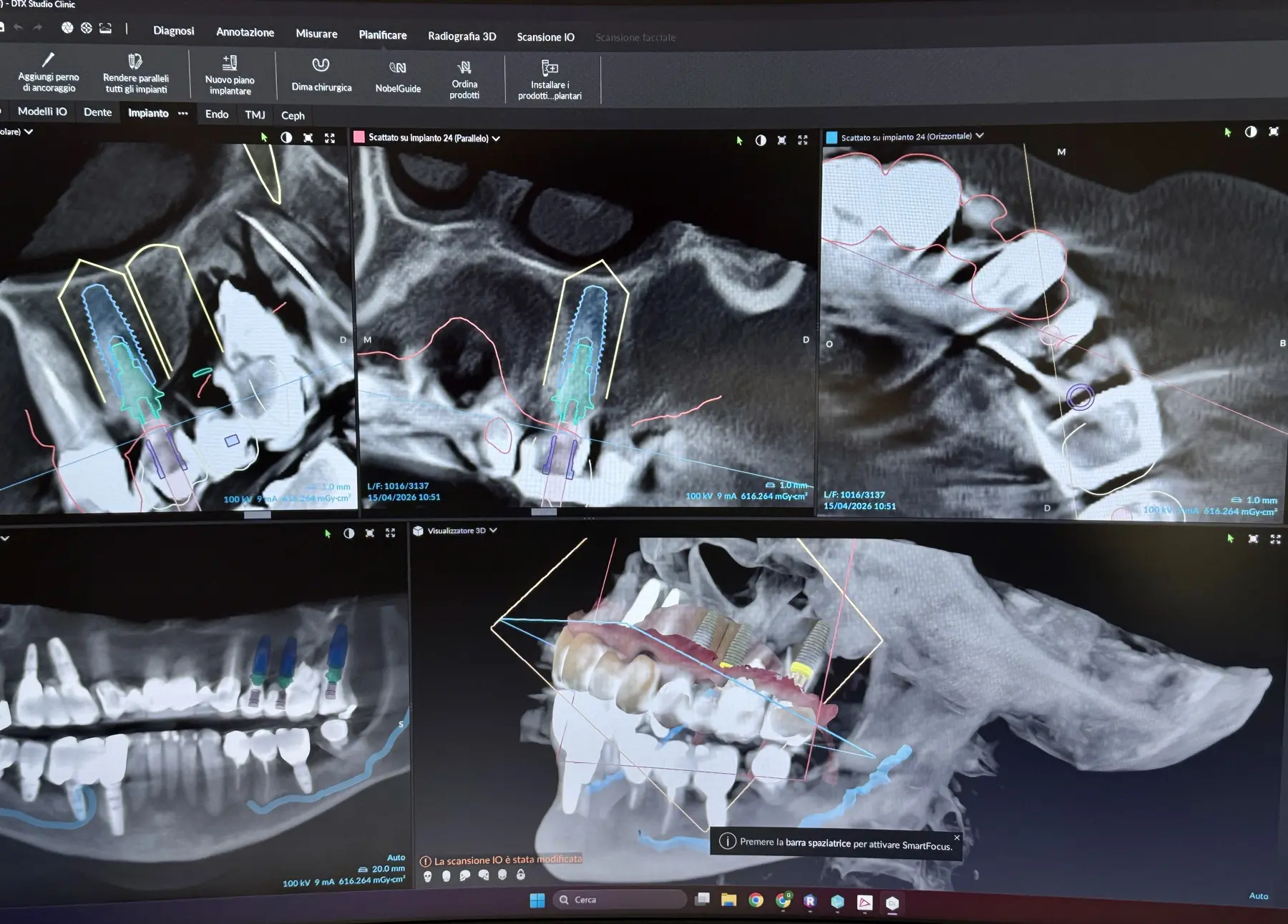
Diagnostics matter too. In complex cases, the diagnostic technology, including Planmeca CBCT when indicated, can help evaluate bone volumes, anatomy and limitations of the case. The tool, however, does not replace the clinical criterion: it is useful when it adds useful information to the decision.
How to re-evaluate an implant plan
A second structured opinion starts from the collection of the tests already available: x-rays, any CBCT, photographs, plan received and medical history. The first objective is to understand if the data is sufficient. If they are not, we evaluate whether to integrate the diagnosis with new elements, always based on the real clinical usefulness.
The evaluation considers residual teeth, gums, available bone, occlusal relationships, aesthetics, function and possibility of maintenance. In the case of implants, it is not enough to decide where to insert an implant: you need to understand if that implant is necessary, if the site is suitable, if regeneration is needed and how the result can be controlled over time.
For this reason the connection with theimplantology is not just surgical. It is diagnostic, prosthetic and decisional. Surgery comes after understanding the case, not before.
Alternatives: why they should be discussed first
One of the most important questions is whether a tooth needs to be replaced or can still be kept. A recent systematic review compared endodontically treated teeth and implant-supported prostheses, reporting comparable outcomes in terms of survival and success, with fewer post-operative interventions and complications for conservative options.
This does not mean that the implant is less suitable overall. It means that, when a tooth is recoverable, the conservative choice must be discussed seriously. At the Buniato Dental Practice, endodontics under the microscope is one of the clinical areas available at the practice and can be included in the evaluation of alternatives when the case allows it.
However, if the tooth is not recoverable or the bone framework requires additional procedures, the re-evaluation must also clarify the rationale for any regenerative interventions. An example is the maxillary sinus lift, which requires precise indications, times and limits.
Shared decision: what needs to be clear
The shared decision is not a formal formula. It is the moment in which the clinician and patient put diagnoses, options, limits, risks and personal preferences on the table. A Delphi study on implantology showed that patients and clinicians may give different weight to some consultation content, including diagnoses and non-implant options. This explains why a patient may leave a visit with a plan in hand but still with crucial questions.
A well-conducted second opinion should clarify at least five points: why that treatment is indicated, which alternatives are reasonable, what limitations exist, which steps are reversible and which are not, how the result will be maintained over time. Only at that point does the choice become truly informed, because the patient not only evaluates the intervention, but also the sequence and biological consequences of the decision.
What to expect at the Buniato Dental Practice
For a second implant opinion, the starting point is an orderly reading of the case. The Buniato Dental Practice is located in Corso Francia 30 in Turin, near the Principi d'Acaja metro, and works with an approach oriented towards diagnosis, precision and explanation of the plan.
During the visit, the available data is analyzed, it is assessed whether diagnostic additions are needed and the possible options are discussed. The goal is not to automatically contradict the received plan. In some cases it can be confirmed; in others it can be modified in the sequence, in the number of implants, in the times or in the indication for recovering dental elements that are still treatable.
A clearer decision today can reduce second-guessing, corrections and future biological impact. This is the true value of the second opinion: not to add uncertainty, but to give structure to the choice.
Frequently asked questions
Does asking for a second opinion mean not trusting the first dentist?
No. It means wanting to better understand a complex plan before proceeding. In implantology, where some decisions are irreversible, an independent opinion can help clarify alternatives, limits and therapeutic sequence.


friendly and willing to listen
Show less
Clean and always tidy premises Excellent staff The doctor is always friendly and willing to listen and find solutions for every need The paediatric dentist is very pleasant and wonderful with children and teenagers The nurses complete the team with excellence and professionalism
What documents should I bring?
It is useful to bring x-rays, any CBCT, clinical photographs if available, the treatment plan received and any information already provided. If the material is not enough, the clinician will evaluate whether to integrate the diagnosis.

The procedures were planned in advance according to the patient’s actual needs
Show less
A dental practice with cutting-edge technology and highly professional staff. The procedures were planned in advance according to the patient’s actual needs and carried out perfectly. Both organisationally and medically, it is undoubtedly among the best dental practices in Turin. Many thanks to Dr Buniato and all the wonderful staff at the practice!
Can the second opinion confirm the initial plan?
Yes. A serious reevaluation can confirm the plan already proposed. The value lies in the explanation: the patient understands why that path is indicated and which alternatives have been excluded.

Dr Buniato and his team are professional, patient and empathetic, listening carefully and answering my questions.
Show less
The clinic’s appointment system is very convenient, and booking online is simple and quick. The treatment environment is clean, tidy and comfortable, with advanced facilities and a warm, relaxing waiting area that effectively eases the tension of visiting the dentist. Dr Buniato and his team are professional, patient and empathetic, listening carefully and answering my questions. Communication entirely in English was effortless. It was a wonderful dental experience, and I highly recommend it to friends and family!
Can a solution other than implants emerge?
In some cases yes, especially if some teeth are still recoverable. Conservative alternatives must be evaluated on a case-by-case basis and are not automatically preferable, but should be discussed when clinically reasonable.

attentive and always willing to explain every stage of treatment.
Show less
I began treatment with Dr Gianluca Buniato to straighten my teeth as an adult — I am 40 — and I can say it was one of the best decisions I could have made. Thanks to a carefully planned course of orthodontic treatment lasting less than two years, I achieved results I would never have thought possible: my smile has changed completely and I finally feel confident showing it!
Dr Buniato is extremely precise, attentive and always willing to explain every stage of treatment. The entire team is also kind, welcoming and very well organised. The practice, on Corso Francia in Turin, is carefully designed down to the smallest detail and immediately gives you a sense of trust and calm.
Although I live quite far from the practice, the excellent reviews persuaded me to put my trust in the doctor, and I can confirm that it was the right choice.
I absolutely recommend this practice to anyone who wants to improve their smile with professionalism, technology and plenty of personal attention.
For a personalized evaluation of your case, Dr. Buniato is available for one first specialist visit with complete diagnostic analysis.
Sources
- Hof M, Tepper G, Semo B, Arnhart C, Watzek G, Pommer B. Patients’ perspectives on dental implant and bone graft surgery: questionnaire-based interview survey. Clin Oral Implants Res. 2014;25(1):42-49. doi:10.1111/clr.12061. PubMed
- Tonogai J, von Bergmann H, Chvartszaid D, Dempster L. Patient and clinician perspectives on implant dentistry decision aid content: Results from an enhanced Delphi study. J Prosthodont. 2024;33(2):117-126. doi:10.1111/jopr.13691. PubMed
- Borda MF, Páez-García S, Murcia LF, Venegas-Sanabria LC, Borda MG. Comparative outcomes of endodontically treated teeth versus dental implant-supported prostheses: a systematic review. Acta Odontol Scand. 2025;84:43871. doi:10.2340/aos.v84.43871. PubMed