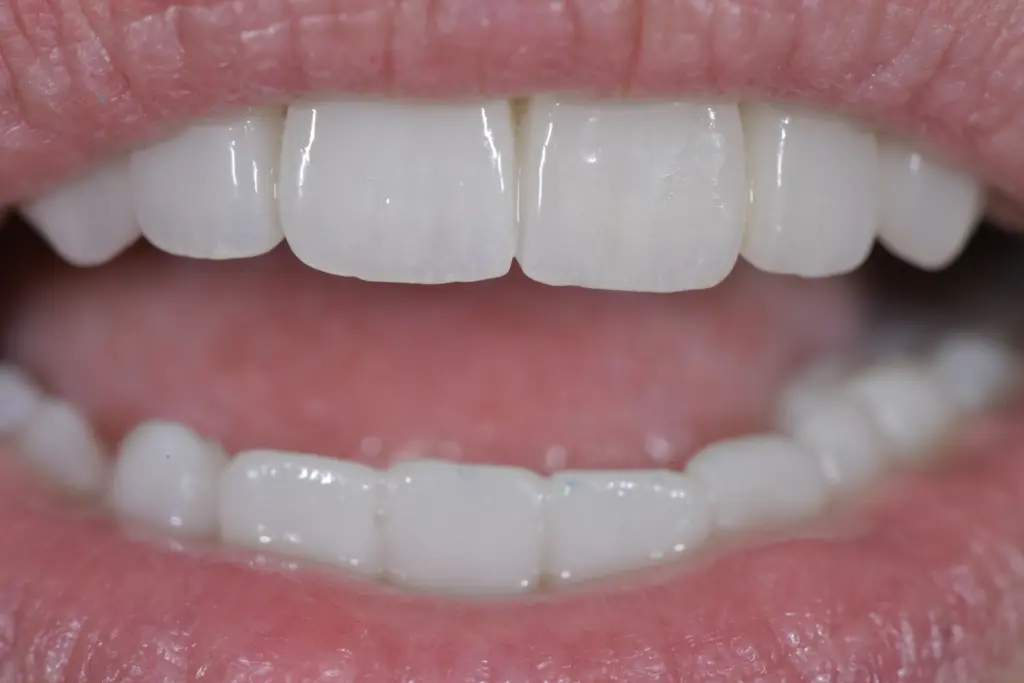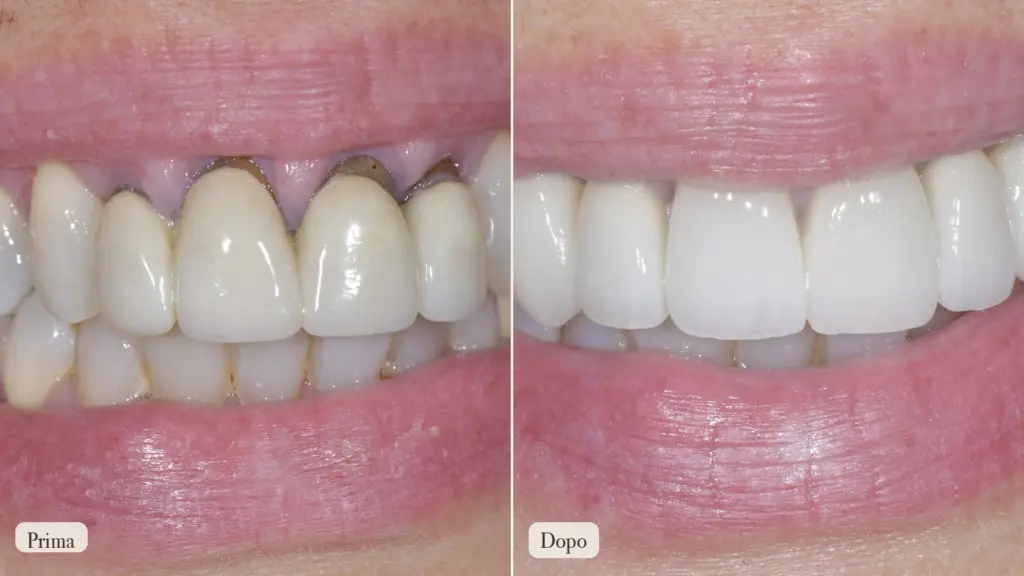
In summary. Professional teeth whitening lightens the color of natural teeth through hydrogen or carbamide peroxide, which oxidizes the pigmented molecules included in the enamel and dentin. In the office, the concentration of the agent, the protection of the soft tissues and the preliminary diagnosis are controlled by the dentist, while the do-it-yourself kits work blindly and with concentrations not calibrated to the individual case. The duration of the result is not fixed: it depends above all on eating habits and smoking.
How does professional whitening work?
The mechanism is chemical, not abrasive. The whitening agent — hydrogen peroxide or carbamide peroxide, which itself breaks down to release hydrogen peroxide — penetrates through the enamel and reaches the dentin, where it triggers an oxidation reaction. The molecules responsible for the color, the chromophores accumulated over the years, are broken down into smaller and less pigmented fragments: the tooth appears lighter because the structure reflects light differently, not because tissue is removed. The review of the mechanism published on Journal of Esthetic and Restorative Dentistry describes this process as a diffusion of the oxidizing agent into the hard tissues and a subsequent degradation of the pigmented compounds.
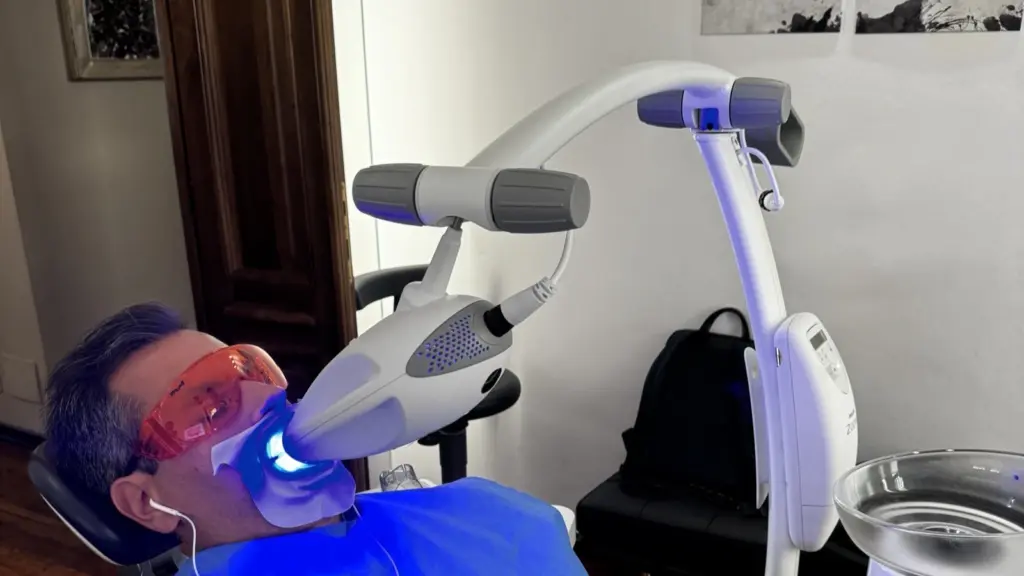
Some protocols under study include an activation phase, with light or laser sources, designed to accelerate the reaction. It is a point on which the literature calls for caution: a systematic review with meta-analysis appeared on Journal of Dentistry did not detect a consistent advantage of light activation on the final result compared to the whitening agent alone, nor an effect on sensitivity, regardless of the peroxide concentration. For this reason, when the laser support of the Lambda SpaceLine system is used in the practice, the choice is calibrated on the individual case and on the person's tolerance, not applied as an automatic standard.
In-office whitening or DIY kit: what's the difference?
The difference is not the molecule, which is often the same, but the control of the context. In the office, the dentist establishes the concentration of the agent, isolates and protects the gum before application, checks that there are no cavities, recessions or inflammations that would make the treatment inappropriate, and chooses between professional application in the chair and custom-made whitening trays to be used at home under supervision. The starting color is measured and documented, so that the result is verifiable.
Over-the-counter kits and non-professional remedies work in opposite conditions: concentrations not adapted to the individual case, absence of gingival protection, no preliminary diagnosis. A systematic review with meta-analysis in Operative Dentistry compared the home protocols prescribed by the dentist with those in the office, without detecting significant differences in effectiveness or sensitivity between the two: in both cases, however, the protocol was established and supervised clinically. The common denominator is oversight, not location. The Cochrane review of home-use whitening products containing peroxide confirms an effect on color, but highlights the variability of results and the frequency of transient side effects. The problem with abrasive "whitening" supermarket products is different again: they act by friction and do not change the intrinsic color, with the risk of wearing out the enamel.
Does whitening damage enamel?
In light of current knowledge, a treatment conducted with peroxide at clinical concentrations and under professional supervision is not associated with permanent structural damage to the enamel. The most frequent side effect is tooth sensitivity, generally transient and reversible at the end of treatment, together with possible temporary gum discomfort. This is what consistently emerges from systematic reviews on the topic, which report sensitivity as a common but not persistent event.
The review “Tooth whitening: what we now know” summarizes the current consensus: peroxide-based whitening agents, used appropriately, are considered an effective method with an acceptable safety profile for lightening teeth, while sensitivity remains the adverse effect to monitor. The management of sensitivity - concentrations, contact times, desensitizing products, breaks between sessions - is precisely what an in-office program allows you to modulate. Preliminary evaluation and exclusion of local contraindications remain necessary.
When is it indicated and when is it not?
Whitening is indicated on natural teeth with widespread discoloration related to age, eating habits, coffee, tea, red wine or smoking, in a healthy mouth and in the absence of active pathology. The preliminary condition is non-negotiable: caries, gingivitis and periodontitis must be treated first, and the treatment is scheduled after the professional hygiene session, when the tooth surface is clean and the real color is finally legible.
There are situations in which whitening is not the correct answer, and it is right to say so first. Restorative materials do not change color: Composite fillings, veneers, crowns and ceramic bridges do not respond to peroxide. If these restorations are in the visible aesthetic area, whitening the surrounding natural teeth can accentuate the difference in shade, and the correct solution becomes the planned replacement of the restoration with one matching the new colour, not the whitening itself. Dental veneers follow a different design logic from that of whitening and must be evaluated separately. Discolouration caused by tetracyclines taken during tooth development, as well as some forms of fluorosis or discoloration from a single devitalized tooth, respond partially, slowly or non-uniformly, and require a dedicated project. Finally the expectations: Whitening brings the tooth to its lightest natural white, not an artificial shade. A uniform and stable color is a realistic result; an unnaturally bright shade is not, and promising it would be incorrect.
How long does it last and how is the result maintained?
The duration of the result is not a fixed figure: it largely depends on the person's habits. Coffee, tea, red wine and smoking gradually reintroduce the pigments, and those who use them frequently see the color change sooner. There is no "definitive" treatment: whitening is a starting point that is maintained over time, not a result achieved once and for all.
Maintenance is based on three elements. The first is periodic professional hygiene, with biofilm and surface pigmentation removal protocols that preserve the color obtained. The second is daily home hygiene and moderation of pigmenting substances in the hours following treatment, when the enamel is more receptive. The third, when indicated, consists of maintenance cycles using custom-made whitening trays, with the regimen prescribed by the dentist. The evaluation of the individual case, with measurement of the starting color and exclusion of contraindications, remains the step that distinguishes a predictable result from an attempt.
Frequently asked questions
Is professional whitening bad for your teeth?
Conducted with peroxide at clinical concentrations and under professional supervision, it is not associated with permanent structural damage to the enamel. The most frequent effect is dental sensitivity, generally transitory and reversible at the end of treatment, which the dentist manages by modulating concentrations, times and desensitizing products.


From the start, the doctor was very helpful and courteous and clearly explained the work he would need to do.
Show less
I did not know Dr Buniato and found him through an internet search. My old bite splint had broken, and I was looking for a practice that used cutting-edge techniques to make a new one. From the start, the doctor was very helpful and courteous and clearly explained the work he would need to do. Once the splint had been made, we had to meet several times so that he could adjust it to fit my teeth as well as possible. Now I have a splint that does its job perfectly. Above all, I greatly appreciated his human warmth, helpfulness, courtesy, calm manner and ability to explain the various steps that would follow. The reception staff are excellent too. The practice is clean, modern and well cared for. What can I say: these days, a doctor like this is almost a rarity. So I recommend him and thank him sincerely.
What is the difference between in-office whitening and the kits I buy myself?
The molecule may be the same, but the control changes: in the office the concentration is calibrated to the case, the gum is protected and a preliminary diagnosis excludes tooth decay or inflammation. Do-it-yourself kits work without these control devices, with more variable results and a greater risk of sensitivity or gum discomfort.

From the very first appointment, I was impressed by the care and clarity with which solutions were proposed to me
Show less
I contacted Dr Gianluca Buniato’s dental practice for advice and a possible estimate to address my many complex dental problems. From the very first appointment, I was impressed by the care and clarity with which solutions were proposed to me, and I was soon able to see how effective they were. I feel I should thank Dr Buniato and his team not only for the professionalism with which they work in a dental practice using excellent technology, at very reasonable prices, but also for their ability to put patients at ease at all times.
Does whitening also work on veneers, crowns and fillings?
No. Restorative materials — composite, ceramic veneers, crowns and bridges — do not change color with peroxide. If they are in the aesthetic area, whitening the natural teeth around them can accentuate the difference in shade: in that case the replacement of the restoration with the new color is planned.

He explains what he is doing and what you may feel before each step
Show less
I’m writing a little more than I usually would because I know how difficult it can be to find a dentist you genuinely feel comfortable with — especially when you are looking for treatment abroad. I came to Turin for dental treatment and honestly could not be happier that I found Dr. Buniato.
What impressed me from the beginning was how thorough and transparent everything was. He takes the time to do a proper assessment, with detailed images and analysis, and then explains clearly what is going on, what the different options are, which one he recommends and what each option would cost. You are never left in the dark or simply expected to trust that someone knows what is best for you. You understand what is being done, why it is being done and what to expect.
That same care continues throughout the treatment. He explains what he is doing and what you may feel before each step, so you are never caught by surprise. You can tell that he is incredibly precise and genuinely cares about getting every detail right.
And the result exceeded my expectations. I had virtually no pain afterwards, despite expecting quite the opposite. The work looks excellent, but even more importantly, it feels completely natural. After dental work, there is usually some adjustment period — you notice that something has changed, or your bite may feel different. With Dr. Buniato, I had none of that. Everything felt completely natural from the moment I left the chair.
I was also genuinely impressed by the technical standard of the practice. The equipment and technology are on a level I have rarely seen, and it is clear that they are used with real expertise rather than simply being there for show.
The whole team is warm, attentive and professional, and you get the feeling that they are willing to take the time needed to do things properly.
I would genuinely recommend Dr. Buniato to anyone looking for excellent dental care in Turin. I’m very happy I found him and will definitely be back for my future treatment.
How long does the result last?
There is no standard duration: it depends on the person's habits. Coffee, tea, red wine and smoking progressively bring the pigments back to the tooth. Periodic professional hygiene, careful home hygiene and, when indicated, maintenance cycles with custom-made whitening trays prolong color stability.

The dentists are professional and attentive to each patient’s particular sensitivities.
Show less
The practice has a very welcoming waiting room, and all the rooms are bright and clean. The staff are professional, and the reception team is well organised when it comes to information, appointments and email reminders for them. The dentists are professional and attentive to each patient’s particular sensitivities. In conclusion, I am fully satisfied with the treatment and the result achieved.
Can I whiten my teeth if I have tetracycline discolouration?
Tetracycline discolorations, some forms of fluorosis and the discoloration of a single devitalized tooth respond partially, slowly or unevenly. They are not an absolute contraindication, but require a dedicated assessment and a specific project, with expectations discussed in advance.

He works with great attention to patients’ needs.
Show less
I have known the Buniato dental practice for several years, after various experiences at other practices! I have always had a good experience: the doctor and his colleagues are knowledgeable, kind and precise. He has always advised me tactfully but professionally, and I must say that, although I am quite afraid of the dentist, I feel calm with him. He works with great attention to patients’ needs. Thank you again. Elisabetta
Do I have to do hygiene before whitening?
Yes. Whitening is scheduled after the professional hygiene session, when the surface is clean of biofilm and surface pigmentations and the actual color of the tooth is legible. Caries and gum inflammation must be treated before treatment.

attentive and always willing to explain every stage of treatment.
Show less
I began treatment with Dr Gianluca Buniato to straighten my teeth as an adult — I am 40 — and I can say it was one of the best decisions I could have made. Thanks to a carefully planned course of orthodontic treatment lasting less than two years, I achieved results I would never have thought possible: my smile has changed completely and I finally feel confident showing it!
Dr Buniato is extremely precise, attentive and always willing to explain every stage of treatment. The entire team is also kind, welcoming and very well organised. The practice, on Corso Francia in Turin, is carefully designed down to the smallest detail and immediately gives you a sense of trust and calm.
Although I live quite far from the practice, the excellent reviews persuaded me to put my trust in the doctor, and I can confirm that it was the right choice.
I absolutely recommend this practice to anyone who wants to improve their smile with professionalism, technology and plenty of personal attention.
Sources
- Kwon SR, Wertz PW. Review of the Mechanism of Tooth Whitening. J Esthet Restor Dent. 2015;27(5):240-257. doi:10.1111/jerd.12152. PubMed.
- Carey CM. Tooth whitening: what we now know. J Evid Based Dent Pract. 2014;14 Suppl:70-76. doi:10.1016/j.jebdp.2014.02.006. PubMed.
- de Geus JL, Wambier LM, Kossatz S, Loguercio AD, Reis A. At-home vs In-office Bleaching: A Systematic Review and Meta-analysis. Oper Dent. 2016;41(4):341-356. doi:10.2341/15-287-LIT. PubMed.
- Maran BM, Burey A, de Paris Matos T, Loguercio AD, Reis A. In-office dental bleaching with light vs. without light: A systematic review and meta-analysis. J Dent. 2018;70:1-13. doi:10.1016/j.jdent.2017.11.007. PubMed.
- Eachempati P, Kumbargere Nagraj S, Kiran Kumar Krishanappa S, Gupta P, Yaylali IE. Home-based chemically-induced whitening (bleaching) of teeth in adults. Cochrane Database Syst Rev. 2018;12(12):CD006202. doi:10.1002/14651858.CD006202.pub2. PubMed.
For an evaluation of your specific case, the first specialist visit includes complete diagnostic analysis, measurement of the starting color and exclusion of contraindications before any treatment.