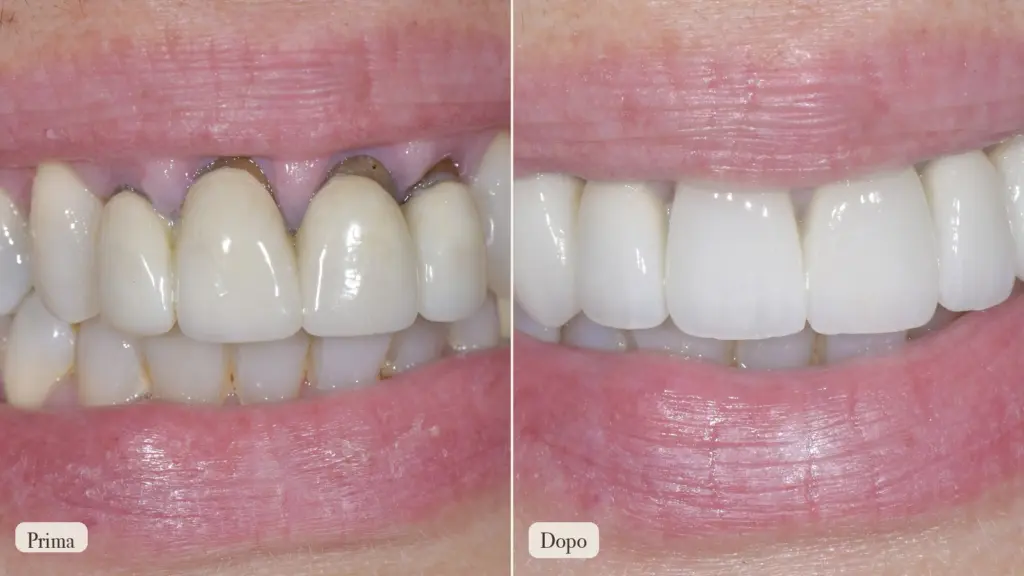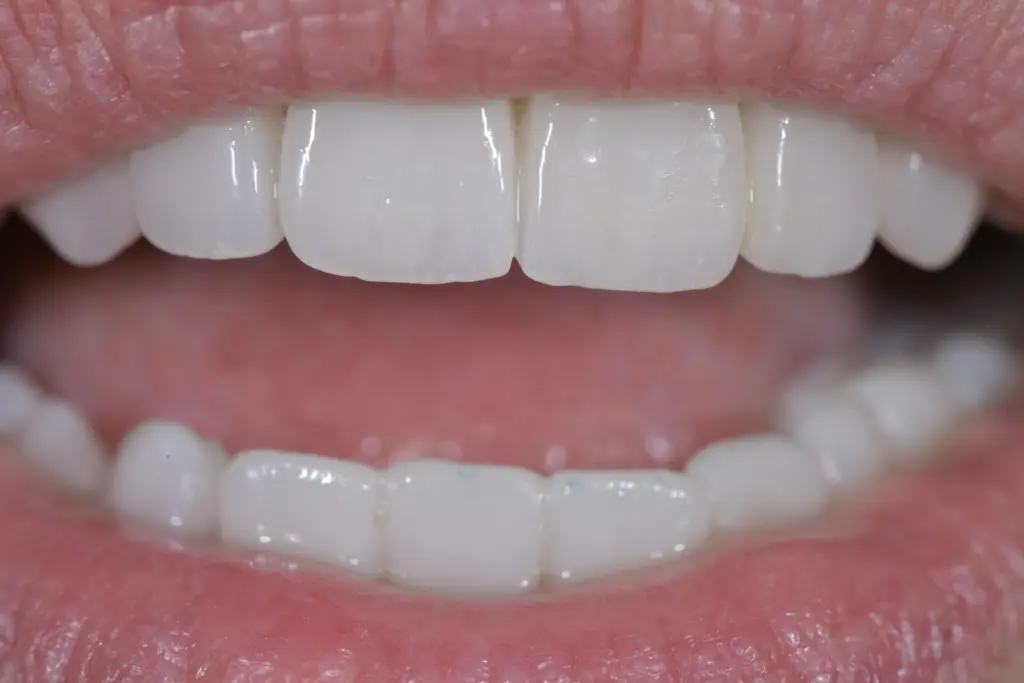
Feldspathic ceramic, lithium disilicate and composite have different properties and indications. Ceramics show favorable long-term outcomes in the available studies; composite can be a conservative, repairable definitive restoration as well as an option for temporary stages. The choice takes remaining enamel, loading, aesthetic goals and maintenance into account.
Ceramics and composite: properties and indications
Feldspathic ceramic is a glass-based ceramic that can be layered by hand by the dental technician, adjusting translucency, color and surface texture. Lithium disilicate is a glass ceramic processed by pressing or from blocks, with different mechanical properties. Both have long-term clinical documentation. Direct composite offers another option: it is shaped chairside, may require minimal preparation and is repairable. It may be indicated as a definitive or transitional restoration, depending on the case.
For whom feldspathic is indicated and for whom disilicate
Feldspathic ceramic is indicated when the aesthetic requirement is high, the residual enamel is sufficient for reliable bonding and the preparation can remain confined within the enamel. Manual layering makes it possible to reproduce color gradients and incisal translucency effects consistent with the adjacent teeth. A 2024 literature review explicitly recommends feldspathic, leucite ceramic and lithium disilicate as the materials of choice for the anterior region, and stresses that dentin exposure during preparation significantly reduces the success of the restoration. Material selection is therefore inseparable from the design of the preparation: the operating criterion is to remain, as far as possible, within the enamel.
Lithium disilicate is indicated when the ceramic must offer higher mechanical strength than pure feldspathic: reduced available thickness, limited parafunction, teeth that close against demanding opposing restorations. A 2025 systematic review with meta-analysis, with a mean follow-up of about ten years, found survival rates of around 94-97%, comparable to those of feldspathic and leucite-reinforced ceramic; disilicate tends to show a slightly lower overall rate of technical, aesthetic and biological complications in the medium to long term. The adhesive protocol for silica-based ceramics involves hydrofluoric acid etching and silanization of the inner surface: without these steps, bonding is not reliable over time.
When none of the three materials is the answer
Before choosing the material, it must be clarified whether the veneer is really indicated. When the problem is the position of the teeth, orthodontics corrects the cause without removing enamel; when it is only the color, whitening may be enough; when the residual enamel is scarce, periodontitis is active or there is unmanaged bruxism, no ceramic offers reliable bonding or a reliable prognosis and the correct path is a different one. In these cases, forgoing the veneer is not a fallback: it is the choice that preserves more healthy structure and defers the restoration, if ever, to better conditions.
The role of composite
Direct composite allows conservative, repairable restorations and can also be used for aesthetic trials or transitional stages. In the cited ten-year trial, survival was 75% for indirect composite veneers and 100% for ceramic veneers. An evaluation of 1459 restorations also found a higher risk of failure for direct composite than for ceramic. These findings inform the choice and maintenance, but do not mean that every composite restoration must be temporary.
What differs between the materials in everyday use
In terms of invasiveness, direct composite often allows minimal or no preparation; disilicate and feldspathic require a conservative preparation that allows the thickness appropriate to the material and to the adhesive bond. In terms of durability, ceramics have proven more stable over time than composite, with consistent data both in randomized studies and in evaluations of clinical practice. In terms of maintenance, composite is more easily repaired directly but more prone to marginal discoloration and loss of surface gloss; ceramics, if extensively damaged, generally require replacement of the veneer. In all cases, the factor that determines the prognosis is the quality of the bond: the presence of residual enamel and rigorous execution of the adhesive protocol weigh more than the choice of material itself.
How we build the choice of material
In our decision-making process, the material is the last variable, not the first. Aesthetic and functional diagnosis, assessment of the remaining enamel, occlusal analysis and smile design using a 3Shape TRIOS 6 digital scan come first. Only after agreeing the aesthetic and functional goals and assessing the design with a composite mock-up tried in the mouth do we choose the material that best achieves it within the limits of available thickness and enamel preservation. The feldspathic veneers are layered by hand by the master dental technician at Oral Design Center. The page on handcrafted feldspathic ceramic veneers describes the working method; the pages on feldspathic veneers for a natural smile, when veneers are indicated and digital smile design explore complementary aspects of the decision.
Frequently asked questions
In which situations are veneers not the right solution for me?
Veneers are not indicated when there is insufficient residual enamel for reliable bonding, in the presence of severe untreated bruxism, in cases of active periodontal disease or untreated caries, or when the aesthetic problem can be resolved with less invasive treatments such as orthodontics or whitening. In these cases the correct path is a different one and is proposed at the first visit.


He takes the time to do a proper assessment, with detailed images and analysis, and then explains clearly what is going on, what the different options are
Show less
I’m writing a little more than I usually would because I know how difficult it can be to find a dentist you genuinely feel comfortable with — especially when you are looking for treatment abroad. I came to Turin for dental treatment and honestly could not be happier that I found Dr. Buniato.
What impressed me from the beginning was how thorough and transparent everything was. He takes the time to do a proper assessment, with detailed images and analysis, and then explains clearly what is going on, what the different options are, which one he recommends and what each option would cost. You are never left in the dark or simply expected to trust that someone knows what is best for you. You understand what is being done, why it is being done and what to expect.
That same care continues throughout the treatment. He explains what he is doing and what you may feel before each step, so you are never caught by surprise. You can tell that he is incredibly precise and genuinely cares about getting every detail right.
And the result exceeded my expectations. I had virtually no pain afterwards, despite expecting quite the opposite. The work looks excellent, but even more importantly, it feels completely natural. After dental work, there is usually some adjustment period — you notice that something has changed, or your bite may feel different. With Dr. Buniato, I had none of that. Everything felt completely natural from the moment I left the chair.
I was also genuinely impressed by the technical standard of the practice. The equipment and technology are on a level I have rarely seen, and it is clear that they are used with real expertise rather than simply being there for show.
The whole team is warm, attentive and professional, and you get the feeling that they are willing to take the time needed to do things properly.
I would genuinely recommend Dr. Buniato to anyone looking for excellent dental care in Turin. I’m very happy I found him and will definitely be back for my future treatment.
If I choose composite, will I still have to move to ceramic sooner or later?
Not necessarily. Composite can remain in place as a restoration when it meets the needs of the case, with check-ups and repairs if needed. Ceramics showed greater longevity in the cited studies, but this does not mean everyone must switch to ceramic. The choice is reassessed according to the condition of the teeth, the restoration and the goals.
How long do feldspathic ceramic veneers last compared with disilicate ones?
The most recent clinical literature shows no statistically significant differences in survival at around ten years between feldspathic, leucite-reinforced ceramic and lithium disilicate veneers: the rates remain comparable. Disilicate tends to show a slightly lower overall complication profile, not a longer lifespan in absolute terms.
I have read about zirconia: why is it not among the options proposed?
Long-term clinical data on zirconia veneers are still limited, with reported observations of around two to three years: it cannot currently be considered an established option on the same footing as feldspathic, leucite ceramic and lithium disilicate, for which ten-year follow-ups are available. The prudent choice remains that of materials with documented long-term evidence.
If a veneer chips, is it repaired or remade?
It depends on the material. Direct composite is repaired chairside, by adding material to the damaged area. For ceramic, a small chip can sometimes be polished or repaired with composite, but extensive damage generally requires replacement of the veneer. This is one of the reasons why the quality of the initial bonding matters more than the choice of material.
Sources
- Klein P, Spitznagel FA, Zembic A, et al. Survival and Complication Rates of Feldspathic, Leucite-Reinforced, Lithium Disilicate and Zirconia Ceramic Laminate Veneers: A Systematic Review and Meta-Analysis. Journal of Esthetic and Restorative Dentistry. 2025. doi:10.1111/jerd.13351. PMID: 39523553.
- Komine F, Furuchi M, Honda J, et al. Clinical performance of laminate veneers: a review of the literature. Journal of Prosthodontic Research. 2024. doi:10.2186/jpr.JPR_D_23_00151. PMID: 38220160.
- Gresnigt MMM, Cune MS, Jansen K, et al. Randomized clinical trial on indirect resin composite and ceramic laminate veneers: up to 10-year findings. Journal of Dentistry. 2019. doi:10.1016/j.jdent.2019.06.001. PMID: 31181242.
- Mazzetti T, Collares K, Rodolfo B, et al. 10-year practice-based evaluation of ceramic and direct composite veneers. Dental Materials. 2022. doi:10.1016/j.dental.2022.03.007. PMID: 35379471.
- Araujo E, Perdigão J. Anterior veneer restorations: an evidence-based minimal-intervention perspective. The Journal of Adhesive Dentistry. 2021. doi:10.3290/j.jad.b1079529. PMID: 33825424.