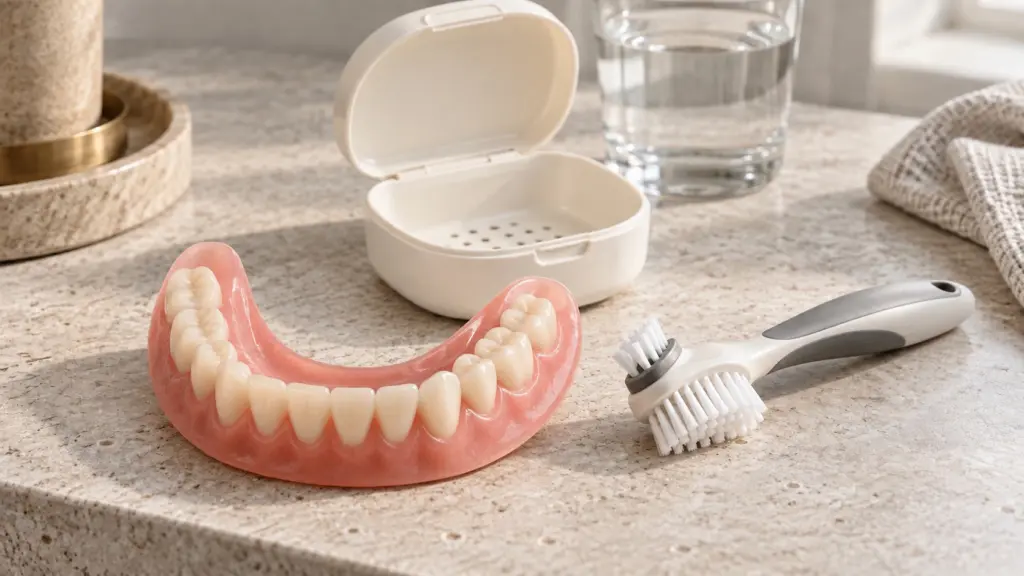
An overdenture is a removable denture that can use implants and retention systems to improve stability. It is removed for cleaning and is not equivalent to a fixed prosthesis. Whether it is indicated depends on anatomy, general health, the ability to maintain hygiene and expectations, after comparison with the available alternatives.
Removable does not necessarily mean without implants
When all the teeth in an arch are missing, a conventional complete denture and a removable denture associated with implants represent different options. In an overdenture, the attachments and prosthetic design can contribute to retention. The role of the supporting tissues and implants varies according to the design chosen.
The difference from a fixed restoration matters in everyday life: the patient removes the denture according to the instructions received and cleans both the appliance and the structures in the mouth. It is therefore not a matter of promising “fixed teeth” under another name. How it is used needs to be understood before making a choice.
The term overdenture can also appear in different contexts; here, the removable solution on implants is considered. During the consultation, it is useful to ask for an example of how the proposed system works, clarifying how to insert and remove the denture and which parts require professional maintenance.
When it can be included in a comparison of alternatives
The discussion starts with the condition of the mouth and the difficulties the patient wishes to address. A poorly stable denture, for example, first requires an assessment of its fit and the causes of the problem. It does not automatically lead to choosing implants: conventional solutions or changes to the existing design may also need to be considered.
If teeth remain, their prognosis must be assessed separately. The availability of an implant solution does not justify extracting teeth that can be saved solely to simplify the prosthetic design. A conservative approach requires an explanation of which teeth can be retained, with what limitations and what care over time.
Aspects to assess include tissue conditions, available space, general health and the ability to manage cleaning. Manual dexterity and practical expectations also matter: a technically possible solution might not suit the person's routine. The plan must take these factors into account together.
What we know about stability and satisfaction
The available reviews describe benefits in satisfaction and quality of life for some overdentures compared with conventional complete dentures. However, much of the comparison concerns the toothless lower jaw, often with two implants. This context must be kept explicit when explaining the results.
It is not correct to automatically extend the conclusions to the upper arch, to every anatomy or to a comparison with any fixed prosthesis. The number of implants, the retention system and the distribution of supports are determined after diagnosis. The number cited in a study does not in itself constitute a prescription.
Furthermore, an average improvement observed in research does not guarantee the same individual experience. Expectations, habits and initial conditions can influence how the outcome is perceived. The consultation serves to translate general possibilities into realistic goals: what might become easier, what adjustments will be necessary and what limitations will remain.
Hygiene, attachments and maintenance are part of the plan
The presence of implants does not eliminate the need for cleaning and check-ups. The patient must be able to reach the areas to be cleaned and use the appliance correctly. Instructions are adapted to the system in place, avoiding improvised procedures or products chosen without considering the materials.
The literature on maintenance of lower-jaw overdentures describes the possibility of work being needed on prosthetic elements over time. Attachments, retention components and dentures may require adjustments, repairs or replacements. The heterogeneity of the studies does not allow a fixed number of years without care to be promised or one system to be declared universally better.
It is useful to discuss these aspects before treatment: what check-ups will be necessary, what may be subject to wear and how a change in stability will be managed. The programme of hygiene and maintenance is not an optional extra. It is part of assessing the practical sustainability of the chosen solution.
Making a decision in Turin with a complete picture
The consultation compares the starting situation with clinically reasonable options. Withinimplant dentistry, an overdenture is an option to be indicated when appropriate, not an alternative to be offered indiscriminately to everyone. Conventional dentures, removable solutions on implants and fixed restorations have characteristics that need to be explained clearly.
To make the comparison concrete, it can help to start with everyday activities that cause difficulties: eating certain foods, speaking, cleaning the denture or removing it. Reporting these aspects helps establish shared goals. Any existing reports and information about the denture already in use are useful, while new examinations are requested when indicated.
Those who live far away can prepare for the first appointment and arrange subsequent check-ups. It is useful to also discuss continuity of care and maintenance, without shortening biological timescales to fit travel arrangements. Logistical planning remains subject to clinical checks and the individual response.
Before deciding, it is useful to receive an explanation of the alternatives, their respective limitations and the planned stages. The choice does not depend solely on initial stability: it includes the ability to manage the denture every day and access the necessary care over the years.
Frequently asked questions
Is an overdenture a fixed prosthesis?
No. An overdenture remains removable and is taken out by the patient according to the instructions received, including for cleaning. Implants and attachments can contribute to its retention, but do not turn it into a fixed restoration. This practical difference needs to be understood before choosing the treatment plan.


From the very first appointment, I was impressed by the care and clarity with which solutions were proposed to me
Show less
I contacted Dr Gianluca Buniato’s dental practice for advice and a possible estimate to address my many complex dental problems. From the very first appointment, I was impressed by the care and clarity with which solutions were proposed to me, and I was soon able to see how effective they were. I feel I should thank Dr Buniato and his team not only for the professionalism with which they work in a dental practice using excellent technology, at very reasonable prices, but also for their ability to put patients at ease at all times.
Are two implants always enough for an overdenture?
No. Many studies concern the toothless lower jaw treated with two implants, but do not justify using the same arrangement in every mouth. The arch, anatomy, prosthetic space and design influence the choice. The number and arrangement of implants are determined after an individual clinical assessment.

attentive and always willing to explain every stage of treatment.
Show less
I began treatment with Dr Gianluca Buniato to straighten my teeth as an adult — I am 40 — and I can say it was one of the best decisions I could have made. Thanks to a carefully planned course of orthodontic treatment lasting less than two years, I achieved results I would never have thought possible: my smile has changed completely and I finally feel confident showing it!
Dr Buniato is extremely precise, attentive and always willing to explain every stage of treatment. The entire team is also kind, welcoming and very well organised. The practice, on Corso Francia in Turin, is carefully designed down to the smallest detail and immediately gives you a sense of trust and calm.
Although I live quite far from the practice, the excellent reviews persuaded me to put my trust in the doctor, and I can confirm that it was the right choice.
I absolutely recommend this practice to anyone who wants to improve their smile with professionalism, technology and plenty of personal attention.
Do the attachments require maintenance?
They may require it, along with the other components of the denture. A change in retention or stability should be reported, avoiding adjustments at home. Check-ups allow wear, hygiene and fit to be assessed; their frequency and any work needed depend on the system and the case, with no identical guaranteed lifespan for all patients.

their kindness in welcoming patients and their helpfulness in arranging appointments.
Show less
Dr Buniato and his entire team stand out for their great professionalism and expertise, as well as for their kindness in welcoming patients and their helpfulness in arranging appointments. A dental practice I absolutely recommend!!
For a personalised assessment of your case, Dr Buniato is available for an initial dental consultation with a comprehensive diagnostic analysis.
Sources
- Egido Moreno S et al. Evaluation of the quality of life and satisfaction in patients using complete dentures versus mandibular overdentures. Systematic review and meta-analysis. Clin Exp Dent Res. 2021;7(2):231–241. PMID: 33205918; DOI: 10.1002/cre2.347.
- Assaf A et al. Prosthetic maintenance of different mandibular implant overdentures: A systematic review. J Prosthet Dent. 2017;118(2):144–152.e5. PMID: 28385441; DOI: 10.1016/j.prosdent.2016.10.037.
- Kutkut A et al. A systematic review of studies comparing conventional complete denture and implant retained overdenture. J Prosthodont Res. 2018;62(1):1–9. PMID: 28666845; DOI: 10.1016/j.jpor.2017.06.004.