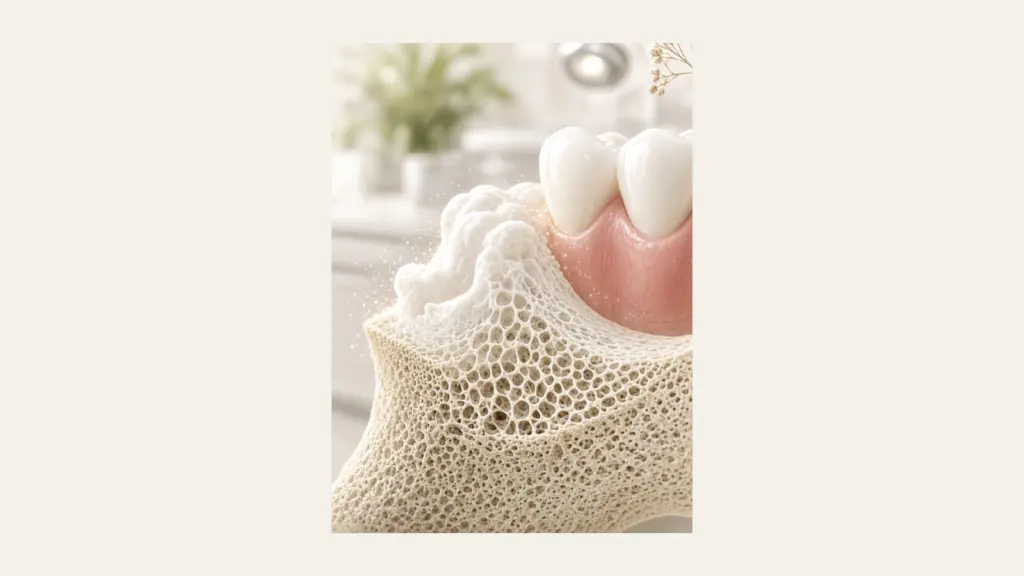
After periodontitis, implants may be considered following treatment and reassessment of the disease, together with dedicated maintenance. Periodontal stability is a requirement that must be verified: the decision also depends on the prognosis of the remaining teeth, local conditions and individual risk.
Who may benefit from considering implants after periodontitis
People who have lost teeth because of periodontitis have often been told that implants are risky in their case. An implant pathway after a history of periodontitis is intended for people who have been diagnosed with periodontal disease, have completed periodontal treatment and need to consider how to replace teeth already lost. It may be considered when the periodontal condition is stable, bleeding on probing has decreased, residual pockets are under control and the person agrees to follow a dedicated recall programme. A history of the disease does not automatically rule out implants, but requires a risk assessment. Control of the gums alone neither makes tooth replacement necessary nor guarantees that it is appropriate.
Before deciding, it is also necessary to clarify how follow-up appointments can be attended. In patients with a history of periodontitis, the absence of regular maintenance and difficulty controlling plaque are associated with a greater risk of peri-implantitis. If attending recalls is not feasible, the plan must take this limitation into account and consider the alternatives relevant to the case.
Periodontal assessment before surgery
The assessment begins with a complete periodontal reassessment: probing depths, bleeding on probing, tooth mobility, plaque index and diagnosis according to the 2017 EFP/AAP classification. The results are compared with previous findings to understand the response to treatment and identify any sites still requiring care. A reduction in symptoms is not enough to establish suitability for an implant: disease control and the prognosis of the remaining teeth must be assessed. The decision is then discussed alongside prosthetic alternatives and the necessary checks.
When indicated for implant planning, we complement the clinical assessment with three-dimensional imaging using CBCT Planmeca VISO G3, to study the anatomy of the sites, assess the remaining bone volume and plan implant positioning. An intraoral scan can complement the prosthetic assessment when useful. Individual risk assessment, based on documented periodontal parameters, guides the decision: a history of periodontitis, bleeding on probing, deep residual pockets, the extent of bone loss relative to age and adherence to supportive periodontal therapy all influence whether to proceed immediately, wait for further stabilisation or reconsider the prosthetic plan.
When it is better to wait, or preserve the tooth
Deep pockets with bleeding require reassessment and, where necessary, further periodontal treatment before an implant is scheduled. Smoking, diabetes control and the ability to maintain oral hygiene also form part of the individual risk assessment. These factors do not all lead to the same decision: they may call for preliminary measures, discussion with the treating physician, a postponement or a change to the plan. The sequence is determined by the clinical situation and the response to care.
The opposite also applies: a tooth with reduced but stable periodontal support after treatment, without progressive mobility, may have a prognosis that makes preservation and postponement of an implant reasonable. The decision compares the prognosis of the tooth with that of its possible replacement on a case-by-case basis, also considering function and the ability to clean it. Preservation, when clinically reasonable, remains an option to discuss; an implant does not remove the predisposition to diseases of the supporting tissues.
The risk of peri-implantitis in people with a history of periodontitis
Peri-implantitis is defined as a pathological condition of the tissues surrounding implants, with inflammation of the peri-implant connective tissue and progressive loss of supporting bone. It may develop in the first years after placement and progress non-linearly, with phases of acceleration that make ongoing monitoring relevant. A 2018 systematic review published in Journal of Periodontal Research reported median prevalences of peri-implantitis of 14.3% in groups with a history of periodontitis and 7.0% in groups representative of the general population. Among regular participants in prophylaxis programmes, the median was 9.0%, while in groups without regular preventive maintenance it was 18.8%. These are summaries of heterogeneous studies: they do not measure an individual's risk or, on their own, demonstrate how much maintenance reduces it.
The AO/AAP consensus published in 2025 confirms a history of periodontitis among the main systemic and behavioural risk factors, alongside smoking, uncontrolled diabetes, poor biofilm control and obesity. It also identifies local factors such as implant malposition, unfavourable prosthetic conditions and thin or otherwise unfavourable soft tissues around the implant. The assessment therefore combines general health, oral conditions and the prosthetic plan. A prevalence percentage is not an implant loss rate and cannot replace this assessment.
Dedicated maintenance after implant placement
After periodontitis, maintenance is planned together with implant care. The programme includes recalls tailored to the individual's risk profile, with peri-implant probing, biofilm assessment and targeted professional cleaning: the aim is to identify any signs of inflammation promptly. Peri-implant mucositis can be treated with non-surgical professional cleaning and risk factor control. Progression to peri-implantitis is not inevitable; however, when bone loss occurs alongside inflammation, more complex treatment, including surgery, may be required. Complete resolution of peri-implantitis is not always predictable.
Implant planning, using Nobel Biocare components, and the prosthetic plan consider access for cleaning and examinations from the outset, in continuity with periodontal therapy and with gum care during maintenance: examinations consider natural teeth, soft tissues and implants together. Periodontal history remains relevant even when there are no symptoms. For people living far away, it is useful to clarify before starting which appointments will require attendance at the practice and whether the schedule will remain feasible over time.
Frequently asked questions
I had periodontitis years ago and things are fine now: can I have implants?
This is possible in some cases, but past treatment alone does not establish an indication. Current disease control, the remaining teeth, the site to be restored and risk factors must be reassessed. The ability to attend regular maintenance is part of the plan; the decision is made after the clinical assessment.
I recently stopped smoking and my diabetes is still a little unstable: are implants still an option?
An individual assessment is needed. Smoking and uncontrolled diabetes are risk factors to consider alongside periodontal conditions. Glycaemic control may require discussion with the treating physician before timing and indication are determined. There is no single answer for everyone: the necessary preliminary measures are clarified and the plan is then reassessed.
How often will I need to attend check-ups after getting implants?
Intervals are tailored to risk and the response to care. The schedule takes into account hygiene, bleeding on probing, the condition of the tissues around the implants and periodontal stability. It may be adjusted after examinations. Before starting, it is advisable to clarify this commitment, without assuming that an absence of pain makes maintenance appointments unnecessary.
I still have a slightly loose tooth: should it be removed immediately and replaced with an implant?
Not automatically. A tooth with reduced but stable support after periodontal therapy may have a prognosis that makes preservation reasonable, and the implant site still inherits the person's risk profile. The decision compares the prognosis of the tooth with that of an implant on a case-by-case basis; preventive extraction is not a shortcut.
For an individual assessment of your case, Dr Buniato is available for an initial dental consultation with a complete diagnostic assessment.
Studio Dentistico Buniato, Corso Francia 30, Turin, Principi d'Acaja stop.
Sources
- Schwarz F, Derks J, Monje A, Wang HL. Peri-implantitis. Journal of Periodontology. 2018. doi:10.1002/JPER.16-0350. PMID: 29926957
- Wang HL, Avila-Ortiz G, Monje A, et al. AO/AAP consensus on prevention and management of peri-implant diseases and conditions: Summary report. Journal of Periodontology. 2025. doi:10.1002/JPER.25-0270. PMID: 40501397
- Dreyer H, Grischke J, Tiede C, et al. Epidemiology and risk factors of peri-implantitis: A systematic review. Journal of Periodontal Research. 2018. doi:10.1111/jre.12562. PMID: 29882313
- Orishko A, Imber JC, Roccuzzo A, et al. Tooth- and implant-related prognostic factors in treatment planning. Periodontology 2000. 2024. doi:10.1111/prd.12597. PMID: 39234949