Fixed rehabilitation on four implants is a documented option for total edentulism of an arch when the available bone, implant stability at placement and a stable opposing arch allow it. When these premises are lacking, a greater number of implants, preliminary regeneration or an overdenture are more proportionate to the case.
What is fixed rehabilitation on four implants
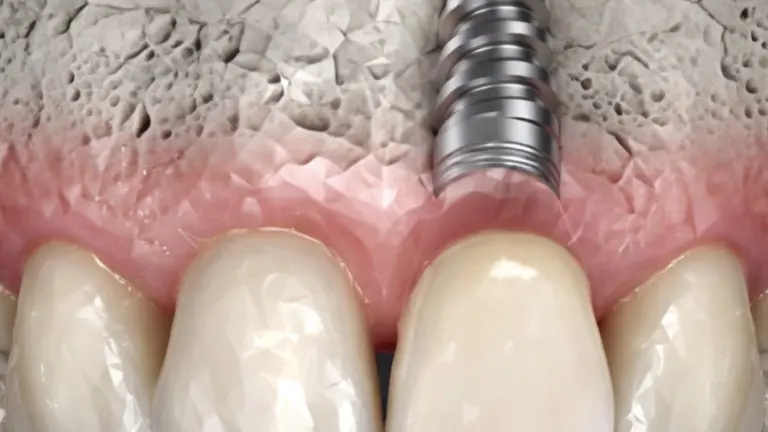
The expression «fixed rehabilitation on four implants» — also known as the All-on-4 concept — refers to a fixed prosthesis that replaces the entire dental arch resting on four implants. Two are placed vertically in the anterior region, where bone volume is generally greater and farther from the maxillary sinus and the mandibular canal. The two posterior ones are tilted distally: the angulation shifts their emergence posteriorly with respect to the point of entry into the bone. The tilt has a precise geometric role: it increases the antero-posterior distance between the support points of the prosthesis and reduces the cantilever portion behind the last implant.
A clinical review published in Dental Clinics of North America in 2015 describes the configuration as a way to achieve effective stabilization of the entire arch using longer implants, which remain within the available bone while avoiding structures such as the maxillary sinus or the mandibular canal. The biomechanical premise is not the choice of the number of implants in itself, but the consistency between surgical positioning, bone quality and quantity, the stability achieved by the implant at the time of placement and the resulting prosthetic design. The anatomical variables of the individual case — vertical height, bucco-lingual thickness, density of the quadrants — affect from the outset the feasibility of this configuration compared with others.
For whom rehabilitation on four implants is indicated
The main indication is total edentulism of an arch — absence of teeth in the entire upper arch, lower arch or both — or a terminal situation in which the remaining teeth have no reasonable prognosis and the rehabilitation is planned after their removal. A 2017 systematic review published in the Journal of Clinical and Experimental Dentistry presents the immediate-loading configuration as a predictable alternative in the atrophic arch for patients who intend to avoid extensive regenerative procedures, such as bilateral maxillary sinus lifts or large-volume bone grafts, associated with greater morbidity and longer timelines.
In the clinical pathway, three elements are assessed together. The first is the availability of residual bone for predictable anchorage of the four implants in the geometrically useful positions. The second is the stability achieved by the implants during surgery, an objective clinical parameter associated with the possibility of immediately loading the provisional prosthesis. The third is the stability of the opposing arch, whether it is natural dentition, another fixed rehabilitation or an arch that in turn needs to be rehabilitated. When the three elements converge, the choice is proportionate to the case.
When four implants are not enough
Rehabilitation on four implants is not indicated when the biomechanical or biological conditions do not hold up. If the stability achieved by the implants does not reach the clinical threshold associated with immediate loading, forcing the protocol exposes the implant to micromovements during healing and to possible failure of osseointegration; in these situations the implants heal beneath the mucosa and the prosthetic connection takes place at a later stage, with a longer pathway that is nonetheless consistent with the clinical premises. If the residual bone does not allow predictable anchorage of the four implants in the positions useful to the design, stabilization of the entire arch is lost; increasing the number of implants, changing the distribution or planning preliminary regeneration become more proportionate options.
In the diagnostic phase, some thresholds guide the reading of the case: a residual bone height that in the posterior quadrants falls below a few millimeters, a bucco-lingual thickness insufficient to accommodate the planned implant diameter, a reduced cortical density that compromises the primary stability required by immediate loading, the proximity of anatomical structures such as the mandibular canal or the floor of the maxillary sinus that constrains the angulation of the posterior implants. These are not absolute numbers that automatically rule out the configuration, but parameters which, read together with the clinical examination and the prosthetic design, indicate when forcing four implants would mean accepting an unnecessary biomechanical compromise.
If the opposing arch is unstable — worn dentition or dentition with an uncertain prognosis, a partially rehabilitated arch that needs to be revisited, uncontrolled parafunctions such as bruxism — the load the rehabilitation receives does not correspond to that anticipated in clinical studies. Aesthetic or functional expectations incompatible with the biomechanical limits of the configuration must be clarified during the planning phase. A 2019 review published in the Nigerian Journal of Clinical Practice points out that the indications and contraindications of four-implant rehabilitation must be weighed case by case, in both arches, and that long-term success criteria are not yet established.
How we structure the assessment
During the specialist first visit we collect the clinical history, listen to the patient's expectations and assess periodontal conditions, occlusion and function. The CBCT performed with Planmeca VISO G3 allows the volume, density and morphology of the residual bone to be measured in three dimensions, verifying the position of the maxillary sinuses, the mandibular canal and the other anatomical structures to be preserved during surgery. The intraoral scan with 3Shape TRIOS 6 provides the reference surface for the prosthetic design and for the virtual positioning of the implants before surgery.
The opposing arch is studied with the same criteria as the arch to be rehabilitated, because it determines the load the prosthesis will receive. The combination of these data, integrated with the clinical examination, indicates whether four-implant rehabilitation is indicated or whether another approach better suits the case. At this stage we explain to the patient the evidence, limits, alternatives and implications of each choice, with the data supporting the indication. Discussing the logic of the pathway together — what the literature says, which variables matter, what results can reasonably be expected and over what time horizon — makes it possible to build an informed decision on the individual case.
The pathway in stages
After the diagnostic phase comes surgery, with placement of the four implants according to the preoperative planning: intraoperative torque check on each implant and verification of the positioning against the prosthetic design. If the stability achieved allows it, the implants are connected on the same day to a fixed provisional prosthesis, designed to be aesthetic and functional without overloading the implants in the first phase of osseointegration. When stability is not sufficient, the implants heal beneath the mucosa and the prosthetic connection takes place at a later stage.
A provisional phase follows, which allows the patient to live with the new rehabilitation and assess aesthetics and function, and the tissues to remodel around the new prosthetic geometry. Only after this maturation comes the definitive prosthesis, designed on the findings gathered in the provisional phase. The 2017 systematic review documents, for the immediate loading protocol, implant survival above 99% beyond 24 months of observation, with limited methodological quality and short follow-ups: a figure that provides guidance on the short-to-medium term and does not describe the long term. Surgical pain is controlled with local anaesthesia and postoperative drug therapy agreed case by case.
The alternatives to four-implant rehabilitation
The choice to split the rehabilitation into two or more independent bridges on a larger number of implants follows a precise criterion: when the residual bone shows uneven volumes across the sectors — measurable in the diagnostic phase with CBCT in terms of vertical height, buccolingual thickness and density — or when one wishes to preserve the possibility of intervening in the future on one segment without calling into question the stability of the entire arch, modularity carries more weight than the continuity of a single scheme. In the presence of insufficient posterior bone but adequate anterior volume, it is possible to consider bone regeneration with maxillary sinus lift before implant placement, when the patient's objective justifies the additional phase. There are situations in which a partial rehabilitation is more proportionate than a full arch: when the remaining teeth have a prognosis that allows them to be retained with endodontics and appropriate restorations, insisting on extraction to make the rehabilitation uniform is not always proportionate.
The overdenture on two to four implants, retained by stud attachments or by a connecting bar, is considered when the functional goal allows removal at home for cleaning or when the residual bone volume does not permit the geometric distribution required by the fixed design. The difference in maintenance is concrete: the fixed prosthesis requires interdental brushes and specific dental floss to clean under the structure without removing it; the overdenture is removed by the patient and cleaned outside the mouth, with periodic replacement of the retention attachments, which lose strength with use. The 2015 review reports for the four-implant design a survival range between 92.5% and 100% in the maxilla, between 93% and 100% in the mandible, and for the prosthesis between 99.2% and 100%: the variability itself indicates that case selection weighs more than the choice of a design.
Maintenance over time
The outcome of a full-arch rehabilitation does not end with the delivery of the definitive prosthesis. The 2017 systematic review notes that biological complications, in particular peri-implantitis, are documented in follow-up checks over time and require a dedicated hygiene maintenance program. The program includes: professional hygiene sessions with instruments dedicated to implant surfaces, to avoid scratches or alterations of the surface; instructions for home cleaning of the spaces under the prosthesis, with aids such as interdental brushes, specific dental floss and oral irrigators, adapted to the geometry of the rehabilitation; periodic clinical and radiographic checks focused on the stability of the peri-implant bone; verification of the integrity of the prosthetic components and of the stability of the occlusion.
The maintenance program is part of the rehabilitation plan. The long-term outcome depends as much on the quality of the procedure as on the consistency of maintenance; each component — implants, prosthetic connections, veneering materials, peri-implant tissues — has a trajectory of wear and adaptation that periodic checks intercept before it becomes a complication. The frequency of recall visits is calibrated to the case, taking into account the patient's periodontal history, the home hygiene that can be achieved and the geometry of the prosthesis. The maintenance program is defined together with the definitive prosthesis and integrated with the implant management of the individual case.
Frequently asked questions
If I have little posterior bone, can I still have fixed teeth in a day?
The answer is not automatic. The tilting of the posterior implants is designed precisely to manage vertically reduced bone, but an adequate anterior volume and predictable anchorage in the planned positions are still needed. In some cases a different design — more implants, a different distribution, or preliminary bone regeneration — yields a result more proportionate to the case, and the choice is discussed with the clinical data at hand.
Do I necessarily have to remove the teeth I still have as well?
Not necessarily. Full-arch rehabilitation is considered when the remaining teeth do not have a reasonable prognosis. If some teeth can be preserved with endodontics, periodontology or appropriate restorations, the plan takes them into account before proposing a full arch. Each tooth is assessed individually and conservative choices remain an option on the table.
If I grind my teeth at night, is this solution still suitable for me?
Uncontrolled bruxism is a factor that weighs on the decision. The load that a nocturnal parafunction transmits to the implants and to the prosthesis does not correspond to that expected in clinical studies. It must be assessed case by case: in some situations the rehabilitation remains indicated with dedicated aids such as protective occlusal splints, in others a different design or a preliminary phase of bruxism control is more prudent.
How long does it take to reach the definitive prosthesis?
Usually a few months. After surgery, a fixed provisional prosthesis is worn until osseointegration is complete and the tissues have stabilized around the new geometry; the definitive prosthesis is designed based on the findings of this phase. The exact duration depends on the individual biological response and is indicated at the first visit.
I have already been offered this solution elsewhere: can I ask for a second opinion?
Yes. By bringing the CBCT, the clinical records and the plan received to the visit, an independent reading of the data is possible. If the clinical premises hold, we confirm it; if elements emerge that merit a different design, we explain them with the evidence. A second opinion serves to understand the indications, sequence and alternatives of your own case.
For a personalized assessment of your case, Dott. Buniato is available for a specialist first visit with a complete diagnostic analysis. The practice is located in Turin, at Corso Francia 30 (Principi d'Acaja metro).
Sources
- Soto-Peñaloza D, Zaragozí-Alonso R, Peñarrocha-Diago M, Peñarrocha-Diago M. The all-on-four treatment concept: Systematic review. Journal of Clinical and Experimental Dentistry. 2017. doi:10.4317/jced.53613. PMID: 28298995.
- Chan MH, Holmes C. Contemporary “All-on-4” concept. Dental Clinics of North America. 2015. doi:10.1016/j.cden.2014.12.001. PMID: 25835803.
- Durkan R, Oyar P, Deste G. Maxillary and mandibular all-on-four implant designs: A review. Nigerian Journal of Clinical Practice. 2019. doi:10.4103/njcp.njcp_273_18. PMID: 31417044.