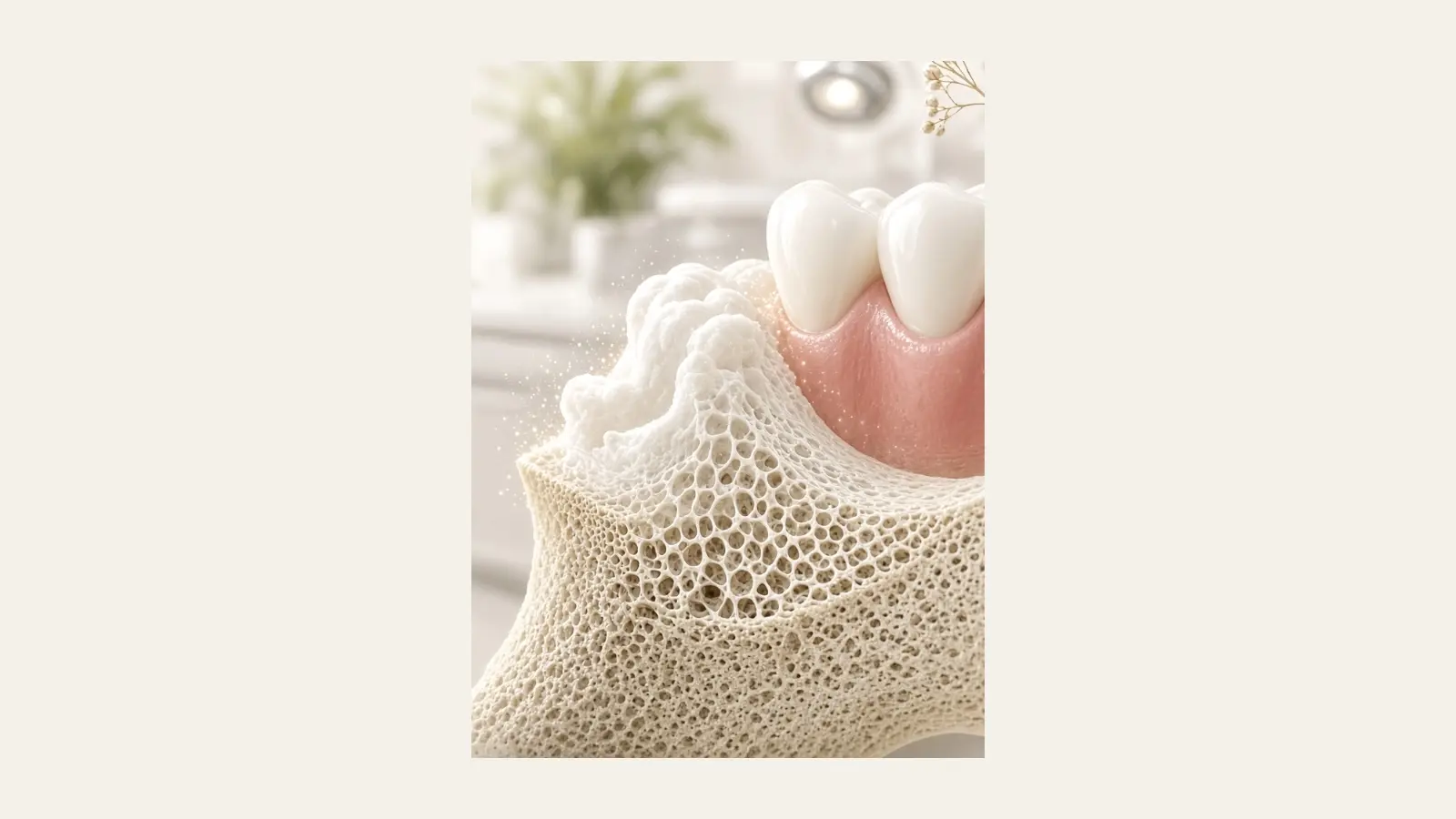
A dental bone graft may use the patient’s own bone, purified animal-derived matrices or synthetic substitutes. Materials and traceability are documented. The indication for grafting depends on the defect, remaining bone and prosthetic plan, with three-dimensional imaging when necessary.
The classes of biomaterials used in implantology
When the bone ridge is not sufficient to accommodate an implant in the prosthetically correct position, the clinician may consider a graft. The classes used in implant practice are mainly three: autologous bone, when needed, harvested with dedicated instruments and mixed with the chosen biomaterial; animal-derived materials purified and certified as medical devices; synthetic substitutes based on calcium phosphates, such as hydroxyapatite. Animal-derived matrices and synthetic substitutes act as an osteoconductive scaffold, that is, a structure into which the patient's bone cells migrate and deposit new tissue; autologous bone also contributes viable cells. A 2024 review by Nikç and colleagues points out that the choice of class affects healing times, residual resorption and the long-term stability of the implant, and must be tailored to the clinical indication. A 2025 randomised controlled trial by Sanz and colleagues compared a resorbable synthetic substitute with an autologous bone block in the augmentation of atrophic ridges: in both groups the implants were placed and integrated, with minor adverse events.
How the safety of animal-derived materials is assessed
The most frequent concern relates to animal-derived materials. They are not living bone, but matrices subjected to industrial purification processes and certified for clinical use. At Studio Buniato, every regenerative material used is accompanied by the manufacturer's technical data sheet. The type of material planned is indicated in the informed consent signed before the procedure; manufacturer, batch number and expiry date are recorded in the clinical record on the day of the procedure and a copy remains available on request. The preoperative CBCT image and, when performed, the follow-up image are also part of the documentation the patient can keep, together with the surgical report and the post-operative instructions.
When the graft is indicated and when it can be avoided
A bone graft is not an automatic step in implantology. It is indicated when the residual ridge is insufficient in height or thickness to accommodate an implant in the prosthetically correct position. The typical situations are the maxillary sinus lift in the posterior region, horizontal ridge augmentation in the aesthetic zones and socket preservation after a difficult extraction, a procedure that reduces the physiological resorption of the first months and preserves the volume needed for subsequent implant placement.
When the residual bone is already sufficient, proposing a graft adds a procedure with no real benefit, prolongs treatment times and increases morbidity. There are also situations that call for caution: a clinical case published in 2024 by Narahara and colleagues describes bone augmentation with synthetic material, with documented healing, in a person on low-dose bisphosphonate therapy, underlining that case selection and dialogue with the treating physician remain central. As this is a single clinical case, the finding should be read as an indication for individual caution.
The role of CBCT in the clinical decision
The decision whether to graft comes from measurement. At Studio Buniato, at Corso Francia 30 in Turin, every implant assessment involving possible regeneration starts with a targeted CBCT scan with Planmeca VISO G3: the tomography makes it possible to measure in millimetres the height and thickness of the available bone and to estimate its density, and to verify the position of delicate anatomical structures such as the floor of the maxillary sinus or the mandibular canal. Whether the graft is necessary depends on this measurement. When the CBCT shows adequate bone volume, the graft can often be avoided and the implant placement planned on the CBCT goes ahead. When, on the other hand, the bone is insufficient, the same three-dimensional image makes it possible to choose the class of biomaterial consistent with the prosthetic objective and to predict healing times in advance.
What to expect after the graft
A well-executed graft takes time to integrate with the patient's bone. Timing varies depending on the treated site, the regenerated volume and the type of material: some procedures allow simultaneous implant placement, others require months of waiting before proceeding with the implant phase. In the post-operative phase, scheduled check-ups are maintained to verify soft tissue healing and, when indicated, a follow-up CBCT is repeated to confirm bone maturation before loading the implant. The entire process is documented, from the material used to the radiographic check-ups: the documentation remains in the patient record and a copy is available on request, together with the post-operative instructions. The preoperative digital impression, when indicated, also becomes part of the technical documentation of the case and allows more predictable planning of the subsequent prosthetic phase. Once the prosthesis has been fitted, an implant in regenerated bone follows the same maintenance as any implant: consistent home oral hygiene and professional check-ups at set intervals, because peri-implantitis remains the main cause of late failure.
Frequently asked questions
Can I ask for only my own bone to be used?
Yes, you can ask for this. The assessment must be made case by case: harvesting autologous bone involves a second surgical site and additional morbidity, and in many indications today combinations with other biomaterials are used to reduce overall invasiveness while maintaining the expected clinical outcome. The final choice is shared after examining the CBCT and discussing your preferences explicitly.


friendly and willing to listen
Show less
Clean and always tidy premises Excellent staff The doctor is always friendly and willing to listen and find solutions for every need The paediatric dentist is very pleasant and wonderful with children and teenagers The nurses complete the team with excellence and professionalism
If I have taken bisphosphonates, can I still have a graft?
Therapy with bisphosphonates or other antiresorptive drugs requires a dedicated assessment: the decision depends on dosage, duration of therapy, route of administration and coordination with your treating physician. A clinical case published in 2024 describes bone augmentation performed in this scenario; as this is a single case, selection remains individual.

He works with great attention to patients’ needs.
Show less
I have known the Buniato dental practice for several years, after various experiences at other practices! I have always had a good experience: the doctor and his colleagues are knowledgeable, kind and precise. He has always advised me tactfully but professionally, and I must say that, although I am quite afraid of the dentist, I feel calm with him. He works with great attention to patients’ needs. Thank you again. Elisabetta
How do I know exactly what has been placed in me?
Every regenerative material has a batch number, a manufacturer, an expiry date and a technical data sheet recorded in the surgical clinical record. On request, you are given a copy of this data, together with the preoperative CBCT report and, if performed, the follow-up image.

He explains what he is doing and what you may feel before each step
Show less
I’m writing a little more than I usually would because I know how difficult it can be to find a dentist you genuinely feel comfortable with — especially when you are looking for treatment abroad. I came to Turin for dental treatment and honestly could not be happier that I found Dr. Buniato.
What impressed me from the beginning was how thorough and transparent everything was. He takes the time to do a proper assessment, with detailed images and analysis, and then explains clearly what is going on, what the different options are, which one he recommends and what each option would cost. You are never left in the dark or simply expected to trust that someone knows what is best for you. You understand what is being done, why it is being done and what to expect.
That same care continues throughout the treatment. He explains what he is doing and what you may feel before each step, so you are never caught by surprise. You can tell that he is incredibly precise and genuinely cares about getting every detail right.
And the result exceeded my expectations. I had virtually no pain afterwards, despite expecting quite the opposite. The work looks excellent, but even more importantly, it feels completely natural. After dental work, there is usually some adjustment period — you notice that something has changed, or your bite may feel different. With Dr. Buniato, I had none of that. Everything felt completely natural from the moment I left the chair.
I was also genuinely impressed by the technical standard of the practice. The equipment and technology are on a level I have rarely seen, and it is clear that they are used with real expertise rather than simply being there for show.
The whole team is warm, attentive and professional, and you get the feeling that they are willing to take the time needed to do things properly.
I would genuinely recommend Dr. Buniato to anyone looking for excellent dental care in Turin. I’m very happy I found him and will definitely be back for my future treatment.
I already have a plan with a graft proposed elsewhere: does a second assessment make sense?
Yes, and it starts from the same measurement: a recent CBCT, read against the planned prosthetic position. A different plan is not in itself an error: it may depend on the examination used, the prosthetic objective or the timing of the assessment. If bone height and thickness are sufficient, the graft may become avoidable; if they are not, the second assessment confirms it.

Dr Buniato and his team are professional, patient and empathetic, listening carefully and answering my questions.
Show less
The clinic’s appointment system is very convenient, and booking online is simple and quick. The treatment environment is clean, tidy and comfortable, with advanced facilities and a warm, relaxing waiting area that effectively eases the tension of visiting the dentist. Dr Buniato and his team are professional, patient and empathetic, listening carefully and answering my questions. Communication entirely in English was effortless. It was a wonderful dental experience, and I highly recommend it to friends and family!
I have been told I have little bone: is a graft always mandatory?
No. If the CBCT shows sufficient height and thickness for the planned prosthetic position, the graft adds no benefit and is not proposed. It is instead postponed or advised against when healing is poorly predictable, for example with high-dose antiresorptive therapies or uncompensated general conditions, which must be clarified with the treating physician before deciding.

attentive and always willing to explain every stage of treatment.
Show less
I began treatment with Dr Gianluca Buniato to straighten my teeth as an adult — I am 40 — and I can say it was one of the best decisions I could have made. Thanks to a carefully planned course of orthodontic treatment lasting less than two years, I achieved results I would never have thought possible: my smile has changed completely and I finally feel confident showing it!
Dr Buniato is extremely precise, attentive and always willing to explain every stage of treatment. The entire team is also kind, welcoming and very well organised. The practice, on Corso Francia in Turin, is carefully designed down to the smallest detail and immediately gives you a sense of trust and calm.
Although I live quite far from the practice, the excellent reviews persuaded me to put my trust in the doctor, and I can confirm that it was the right choice.
I absolutely recommend this practice to anyone who wants to improve their smile with professionalism, technology and plenty of personal attention.
For a personalized evaluation of your case, Dr. Buniato is available for one first specialist visit with complete diagnostic analysis, at Corso Francia 30 in Turin (Principi d'Acaja metro station).
Sources
- Nikç F, Muçolli G, Muçolli G. Regenerative materials – their indications and use in implantology: a literature review. Georgian Medical News. 2024. PMID: 39855177
- Sanz M, Gjerde C, Gjertsen BT, et al. Bone augmentation of atrophic alveolar ridges using a synthetic bone substitute with mesenchymal stem cells: a randomized, controlled clinical trial. Clinical Oral Implants Research. 2025. doi:10.1111/clr.70025. PMID: 40844304
- Narahara S, Ohba S, Ichinose S, et al. Bone augmentation with alloplastic graft material in a patient under bisphosphonate therapy: a case report and literature review. Journal of Oral Implantology. 2024. doi:10.1563/aaid-joi-D-24-00077. PMID: 38953229
