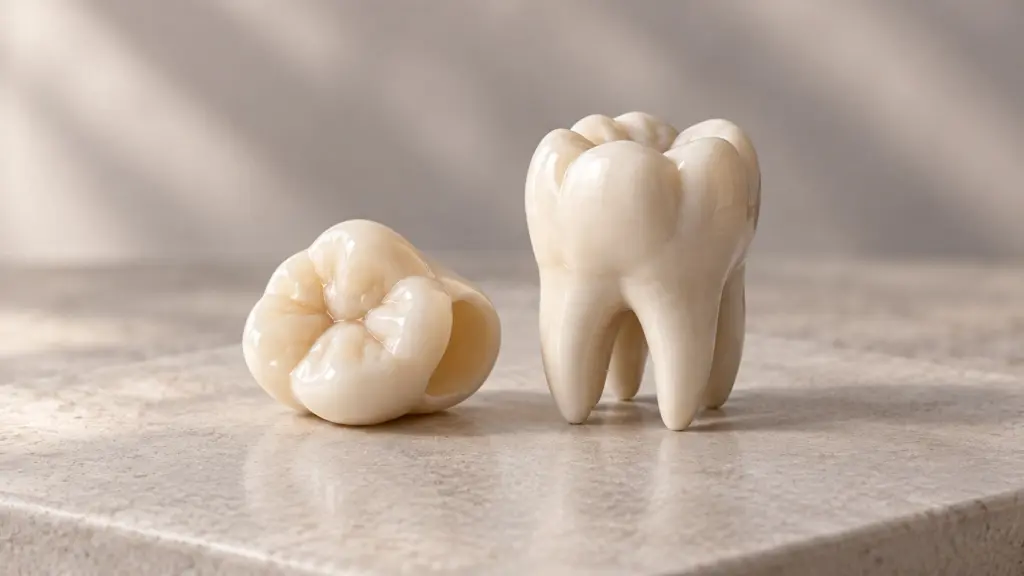
A temporary restoration accompanies a stage of treatment and has specific roles in protection, function and assessment. Its management depends on the work carried out and the condition of the mouth. Before leaving the practice, it is useful to clarify instructions, checks and next steps, especially if you live far from Turin.
Why the temporary restoration is part of treatment
The word “temporary” describes the intended duration within the treatment process, not the absence of a clinical function. While waiting for the definitive restoration, it may be necessary to protect prepared structures, maintain useful relationships and allow function compatible with the current stage. Materials and design are chosen with these aims in mind.
Not all temporary restorations are the same. A temporary crown on a tooth and a solution used in a more extensive rehabilitation do not necessarily have the same constraints. Instructions on chewing, hygiene and checks may also differ. Following advice received from an acquaintance may therefore be inappropriate.
It is useful to understand the role of your own temporary restoration: what it needs to protect, what it allows to be assessed and which aspects still require a further step. A clear explanation helps distinguish an expected limitation from a change that should be reported, without interpreting every sensation as a problem or dismissing it from the outset.
What is checked before the definitive restoration
Moving to the definitive restoration requires the clinical conditions and the checks specified in the plan to allow it. The fit of the temporary restoration, the tissue response, the relationships between the teeth and the functional or aesthetic features still to be defined may all matter. It is not enough for a certain number of days to have passed.
In some treatment pathways, the temporary restoration helps gather useful information for the next stage. Patients can report how they chew, speak or perceive particular shapes. These observations complement the clinical examination: on their own, they do not prove that the definitive restoration is already ready or that it will reproduce every sensation.
If the treatment involves a tooth that has had root canal treatment, the restoration must be considered within the overall assessment of the remaining structure and function. Endodontics and saving the tooth need to be linked to the subsequent protection provided by a restoration. The actual sequence depends on the case and cannot be decided simply by reading the name of the treatment.
Making everyday instructions concrete
At the end of the appointment, it is advisable to clarify how to clean the area, what precautions to take during meals and whether any specific restrictions apply. The instructions must relate to the temporary restoration actually in place. There is no need to guess which tool to use or to adapt general instructions to a situation that may be different.
A simple question can prevent misunderstandings: may I show you how I have understood I should clean this area? A practical check allows a movement to be corrected before it becomes a habit. Any difficulties with manual dexterity or the presence of other devices should also be mentioned, as they may affect which instructions are most suitable.
It is not advisable to smooth, glue or alter the temporary restoration yourself. If a surface causes discomfort or your bite seems to have changed, the professional must assess the solution. The fact that a material is temporary does not make home interventions harmless or justify postponing every problem until the definitive restoration is fitted.
Which changes to report to the practice
A restoration coming off, a fracture, new pain or an unexpected difficulty with function warrants contacting the practice. It is useful to explain when the problem appeared, whether the temporary restoration is still in place and which activities are difficult. This information helps arrange an appropriate assessment.
It is not possible to determine remotely that a loose temporary restoration can be left as it is until a set date. A check may be needed even without pain. If the device has come off, keeping it and asking for instructions is preferable to trying to put it back with unsuitable products.
For a sudden problem, further information is available on dental emergencies in Turin, including details for contacting the practice. If significant swelling develops with difficulty breathing or swallowing, urgent medical attention is needed: do not wait for a reply to an ordinary message. The NHS information on urgent dental problems provides general guidance; the access arrangements for the British service do not apply to the practice.
If you live far away: a schedule guided by checks
People travelling to Turin from another city need to know which stage has been completed and which steps remain. Before leaving, it is useful to check the next appointment, the instructions and the contact details to use if anything changes. This reduces uncertainty without making travel a clinical criterion.
The page for patients from Switzerland describes how the treatment pathway is organised. Preparing documents and planning your availability can make appointments easier; it does not mean speeding up healing, omitting checks or fitting the definitive restoration before the necessary conditions are met. Organisational alternatives are assessed with due regard for the stage of care.
If a check requires a different timeframe from the one expected, the schedule is discussed again. It is preferable to know about this possibility in advance, along with the reasons for waiting, rather than regard every change as a failure. A transparent plan distinguishes dates already agreed from estimates that still depend on clinical progress.
The timing of the definitive restoration is therefore a reasoned decision within the treatment pathway. Useful questions are concrete: what do we still need to check, which signs should I report and when will the situation be reassessed? Clear answers make it possible to manage the temporary stage with greater understanding, even when appointments involve travel.
Frequently asked questions
How long can a temporary restoration stay in the mouth?
It depends on the type of restoration, the materials and the aims of the clinical stage. There is no universal duration that can be applied without checks. The schedule should be agreed with the dentist and reassessed if conditions change; feeling well does not mean you can independently extend its use beyond the planned period.


From the very first appointment, I was impressed by the care and clarity with which solutions were proposed to me
Show less
I contacted Dr Gianluca Buniato’s dental practice for advice and a possible estimate to address my many complex dental problems. From the very first appointment, I was impressed by the care and clarity with which solutions were proposed to me, and I was soon able to see how effective they were. I feel I should thank Dr Buniato and his team not only for the professionalism with which they work in a dental practice using excellent technology, at very reasonable prices, but also for their ability to put patients at ease at all times.
If the temporary restoration comes off but does not hurt, can I wait?
It is advisable to contact the practice and describe what happened. The absence of pain does not establish that the tooth or the dental work can remain unprotected until the next appointment. Keep the temporary restoration and follow the instructions you receive, avoiding household glues or attempts to alter it and put it back yourself.

attentive and always willing to explain every stage of treatment.
Show less
I began treatment with Dr Gianluca Buniato to straighten my teeth as an adult — I am 40 — and I can say it was one of the best decisions I could have made. Thanks to a carefully planned course of orthodontic treatment lasting less than two years, I achieved results I would never have thought possible: my smile has changed completely and I finally feel confident showing it!
Dr Buniato is extremely precise, attentive and always willing to explain every stage of treatment. The entire team is also kind, welcoming and very well organised. The practice, on Corso Francia in Turin, is carefully designed down to the smallest detail and immediately gives you a sense of trust and calm.
Although I live quite far from the practice, the excellent reviews persuaded me to put my trust in the doctor, and I can confirm that it was the right choice.
I absolutely recommend this practice to anyone who wants to improve their smile with professionalism, technology and plenty of personal attention.
Can the definitive restoration be brought forward to avoid another trip?
Only if the clinical conditions and the planned checks allow it. Organisation can make appointments more convenient, but it does not replace the time needed for care. Before booking a trip, it is useful to distinguish a confirmed date from an estimate that still depends on reassessment at the practice.

their kindness in welcoming patients and their helpfulness in arranging appointments.
Show less
Dr Buniato and his entire team stand out for their great professionalism and expertise, as well as for their kindness in welcoming patients and their helpfulness in arranging appointments. A dental practice I absolutely recommend!!
For an individual assessment of your case, Dr Buniato is available for an initial dental consultation with a comprehensive diagnostic analysis.
Sources
- Regish KM, Sharma D, Prithviraj DR. Techniques of fabrication of provisional restoration: an overview. Int J Dent. 2011;2011:134659. PMID: 22013441; DOI: 10.1155/2011/134659.