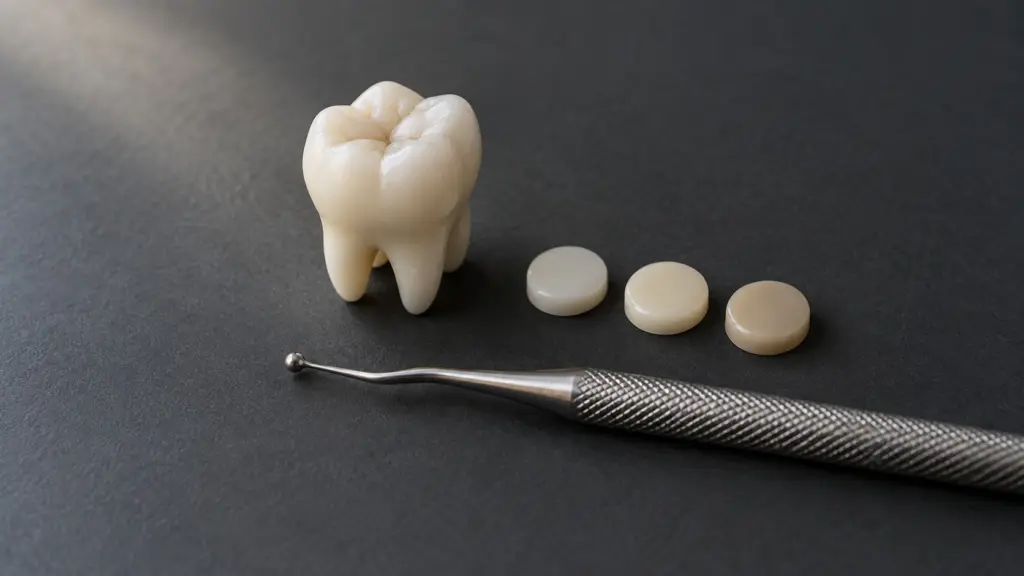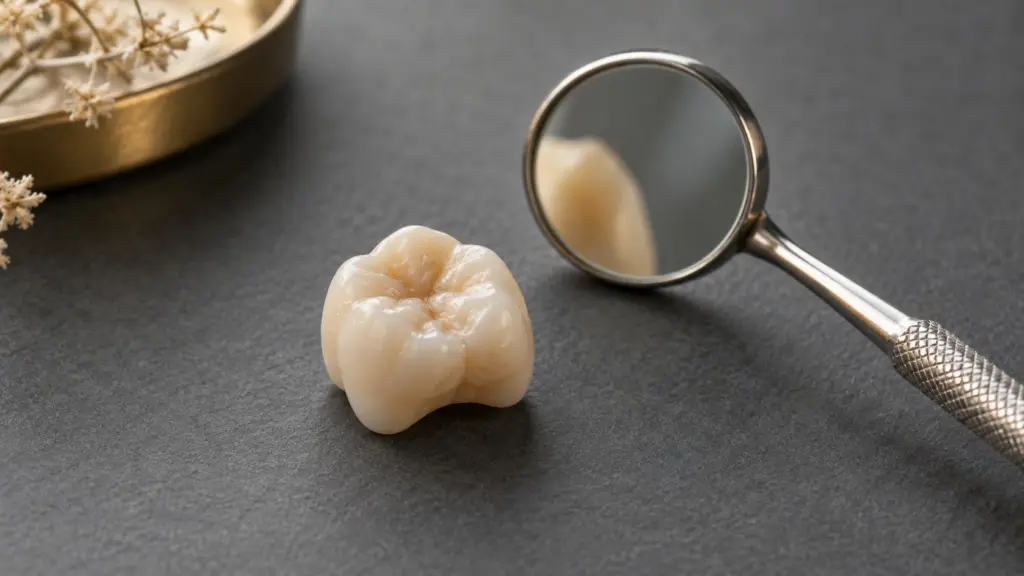
Pain during chewing may be caused by a crack, but it is not enough to diagnose one. To understand whether the tooth can be preserved, the type, extent and consequences of the damage need to be distinguished by assessing the pulp, gums and structure. Options may range from monitoring to a protective restoration, through to other treatments when indicated.
A line on a tooth does not always mean a serious fracture
The common term “crack” can cover very different situations. A fine line confined to the enamel is not the same as a crack affecting the dentine, a fractured cusp or a tooth split into parts. The distinction is not a matter of words: it changes what can be done and how the prognosis is assessed. An enlarged photograph alone cannot establish the depth of the line.
The 2025 position statement from the European Society of Endodontology distinguishes these conditions and recommends interpreting them in their clinical context. The presence of an old filling or previous root canal treatment also needs to be considered without automatically attributing the cause of the problem to that treatment. For the patient, the useful question is what damage has been identified and which features make it more or less concerning in their own case.
Pain on biting: what information helps during the consultation
Discomfort may occur while biting down on food or when releasing the bite. In other situations, sensitivity to cold or intermittent symptoms that are difficult to locate predominate. These descriptions guide the examination, but they can also occur with other conditions. It is helpful to recall how long the symptom has been present, whether it is changing and whether there has been an injury or the loss of part of the restoration.
There is no need to try to reproduce the pain by deliberately biting on hard objects. Clinical tests must be selected and performed by the dentist. Bringing previous X-rays or records to the consultation can help reconstruct the history of the tooth. Comparison with existing examinations does not remove the possible need for further investigations, but it allows that need to be assessed with a specific question in mind, rather than repeating images without a reason.
Why an X-ray alone does not provide the answer
The examination combines inspection of the tooth, assessment of restorations, pulp tests, checks of tooth contacts during chewing and gum probing where relevant. Magnification and lighting can help identify details; sometimes it is necessary to assess what a restoration covers. Each step must have an objective that can be explained. No image, on its own and in every situation, can confirm the absence of a crack or show its full extent.
Three-dimensional tomography also has limitations: it may be considered in selected cases if the other findings do not clarify the problem, but it does not reliably show every fracture line. The detailed article on dental CBCT helps distinguish an examination that is indicated from one requested simply to obtain more images. The question is what additional information could change the decision, taking radiation exposure into account.
Preserving the tooth: possibilities and limitations
Some superficial lines or low-risk situations may require observation over time, while others need a restoration that protects the vulnerable parts of the tooth. The choice depends on structure, symptoms, function and biological conditions. It would not be appropriate to propose the same solution for every crack; likewise, the word “fracture” alone is not enough to justify an extraction.
When the pulp is also affected, root canal treatment may be indicated, but it does not join the fracture back together or automatically make the tooth restorable. The approach to endodontics under the microscope includes assessing the tooth as a whole. In some conditions, the extent of the damage makes preservation unpredictable or unfeasible: recognising this limitation is part of a responsible decision about preserving the tooth, without insisting on a promise to save it at any cost.
Clarifying the plan, including uncertainties
An understandable plan distinguishes what has already been observed from what remains to be checked. Before starting, it is helpful to know whether an assessment phase, temporary protection or a definitive restoration is planned, and which findings could change the plan. Remaining uncertainty cannot be eliminated by choosing a different material or a more sophisticated examination: it needs to be described, together with the plausible alternatives.
The 2023 ESE guideline on pulpal and apical disease supports an approach based on diagnosis and reassessment. During the discussion, it is therefore reasonable to also ask how symptoms will be monitored and whom to contact if they change. Persistent pain should not be treated as normal simply because a restoration has already been placed; it requires discussion with the person managing the case, without inferring its cause remotely.
Organising follow-up appointments when you live far away
For those travelling from Switzerland or another city, the initial communication can serve to describe the symptoms and send the available records. However, it does not replace the tests needed to decide whether the tooth can be saved. Before returning home, it is advisable to agree on the next step, how to manage a new symptom and which instructions to follow in the meantime. The organisational aim is to have a clear point of contact, not to compress the clinical stages into a single trip.
The page for patients from Switzerland describes the first contact with the practice in Turin. If, in the meantime, pain increases, swelling appears or another part of the tooth breaks, prompt advice should be sought without automatically waiting for the follow-up appointment. Difficulty breathing or swallowing requires urgent care. Distance must not become a reason to ignore a significant change.
Frequently asked questions
Does a cracked tooth always need to be extracted?
No. The term covers situations with different levels of severity and different prospects. Some allow monitoring or treatment to preserve the tooth; others may make the tooth impossible to save. The choice requires an assessment of the extent of the damage, the pulp, the supporting tissues and the possibility of achieving an adequate restoration in the specific case.


From the very first appointment, I was impressed by the care and clarity with which solutions were proposed to me
Show less
I contacted Dr Gianluca Buniato’s dental practice for advice and a possible estimate to address my many complex dental problems. From the very first appointment, I was impressed by the care and clarity with which solutions were proposed to me, and I was soon able to see how effective they were. I feel I should thank Dr Buniato and his team not only for the professionalism with which they work in a dental practice using excellent technology, at very reasonable prices, but also for their ability to put patients at ease at all times.
If the X-ray shows nothing, is a crack ruled out?
No. An X-ray can be useful, but it does not necessarily show a crack. CBCT also has limitations and is not automatically indicated. Diagnosis combines the history of the symptoms, clinical examination and relevant investigations. It is therefore important to report symptoms even when a previous image did not reveal a problem.

attentive and always willing to explain every stage of treatment.
Show less
I began treatment with Dr Gianluca Buniato to straighten my teeth as an adult — I am 40 — and I can say it was one of the best decisions I could have made. Thanks to a carefully planned course of orthodontic treatment lasting less than two years, I achieved results I would never have thought possible: my smile has changed completely and I finally feel confident showing it!
Dr Buniato is extremely precise, attentive and always willing to explain every stage of treatment. The entire team is also kind, welcoming and very well organised. The practice, on Corso Francia in Turin, is carefully designed down to the smallest detail and immediately gives you a sense of trust and calm.
Although I live quite far from the practice, the excellent reviews persuaded me to put my trust in the doctor, and I can confirm that it was the right choice.
I absolutely recommend this practice to anyone who wants to improve their smile with professionalism, technology and plenty of personal attention.
Does root canal treatment always resolve pain in a cracked tooth?
No. Root canal treatment treats a pulpal or apical condition when indicated, but it does not mechanically eliminate the fracture. Structure and restoration also need to be assessed. Before proceeding, it is helpful to clarify which part of the problem the treatment addresses and what limitations or necessary checks remain for that tooth.

their kindness in welcoming patients and their helpfulness in arranging appointments.
Show less
Dr Buniato and his entire team stand out for their great professionalism and expertise, as well as for their kindness in welcoming patients and their helpfulness in arranging appointments. A dental practice I absolutely recommend!!
For an individual assessment of your case, Dr Buniato is available for an initial dental consultation with a comprehensive diagnostic assessment.
Sources
- Patel S, Teng PH, Liao WC, et al. Position statement on longitudinal cracks and fractures of teeth. Int Endod J. 2025;58(3):379-390. DOI: 10.1111/iej.14186. PMID: 39840523.
- Duncan HF, Kirkevang LL, Peters OA, et al. Treatment of pulpal and apical disease: The European Society of Endodontology (ESE) S3-level clinical practice guideline. Int Endod J. 2023;56 Suppl 3:238-295. DOI: 10.1111/iej.13974. PMID: 37772327.