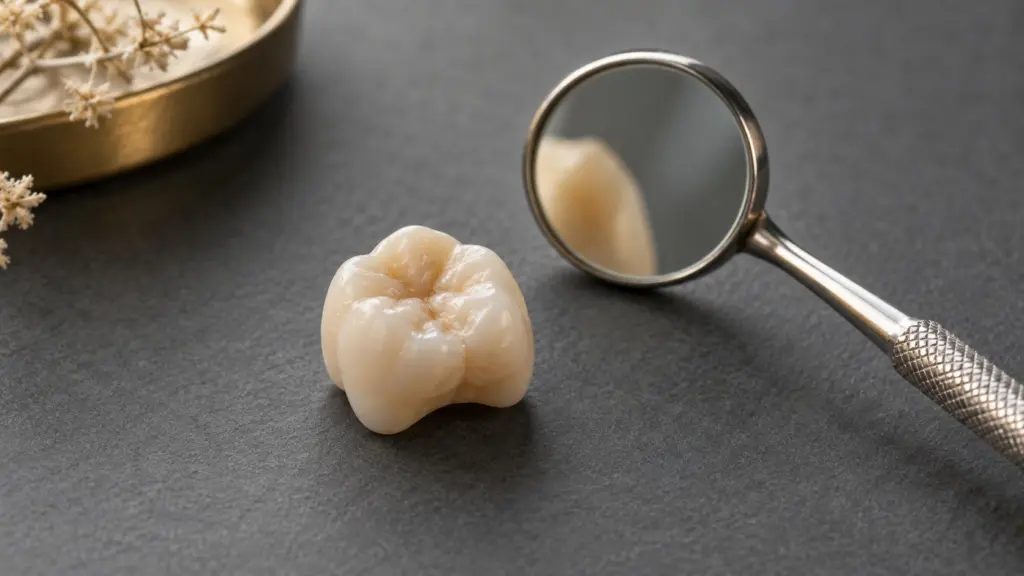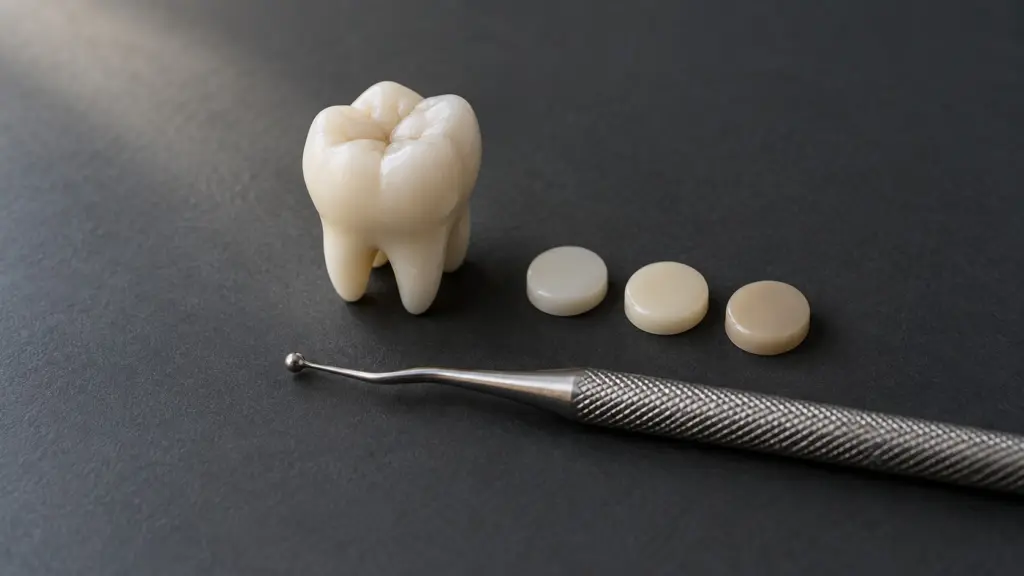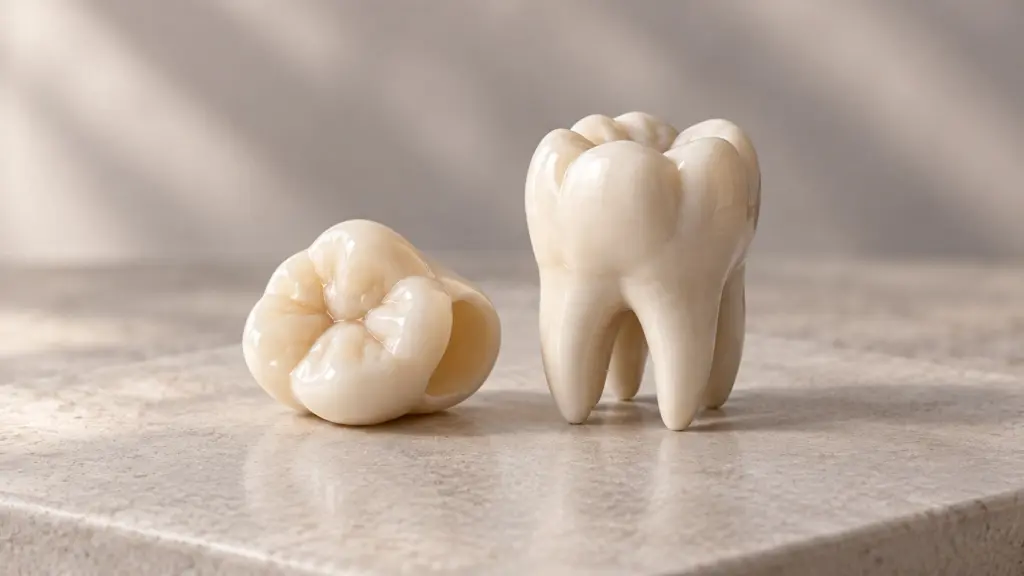
A root canal-treated tooth does not automatically require a full crown. The restoration is chosen based on the remaining tooth structure, position, chewing loads, any cracks and the possibilities for protecting the tooth. In some cases, more conservative restorations are appropriate; in others, greater coverage is needed. The decision must be justified for the individual case.
The question starts with how much tooth remains
After root canal treatment, simply knowing that the tooth is “root canal-treated” does not describe its condition. An incisor with limited tissue loss and a molar with extensively damaged walls present different problems. The amount and distribution of the remaining structure matter, not just the appearance of the visible surface. Restoration planning should therefore be considered alongside endodontic planning, rather than addressed as a separate, last-minute choice.
The European Society of Endodontology position statement on restoring endodontically treated teeth proposes decisions based on these factors, rather than a single material for everyone. Patients may find it helpful to ask which parts of their tooth are still reliable, which need protection and what each option involves. A drawing, a clinical photograph or an explanation using a model can make the reason for the proposal understandable, without turning the image into a diagnosis in its own right.
Fillings, inlays and crowns have different functions
A direct restoration is made on the tooth; an indirect restoration is prepared outside the mouth and then fitted. Among partial restorations, some options cover one or more cusps, the projecting parts involved in chewing. A full crown, by contrast, covers the crown portion more extensively. These names indicate different configurations: they do not form a ranking in which the most extensive solution is always the best.
Preserving healthy tissue is a goal, but it must be balanced with adequate protection. A small restoration is not automatically a prudent choice if it leaves weakened walls vulnerable; a more extensive preparation is not automatically necessary simply because the tooth has received root canal treatment. The point of the discussion is to understand how much coverage is needed, what conditions allow the restoration to bond and what compromises are required by a tooth that is already severely compromised.
What protecting the cusps means
For back teeth, the assessment considers how forces are distributed during function. The plan may require covering areas at risk while preserving other parts where reasonable. Discussing a proposal does not require knowing all the material abbreviations: it is more useful to understand what the restoration protects and which problem would remain unaddressed if an alternative were chosen. The relationships with neighbouring teeth and those in the opposing arch are also part of the examination.
The clinical review by Bhuva and colleagues highlights the role of remaining tooth structure, tooth position, contacts with adjacent teeth, cracks and the timing of the definitive restoration. These elements cannot be summarised as a percentage that applies to every patient. If clenching or grinding habits are present, they should be discussed as part of the plan, without assuming that every root canal-treated tooth automatically requires the same device or identical protection.
A post is not a reinforcement that should always be added
A post may help retain the build-up when the available crown structure is insufficient; it is not a reason to remove useful tissue from every treated tooth. Any indication for its use should be explained along with the limitations of the root and the remaining portion. Saying that a build-up needs retention is different from saying that inserting a post makes any tooth stronger: the second statement would be too general.
Before accepting a proposal, you can ask what function the post serves, whether alternatives exist and which factors affect the prognosis. This is not a dispute between modern and outdated techniques, but a choice based on the actual situation. When the problem concerns a previous root canal treatment, the question of root canal retreatment or the implant alternative is assessed separately, while remaining coordinated with the possibility of restoring the tooth.
Agree on timing and steps before going home
A temporary seal has a purpose and a period of use that should be agreed upon: it should not become indefinite because the tooth causes no discomfort. In the plan, it is useful to distinguish between the completion of root canal treatment, the planned restoration and any check-ups. If clinical aspects remain to be reassessed, they must be explained, without presenting a necessary wait as a mishap or promising a date that the situation does not allow to be set.
For those living in Switzerland or far from Turin, contact can be organised around these stages, clarifying what to do if the temporary restoration is damaged or a symptom develops. The page for patients from Switzerland provides a reference for preparing for the first appointment. Reducing unnecessary travel is an organisational goal; bringing forward a clinical stage when it is not appropriate, or postponing a necessary step without discussion, is not.
The check-up concerns the whole tooth, not just the crown
After restoration, the maintenance programme considers hygiene, restoration margins, gums, function and endodontic status according to the needs of the case. A root canal-treated tooth can still develop problems in the surrounding tissues or the remaining structure. The absence of the pulp does not make it immune to decay or make new pain during chewing irrelevant. Changes should be reported, rather than waiting simply because the restoration appears intact.
At the practice in Turin, assessment of the treatment pathway for microscope-assisted endodontics allows preservation and restoration to be discussed within the overall picture. Before the decision, the patient should know which solution is proposed, which tissue will be preserved and what limitations remain. A good discussion does not promise a universal lifespan: it makes the reason for the choice clear and allows check-ups to be planned to suit the tooth and the person.
Frequently asked questions
If I have no pain, can I postpone the definitive restoration?
The absence of pain does not show that a temporary seal can remain indefinitely. Timing and protection of the tooth must be agreed with the dentist, taking into account the treatment performed and what remains to be checked. If an appointment needs to be rescheduled, it is advisable to contact the practice before changing the plan independently.


From the very first appointment, I was impressed by the care and clarity with which solutions were proposed to me
Show less
I contacted Dr Gianluca Buniato’s dental practice for advice and a possible estimate to address my many complex dental problems. From the very first appointment, I was impressed by the care and clarity with which solutions were proposed to me, and I was soon able to see how effective they were. I feel I should thank Dr Buniato and his team not only for the professionalism with which they work in a dental practice using excellent technology, at very reasonable prices, but also for their ability to put patients at ease at all times.
Is an inlay always more conservative and therefore preferable?
Not necessarily. A partial restoration can preserve tissue in appropriate cases, but it must provide adequate protection and suitable bonding conditions. The choice depends on the remaining structure and the function of the tooth. The comparison with a full crown must be based on the actual case, clarifying the advantages, limitations and clinical reasons for the proposal.

attentive and always willing to explain every stage of treatment.
Show less
I began treatment with Dr Gianluca Buniato to straighten my teeth as an adult — I am 40 — and I can say it was one of the best decisions I could have made. Thanks to a carefully planned course of orthodontic treatment lasting less than two years, I achieved results I would never have thought possible: my smile has changed completely and I finally feel confident showing it!
Dr Buniato is extremely precise, attentive and always willing to explain every stage of treatment. The entire team is also kind, welcoming and very well organised. The practice, on Corso Francia in Turin, is carefully designed down to the smallest detail and immediately gives you a sense of trust and calm.
Although I live quite far from the practice, the excellent reviews persuaded me to put my trust in the doctor, and I can confirm that it was the right choice.
I absolutely recommend this practice to anyone who wants to improve their smile with professionalism, technology and plenty of personal attention.
Does inserting a post always make the tooth stronger?
No. A post can help retain the build-up when needed, but it is not a universal reinforcement. The decision must consider the remaining tissue, the root and the planned restoration. It is useful to ask which problem it solves in your case and why it is preferable to the alternatives considered.

their kindness in welcoming patients and their helpfulness in arranging appointments.
Show less
Dr Buniato and his entire team stand out for their great professionalism and expertise, as well as for their kindness in welcoming patients and their helpfulness in arranging appointments. A dental practice I absolutely recommend!!
For an individual assessment of your case, Dr Buniato is available for an initial dental consultation with a comprehensive diagnostic analysis.
Sources
- Mannocci F, Bhuva B, Roig M, Zarow M, Bitter K, European Society of Endodontology. European Society of Endodontology position statement: The restoration of root filled teeth. Int Endod J. 2021;54(11):1974-1981. DOI: 10.1111/iej.13607. PMID: 34378217.
- Bhuva B, Giovarruscio M, Rahim N, Bitter K, Mannocci F. The restoration of root filled teeth: a review of the clinical literature. Int Endod J. 2021;54(4):509-535. DOI: 10.1111/iej.13438. PMID: 33128279.