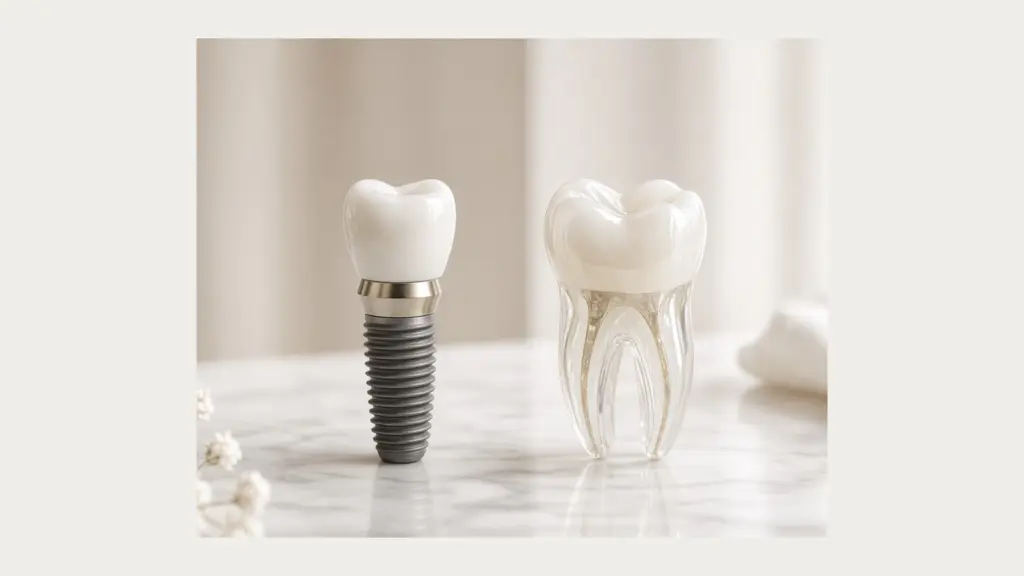
Between root canal retreatment and implant, the natural tooth is preserved when the remaining structure is restorable, the periodontium holds and the canal is reachable: under these conditions retreatment under the microscope has a favourable prognosis. In the presence of a vertical fracture or of non-recoverable structural compromise the choice falls on the single implant.
The clinical comparison between endodontic retreatment and single implant
The question of whether to save the tooth or replace it with an implant often arises when an extraction has been proposed on an already root-treated tooth. A 2017 systematic review published in the Journal of Endodontics directly compared endodontic retreatment, apical surgery and single implant on the available studies, without finding clinically relevant differences in survival up to at least eight years of follow-up. A randomised trial published in 2018 on teeth with an uncertain endodontic prognosis found no statistically significant differences in failures and marginal bone loss at three years between the two options, on a small sample. It should be noted that direct comparisons remain relatively few and longer follow-ups are less numerous, so mean survival should be read as an indicative figure, not as a guarantee for the individual case. On this basis the clinical decision is built on the specific tooth, with verifiable criteria of residual restorability, periodontal support and an endodontic prognosis that can still be achieved.
When endodontic retreatment is indicated
A review published in 2016 in the Journal of the American Dental Association places non-surgical retreatment as a first-line option in the event of failure of a previous root canal treatment, before resorting to apical surgery or to extraction with implant replacement. This is the typical profile of those who come for a second opinion: a panoramic radiograph, an intraoral radiograph, a proposal for extraction and implant already formulated, and the wish to verify whether the tooth can still be preserved. A tooth is retreatable when certain verifiable clinical conditions are met:
- the residual coronal structure is sufficient to support a definitive prosthetic restoration, usually a crown with an adequate ferrule, that is, with sufficient sound tooth structure above the gingival margin;
- the periodontium is healthy or compensated, without advanced bone lesions or significant mobility;
- the canal system is reachable with modern instruments, even where previous fillings, posts or calcifications have complicated its anatomy;
- there are no clinical or radiographic signs of vertical root fracture.
When these conditions combine, preservation of the natural tooth remains the reference standard. A retreatment performed with endodontics under the microscope makes it possible to identify accessory canals, correct procedural errors of the first treatment and seal the system with contemporary biomaterials.
When extraction with a single implant is the most rational choice
The same literature that supports preservation also indicates its limits. Persisting with a tooth that is no longer salvageable postpones an inevitable extraction and complicates the subsequent procedure. Extraction with implant replacement becomes the most rational choice when a vertical root fracture is present, which is often invisible on two-dimensional radiographs but can be suspected on clinical grounds and on targeted CBCT; when the structural compromise is not recoverable, due to an insufficient ferrule, deep caries below the gingival margin or a root thinned by previous treatments; when periodontal lesions are advanced and cannot be stabilised; or after repeated failures of retreatments that were already performed correctly. In these scenarios the single implant may be one of the alternatives to consider, taking into account the clinical conditions, benefits and risks of the case. If the assessment leads to this conclusion, it should be explained openly to the person: a second opinion serves to confirm or correct the initial orientation.
How we decide: from examinations to clinical judgement
The choice between retreating and replacing follows a defined diagnostic pathway. At the first specialist visit we collect the clinical history, assess the tooth in question and, when the anatomy is complex or conventional radiographs are not sufficient, prescribe a CBCT limited to the single sector, performed at Studio Buniato in Corso Francia 30 in Turin with the Planmeca VISO G3 tomograph.
CBCT makes it possible to identify untreated canals, small periapical lesions, resorptions and suspected fracture lines. During the operative phase the Leica M525 operating microscope adds magnification and coaxial illumination that make otherwise invisible details legible: a particularly significant advantage in complex cases such as calcified root canals, where the decision to retreat must rest on anatomy that is actually accessible. Only after the synthesis of these elements does one arrive at a reasoned recommendation.
Tooth preservation, alternatives and treatment timing
At our practice, we prioritise preserving the tooth when clinically indicated. Before choosing an approach, we discuss alternatives, limitations, the steps required and follow-up checks. People travelling from further away can speak with us before their visit to clarify practical arrangements; diagnosis and treatment recommendations require a clinical assessment. Travel schedules follow the protocols and healing times of the individual case.
To prepare for the appointment, information is available on the first specialist consultation.
What to expect from retreatment under the microscope
Retreatment generally takes place over one or two appointments, depending on the complexity of the canal anatomy and on the presence of materials to be removed: previous fillings, posts, fractured instruments. Intraoperative pain is controlled with local anaesthesia; in the healing phase a sensitivity to chewing for a few days is possible and does not in itself constitute a sign of failure. Any transient flare-ups are managed with specific instructions at the check-up.
At the end of root canal therapy the tooth must be restored appropriately: in most cases with a prosthetic crown that protects the remaining structure from chewing loads. In the medium term the radiographic check-up verifies the reduction of the periapical lesion, where present, as an objective sign of tissue healing. In the long term the retreated tooth is maintained like any other natural tooth: professional hygiene and periodic check-ups are the factor that protects the result. Restorative planning is an integral part of the prognosis.
Frequently asked questions
Does a retreated tooth last as long as an implant?
In the direct comparisons available in the literature the survival of the two options shows no clinically relevant differences up to at least eight years of follow-up. In non-comparative series the single implant records high survival rates, but the average figure does not decide the individual tooth: a tooth with a favourable prognosis, correctly retreated and restored with a well-designed crown remains a clinically sound choice over time.


From the start, the doctor was very helpful and courteous and clearly explained the work he would need to do.
Show less
I did not know Dr Buniato and found him through an internet search. My old bite splint had broken, and I was looking for a practice that used cutting-edge techniques to make a new one. From the start, the doctor was very helpful and courteous and clearly explained the work he would need to do. Once the splint had been made, we had to meet several times so that he could adjust it to fit my teeth as well as possible. Now I have a splint that does its job perfectly. Above all, I greatly appreciated his human warmth, helpfulness, courtesy, calm manner and ability to explain the various steps that would follow. The reception staff are excellent too. The practice is clean, modern and well cared for. What can I say: these days, a doctor like this is almost a rarity. So I recommend him and thank him sincerely.
If I have already received a quote for extraction and implant, does it make sense to ask for a second endodontic opinion?
Yes, especially if the tooth in question does not show obvious signs of being unsalvageable. The literature places non-surgical retreatment and apical microsurgery before extraction with a single implant. A dedicated endodontic assessment, with a microscope and CBCT when indicated, clarifies whether that tooth still falls within a favourable prognosis or whether the implant is in fact the more rational choice.

friendly and willing to listen
Show less
Clean and always tidy premises Excellent staff The doctor is always friendly and willing to listen and find solutions for every need The paediatric dentist is very pleasant and wonderful with children and teenagers The nurses complete the team with excellence and professionalism
How can I tell whether my tooth is no longer salvageable?
A targeted assessment is needed: clinical examination of the tooth, digital intraoral radiographs and, where indicated, CBCT limited to the single tooth. The residual coronal structure, periodontal support, presence of signs of vertical fracture and treatability of the root canal system are assessed. In the absence of clear negative signs, retreatment remains a realistic option; when they are present, the implant route becomes the more solid one.

From the very first appointment, I was impressed by the care and clarity with which solutions were proposed to me
Show less
I contacted Dr Gianluca Buniato’s dental practice for advice and a possible estimate to address my many complex dental problems. From the very first appointment, I was impressed by the care and clarity with which solutions were proposed to me, and I was soon able to see how effective they were. I feel I should thank Dr Buniato and his team not only for the professionalism with which they work in a dental practice using excellent technology, at very reasonable prices, but also for their ability to put patients at ease at all times.
For a personalized evaluation of your case, Dr. Buniato is available for one first specialist visit with complete diagnostic analysis.
Sources
- Chércoles-Ruiz A, Sánchez-Torres A, Gay-Escoda C. Endodontics, endodontic retreatment, and apical surgery versus tooth extraction and implant placement: a systematic review. J Endod. 2017. doi:10.1016/j.joen.2017.01.004. PMID: 28343928.
- Torabinejad M, White SN. Endodontic treatment options after unsuccessful initial root canal treatment: alternatives to single-tooth implants. J Am Dent Assoc. 2016. doi:10.1016/j.adaj.2015.11.017. PMID: 26778004.
- Esposito M, Trullenque-Eriksson A, Tallarico M. Endodontic retreatment versus dental implants of teeth with an uncertain endodontic prognosis: 3-year results from a randomised controlled trial. Eur J Oral Implantol. 2018. PMID: 30515483.