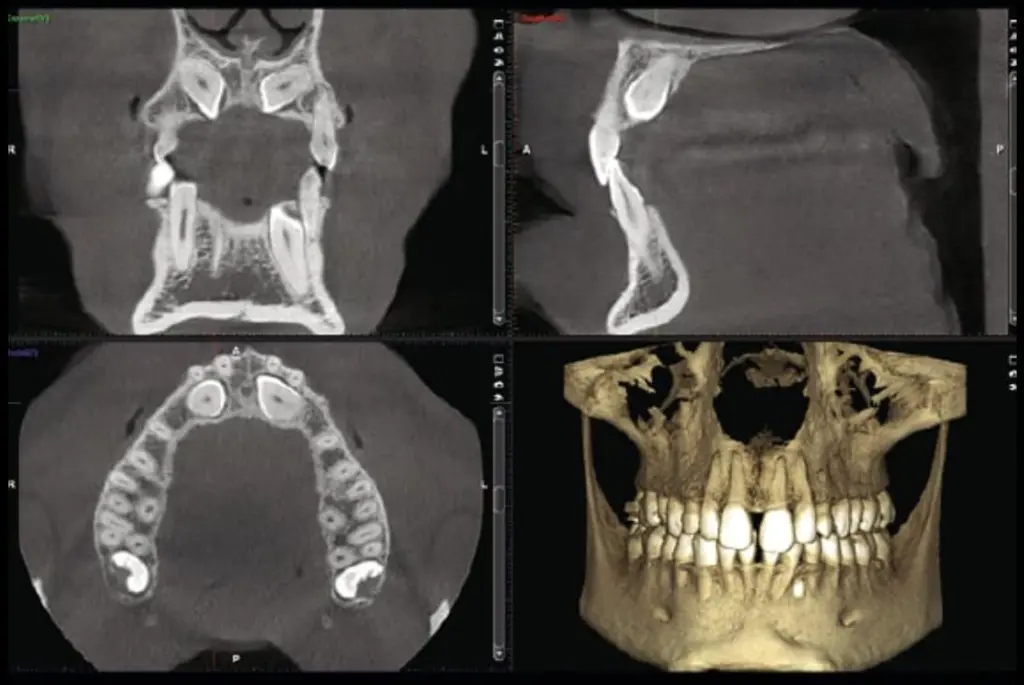
CBCT (Cone Beam Computed Tomography) is a three-dimensional radiological examination that allows the anatomical structures of the oral cavity to be visualized with a precision not achievable by traditional radiography, using doses of radiation that are contained and modulated based on the specific clinical question.
Those who are faced with implant surgery, a complex endodontic evaluation or jaw surgery often find themselves faced with a concrete question: is a 3D CT scan really necessary? And how much radiation does it involve?
These are legitimate questions. The answer requires distinguishing between what two-dimensional radiography can show and what only the third dimension makes visible, without underestimating the issue of dose.
What does CBCT see that a traditional x-ray doesn't show
A panoramic radiograph (OPG) provides a two-dimensional image in which the structures overlap. This is sufficient for many routine evaluations, but becomes a limitation when the clinician needs to accurately measure the bone volume available for an implant, locate a root fracture, or map the course of the inferior alveolar nerve prior to surgery.
CBCT reconstructs a three-dimensional volume of the examined district: the dentist can navigate the anatomy layer by layer, measure real distances and not projections, and identify structures that would remain hidden in two dimensions. In our studio we use the system CBCT Planmeca, which allows you to select the field of view (FOV) and exposure parameters based on the specific clinical question.
When CBCT is clinically indicated
The test is prescribed when the expected diagnostic benefit exceeds the radiological risk and when the necessary information cannot be obtained with lower dose techniques. The main indications in dentistry include:
- Implantology: three-dimensional planning of implant insertion with exact knowledge of bone thickness and height, density of the recipient site and position of the noble structures. In our practice, CBCT is integrated into the Nobel Biocare implant workflow for guided design.
- Complex endodontics: root fractures, atypical root canal anatomy, complications of previous treatments. The literature confirms that CBCT maintains reliable diagnostic accuracy for the evaluation of endodontic conditions even with reduced dose protocols (Al-Haj Husain et al., 2026), supporting the work under operating microscope.
- Third molar surgery: when the panoramic radiograph suggests that the roots of the wisdom tooth are close to the alveolar nerve canal, CBCT clarifies their actual spatial relationship.
- Periapical and periodontal pathology: lesions not evident on conventional radiography or complex bone defects requiring volumetric evaluation.
Not all situations require CBCT. An initial cavity, a routine check-up or a basic periodontal evaluation are managed with intraoral or panoramic radiography. The choice of exam always follows the clinical question.
The dose question: concrete data
The fear of radiation is understandable, but it deserves to be contextualized with the available data. A systematic review that analyzed 23 studies identified at least 13 modifiable technical factors that influence the effective dose of a CBCT: these include voltage (kV), amperage (mA), field of view (FOV), rotation angle, voxel size and exposure time (Moura et al., 2019).
This means that the dose is not a fixed value: it depends on how the exam is set up and what anatomical volume is acquired. Using a small FOV centered on the area of interest significantly reduces exposure compared to a full skull scan.
Research has also shown that it is possible to reduce the CBCT dose by approximately 20% compared to the manufacturer's standard parameters without compromising diagnostic accuracy for root fracture detection (Yalda et al., 2022). The same study highlighted that the high resolution setting does not significantly improve accuracy compared to standard parameters: a fact that reinforces the importance of choosing the appropriate protocol for the question, avoiding unnecessary exposures.
The systematic review also found that different CBCT scanners, with similar exposure parameters, produce significantly different effective doses (Moura et al., 2019). The choice of equipment is not a secondary detail.
How we use CBCT in our practice in Turin
In our practice in Corso Francia 30, Turin, the Planmeca CBCT is part of an integrated diagnostic flow. The test is prescribed when the clinical question justifies it and is performed with parameters optimized for the specific case, selecting field of view and resolution based on the necessary information.
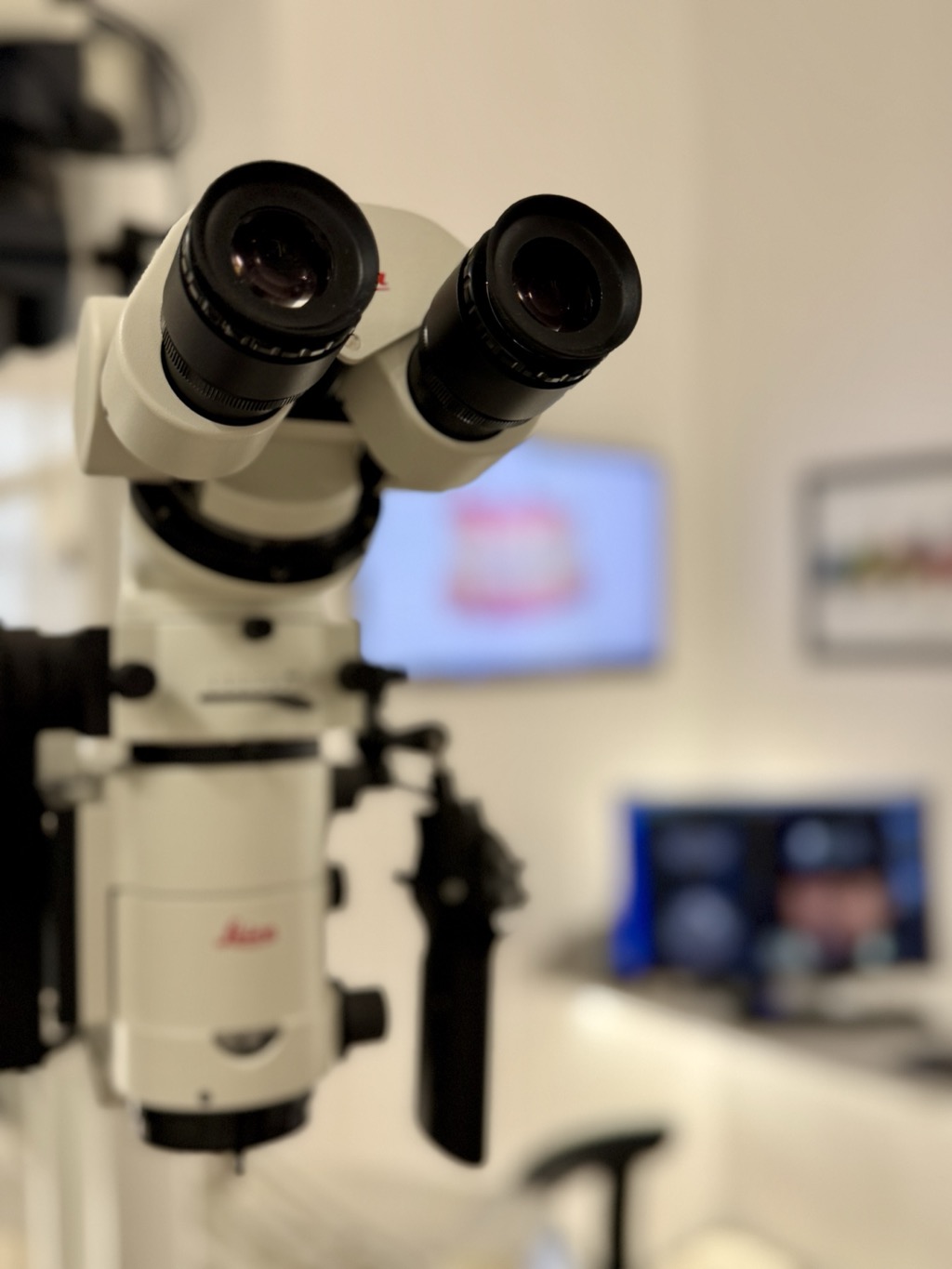
The acquired three-dimensional data integrates with the scans of the 3Shape TRIOS 6 intraoral scanner and with direct clinical analysis to build a complete diagnostic picture. In implantology, this allows you to plan the position, inclination and depth of the implant before surgery. In endodontics, the three-dimensional map guides the work under the Leica operating microscope.
The goal is not to do more tests, but to do the right tests: those that concretely change the diagnosis and the treatment plan.
Frequently asked questions
Is CBCT painful or invasive?
No. The exam lasts a few seconds, requires no preparation and does not involve physical contact other than positioning the chin on the appropriate support. The patient remains standing or sitting and the device rotates around the head without touching it.


his human warmth, helpfulness, courtesy, calm manner and ability to explain the various steps that would follow.
Show less
I did not know Dr Buniato and found him through an internet search. My old bite splint had broken, and I was looking for a practice that used cutting-edge techniques to make a new one. From the start, the doctor was very helpful and courteous and clearly explained the work he would need to do. Once the splint had been made, we had to meet several times so that he could adjust it to fit my teeth as well as possible. Now I have a splint that does its job perfectly. Above all, I greatly appreciated his human warmth, helpfulness, courtesy, calm manner and ability to explain the various steps that would follow. The reception staff are excellent too. The practice is clean, modern and well cared for. What can I say: these days, a doctor like this is almost a rarity. So I recommend him and thank him sincerely.
How much radiation does a CBCT involve compared to a traditional CT scan?
The dose of a dental CBCT is significantly lower than that of a conventional multislice CT of the facial massif. The actual dose depends on the parameters used and the selected field of view. As documented in the literature, at least 13 technical factors can be optimized to contain exposure while maintaining diagnostic quality (Moura et al., 2019).

attentive and always willing to explain every stage of treatment.
Show less
I began treatment with Dr Gianluca Buniato to straighten my teeth as an adult — I am 40 — and I can say it was one of the best decisions I could have made. Thanks to a carefully planned course of orthodontic treatment lasting less than two years, I achieved results I would never have thought possible: my smile has changed completely and I finally feel confident showing it!
Dr Buniato is extremely precise, attentive and always willing to explain every stage of treatment. The entire team is also kind, welcoming and very well organised. The practice, on Corso Francia in Turin, is carefully designed down to the smallest detail and immediately gives you a sense of trust and calm.
Although I live quite far from the practice, the excellent reviews persuaded me to put my trust in the doctor, and I can confirm that it was the right choice.
I absolutely recommend this practice to anyone who wants to improve their smile with professionalism, technology and plenty of personal attention.
Do all patients have to have CBCT?
No. CBCT is prescribed only when the clinical question cannot be resolved with conventional radiography. For routine checks, simple caries or standard periodontal evaluations, intraoral radiography or panoramic imaging remain the reference tests. The three-dimensional examination is reserved for cases in which the additional information concretely modifies the diagnosis or treatment plan.

From the very first appointment, I was impressed by the care and clarity with which solutions were proposed to me
Show less
I contacted Dr Gianluca Buniato’s dental practice for advice and a possible estimate to address my many complex dental problems. From the very first appointment, I was impressed by the care and clarity with which solutions were proposed to me, and I was soon able to see how effective they were. I feel I should thank Dr Buniato and his team not only for the professionalism with which they work in a dental practice using excellent technology, at very reasonable prices, but also for their ability to put patients at ease at all times.
Is CBCT safe in pregnancy?
As with any radiological examination, CBCT in pregnancy is evaluated on a case-by-case basis according to the principle of justification. In general, non-urgent radiological tests are postponed until after delivery. In case of documented clinical need, the clinician evaluates the risk-benefit ratio with the patient.

although I am quite afraid of the dentist, I feel calm with him.
Show less
I have known the Buniato dental practice for several years, after various experiences at other practices! I have always had a good experience: the doctor and his colleagues are knowledgeable, kind and precise. He has always advised me tactfully but professionally, and I must say that, although I am quite afraid of the dentist, I feel calm with him. He works with great attention to patients’ needs. Thank you again. Elisabetta
For an individual assessment of your case, Dr Buniato is available for an initial specialist consultation with a full diagnostic assessment.
Sources
- Moura WS, Chiqueto K, Pithon GM, Neves LS, Castro R, Henriques JFC. Factors influencing the effective dose associated with CBCT: a systematic review. Clin Oral Investig. 2019;23(3). doi:10.1007/s00784-018-2561-4. Disponibile su: PubMed.
- Yalda FA, Theodorakou C, Clarkson RJ, Davies J, Feinberg L, Sengupta A. Determination of a cone-beam CT low-dose protocol for root fracture diagnosis in non-endodontically treated anterior maxillary teeth. Dentomaxillofac Radiol. 2022;51(2):20210138. doi:10.1259/dmfr.20210138. Disponibile su: PubMed.
- Al-Haj Husain A, Mergen V, Al-Haj Husain N, Alkadhi H, Demmert TT, Essig H. Photon-counting detector vs. cone-beam CT in endodontics: a study of simulated endodontic conditions, treatments, and associated complications. BMC Oral Health. 2026;26. doi:10.1186/s12903-026-07765-1. Disponibile su: PubMed.