After a bone graft, the biological maturation of the site is awaited before placing the implant: in delayed maxillary sinus lift the typical window is 6-9 months. Timeframes depend on the biomaterial, the site and the person's condition; when the residual bone is sufficient, simultaneous implant placement avoids the wait.
Who two-stage regeneration is indicated for
Two-stage regeneration is intended for cases in which the volume or quality of the residual bone does not allow the implant to be placed during the same surgical procedure. It typically concerns maxillary sinus lift with extensive loss of bone height, extensive horizontal ridge defects and post-extraction sites that require reconstruction before the implant phase.
It is not indicated when the residual bone allows adequate primary stability: in that case, placement simultaneous with the regenerative surgery remains preferable, because it reduces the number of procedures and the overall duration of the treatment pathway. Two-stage regeneration is therefore not the longer route chosen out of caution, but the one reserved for defects in which the implant would not yet find sufficient support.
The biological phases after the graft
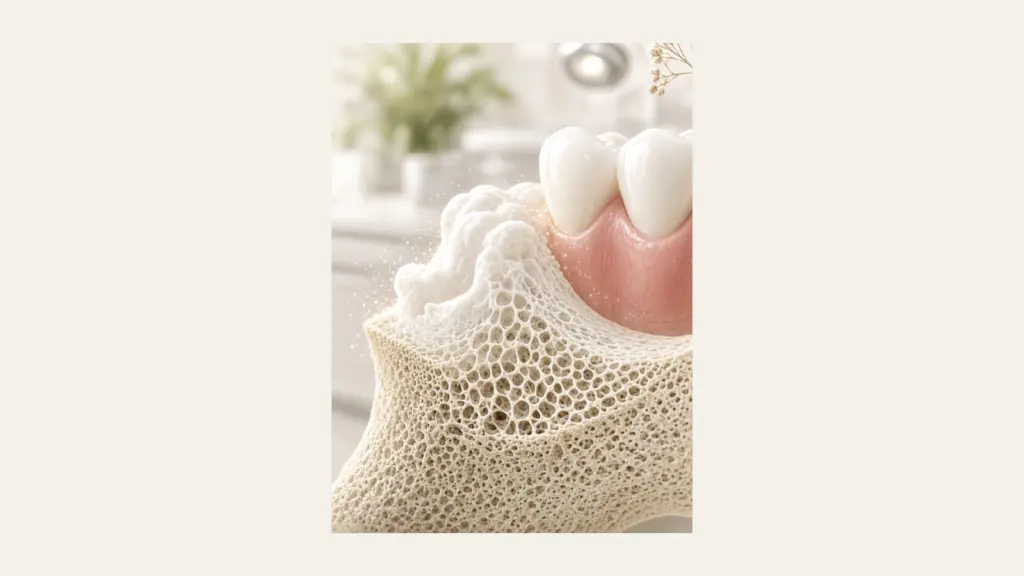
A bone graft — whether in the form of guided bone regeneration with particulate biomaterial and a collagen membrane, or as a maxillary sinus lift — triggers a biological sequence with its own timing, independent of the calendar. In the first hours and days the clot organizes, hemostasis is controlled and the physiological inflammatory response begins. In the following weeks the membrane protects the regenerative space while the patient's cells colonize the biomaterial, which acts as a three-dimensional scaffold. In the following months the newly formed bone matures and remodels, reaching the density and organization suited to supporting a masticatory load.
Not all of these phases end at the same time: the window in which the bone is ready to receive the implant corresponds to sufficient remodeling, not to the mere presence of newly formed tissue. For this reason the clinical decision relies on scheduled check-ups and, when needed, on a three-dimensional assessment with CBCT before proceeding to the implant phase.
What the length of the wait depends on
The waiting window depends on three variables: the biomaterial, the site and the person's general condition. The biomaterial used modulates its duration. A 2018 systematic review with meta-analysis on guided bone regeneration with collagen membranes and particulate materials documented how anorganic bovine bone allows sufficient regeneration and high implant survival rates; the speed at which a graft matures, however, varies from material to material, and is one of the reasons why the schedule is set case by case.
The anatomical site carries similar weight: in maxillary sinus lift with a lateral approach, when the residual bone does not allow simultaneous implant placement, a 2003 clinical overview on maxillary sinus lift surgery indicates a typical wait of 6-9 months before delayed placement. Finally, the patient's condition matters. A 2021 systematic review on patient-related risk factors in maxillary sinus lift confirmed how comorbidities, habits such as active smoking and specific local conditions affect the regenerative prognosis and should be assessed in the pre-surgical phase in order to plan realistic timeframes and approach.
Simultaneous or delayed placement
In guided bone regeneration the implant can be placed simultaneously with the regenerative surgery or in a delayed manner. The 2018 meta-analysis on guided bone regeneration found comparable implant survival rates between the two approaches when the indication is correct, with simultaneous placement recommended if clinical conditions allow it, because it reduces procedures and overall time. The choice is guided by the geometry of the defect, the achievable primary stability and the site. Simultaneous placement does not mean immediate loading: an implant inserted together with the graft is normally fitted with a prosthesis only after osseointegration, because the regenerated tissue does not provide the stability required to load it immediately.
When the sinus lift is extensive and the residual bone is scarce, simultaneous insertion is not indicated: inserting it into a graft that has not yet matured would mean seeking primary stability in a tissue that cannot provide it, with a concrete risk of failed osseointegration. In these cases we prefer a wait of a few months and instrumental verification before proceeding, in line with what is documented by clinical studies on maxillary sinus lift.
How we verify that the bone is ready
Verification combines direct clinical examination, two-dimensional radiographic assessment and, when it may change the decision, a Planmeca VISO G3 CBCT performed in the practice. We observe the volume of the regenerated site, the cortical thickness, the radiological pattern and the relationships with adjacent anatomical structures such as the sinus floor, the mandibular canal and the roots of neighboring teeth. The count of months elapsed is a reference, not a criterion: we look for remodeling sufficient to support the primary stability of the implant and a functional load that is predictable over time. In the meantime the site is reviewed at intervals agreed at discharge, with a two-dimensional radiograph at the intermediate steps and the CBCT reserved for when the implant decision is near; a temporary prosthesis, if planned, is kept away from the grafted area so as not to load it.
Radiological verification is accompanied by prosthetic planning: the intraoral scan with 3Shape TRIOS 6 and the CBCT volume are superimposed to establish where the implant will need to rest in relation to the regenerated bone, with a three-dimensional diagnostics that makes the reason for a go-ahead or a postponement understandable to the patient. Even when the regenerative surgery was performed elsewhere, verification starts from the available documentation and from a clinical and radiographic check of the site.
When shortening the timeframes is not indicated
Some situations make waiting the choice with fewer risks, even when the patient would like to speed up the implant phase:
- Extensive grafts with limited residual bone, in which the primary stability of the implant would not be adequate.
- Patients with systemic factors or habits that slow down bone healing, such as active smoking or uncontrolled metabolic conditions.
- Cases in which the follow-up CBCT shows remodeling that is still incomplete in relation to the site planned for the implant.
In these contexts, postponing the implant phase protects the long-term result: the postponement is justified with the follow-up images and the date of the next check is set immediately, within the treatment pathway of regenerative bone surgery and rehabilitation with Nobel Biocare implants.
Frequently asked questions
I have an important commitment in a few months: can I still have the implant in that window?
It depends on the case. If the defect is limited and primary stability is achievable, placement simultaneous with the regenerative surgery shortens the pathway; if instead the residual bone is scarce or the site is compromised, the wait of a few months is what makes the result predictable. Bringing the implant forward on an immature site entails a higher risk of failure, with no real gain in the duration of the pathway.


The entire team is also kind, welcoming and very well organised.
Show less
I began treatment with Dr Gianluca Buniato to straighten my teeth as an adult — I am 40 — and I can say it was one of the best decisions I could have made. Thanks to a carefully planned course of orthodontic treatment lasting less than two years, I achieved results I would never have thought possible: my smile has changed completely and I finally feel confident showing it!
Dr Buniato is extremely precise, attentive and always willing to explain every stage of treatment. The entire team is also kind, welcoming and very well organised. The practice, on Corso Francia in Turin, is carefully designed down to the smallest detail and immediately gives you a sense of trust and calm.
Although I live quite far from the practice, the excellent reviews persuaded me to put my trust in the doctor, and I can confirm that it was the right choice.
I absolutely recommend this practice to anyone who wants to improve their smile with professionalism, technology and plenty of personal attention.
I had the graft done at another practice: can I continue the implant pathway here?
Yes. We analyze the available documentation — surgical report, pre- and post-operative radiographic examinations, information on the biomaterial and the membrane — and assess the current state of the site with a clinical examination and, if necessary, with a CBCT performed in the practice. We then reconstruct the prosthetic sequence in continuity with what has already been done, clarifying the remaining steps and the realistic remaining timeframes.

Dr Buniato and his team are professional, patient and empathetic, listening carefully and answering my questions.
Show less
The clinic’s appointment system is very convenient, and booking online is simple and quick. The treatment environment is clean, tidy and comfortable, with advanced facilities and a warm, relaxing waiting area that effectively eases the tension of visiting the dentist. Dr Buniato and his team are professional, patient and empathetic, listening carefully and answering my questions. Communication entirely in English was effortless. It was a wonderful dental experience, and I highly recommend it to friends and family!
What happens if at the check-up the bone is not yet ready?
The implant phase is postponed and a further check-up is scheduled, keeping the site protected. It is not a failure but a biological fact: some sites and some biomaterials mature more slowly. Proceeding anyway would mean placing the implant on tissue not yet able to support it, with an avoidable risk and no benefit in terms of overall duration.

The dentists are professional and attentive to each patient’s particular sensitivities.
Show less
The practice has a very welcoming waiting room, and all the rooms are bright and clean. The staff are professional, and the reception team is well organised when it comes to information, appointments and email reminders for them. The dentists are professional and attentive to each patient’s particular sensitivities. In conclusion, I am fully satisfied with the treatment and the result achieved.
Does smoking really affect healing times?
Yes. The literature on patient-related risk factors in maxillary sinus lift includes active smoking among the variables that worsen the regenerative prognosis. Reducing or stopping smoking in the weeks before and after surgery improves local healing conditions and reduces the likelihood of having to extend the wait before placing the implant.

He works with great attention to patients’ needs.
Show less
I have known the Buniato dental practice for several years, after various experiences at other practices! I have always had a good experience: the doctor and his colleagues are knowledgeable, kind and precise. He has always advised me tactfully but professionally, and I must say that, although I am quite afraid of the dentist, I feel calm with him. He works with great attention to patients’ needs. Thank you again. Elisabetta
For a personalized evaluation of your case, Dr. Buniato is available for one first specialist visit with complete diagnostic analysis.
The practice is at Corso Francia 30, Turin, Principi d'Acaja metro stop.
Sources
- Wessing B, Lettner S, Zechner W. Guided Bone Regeneration with Collagen Membranes and Particulate Graft Materials: A Systematic Review and Meta-Analysis. Int J Oral Maxillofac Implants. 2018. doi:10.11607/jomi.5461. PMID: 28938035.
- Kaufman E. Maxillary sinus elevation surgery: an overview. J Esthet Restor Dent. 2003. doi:10.1111/j.1708-8240.2003.tb00298.x. PMID: 14620658.
- Leung M, Alghamdi R, Fernandez Guallart I, et al. Patient-Related Risk Factors for Maxillary Sinus Augmentation Procedures: A Systematic Literature Review. Int J Periodontics Restorative Dent. 2021. doi:10.11607/prd.5265. PMID: 34076648.