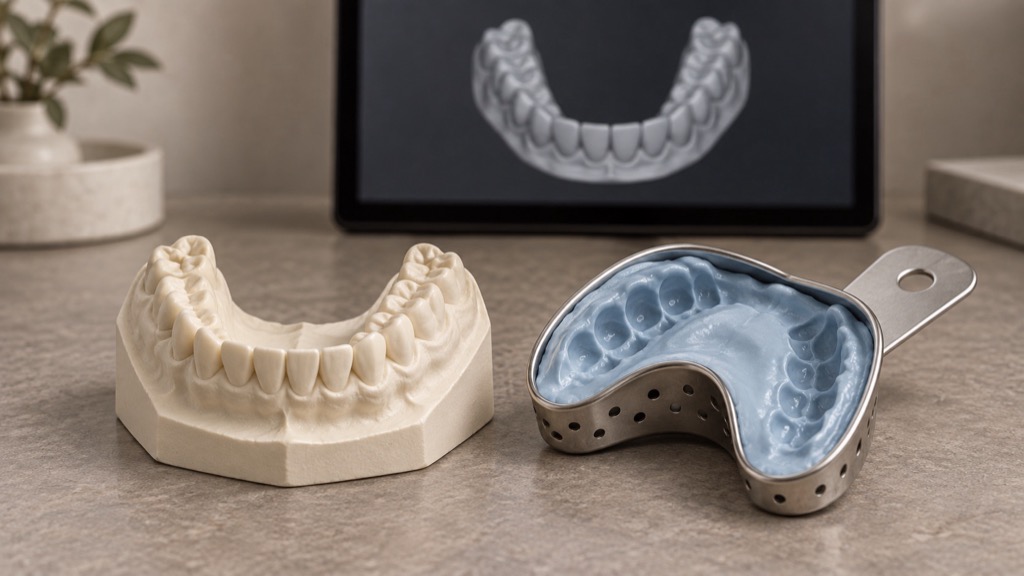
The digital impression with intraoral scanning is today indicated for single crowns, short bridges, orthodontic aligners and numerous partial implant rehabilitations, with accuracy clinically comparable to the traditional technique. The conventional impression remains preferable for complete arches on implants and in specific clinical cases evaluated on a case-by-case basis.
Who can benefit from a digital dental impression?
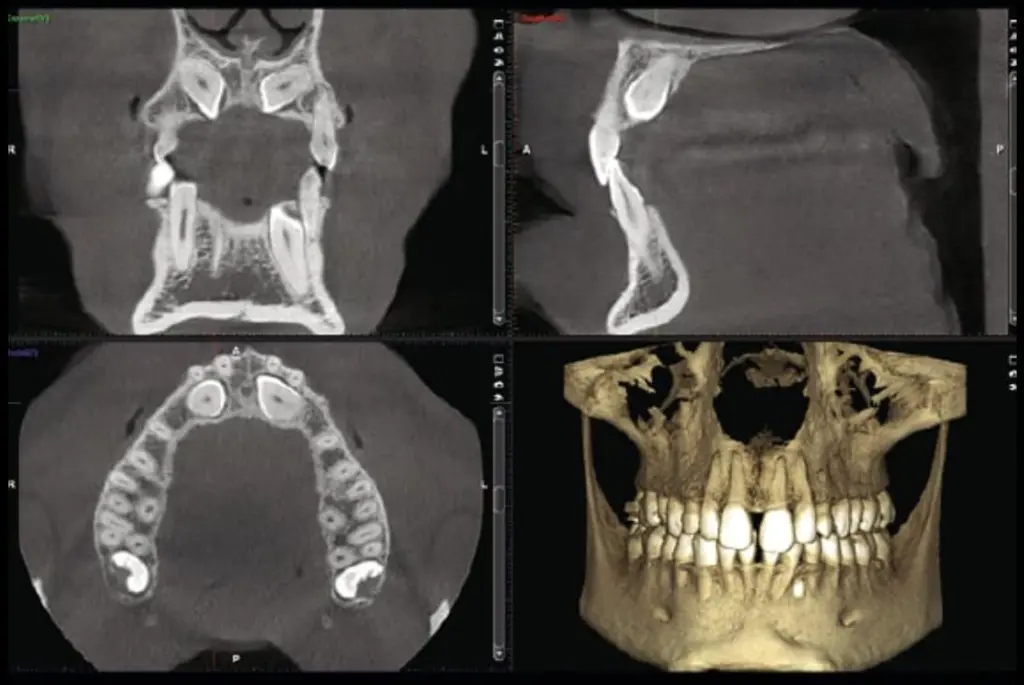
Intraoral scanning is particularly suitable for patients facing single crowns, short extension bridges, partial aesthetic restorations, orthodontic aligners and many partial implant rehabilitations. The prosthodontic literature confirms that, for these scenarios, the three-dimensional accuracy is clinically acceptable and comparable to that of the traditional technique. In Studio Buniato, in Corso Francia 30 in Turin, we use the 3Shape TRIOS 6 intraoral scanner with integrated FaceScan and Planmeca CBCT to build a coherent digital flow from diagnosis to prosthesis. A 2021 systematic review of 437 patients, spread across 9 RCTs and 8 prospective studies, documented reduction in chair time and improvement in patient-reported comfort parameters, regardless of the size of the scanned area and the type of restoration planned. For those who experience complex prosthetic or implant paths, the scan allows you to show the state of the arches in real time and plan each step with greater transparency.
When the traditional impression remains a valid choice
A review published in the Journal of Prosthodontics highlighted that, in the full-arch impression, the conventional technique showed better accuracy than the intraoral scan, which is more vulnerable to deviations when the area to be detected is very large. The 2020 meta-analysis dedicated to implant impressions confirms comparable three-dimensional accuracy for partially edentulous patients, but underlines that for completely edentulous arches the clinical evidence is still limited and further studies are needed. In our clinical practice we indicate the traditional technique when the extent of rehabilitation, the presence of mobile soft tissues or specific anatomical conditions make an impression taken with polymer materials more predictable. Lighting conditions, the color temperature of the operating room and the irregularity of the surfaces to be scanned can also influence the accuracy of the scanner. The choice between digital and analog is not a question of commercial fashion, but of clinical indication documented on a case-by-case basis.
How we decide at Studio Buniato in Turin
The choice of the type of impression arises from the initial diagnostic evaluation and the proposed prosthetic treatment plan. In our practice, each indication is discussed together with the patient: the clinical rationale is explained before proceeding, with a description of the technical alternatives and their respective limitations. For single restorations and fixed prostheses of limited extension, the intraoral scan represents the preferential flow, integrated with the CBCT when it is necessary to correlate bone anatomy and prosthetic design. For large implant rehabilitations we evaluate case by case, taking into account the experience gained in advanced implantology and published data on three-dimensional accuracy. The principle remains the same: choose the technique that reduces prosthetic adaptation errors and multiple adjustments, not the one that makes the practice appear more technological. Transparency on the reasons for a choice is an integral part of our way of working.
What to expect during your intraoral scan
Intraoral scanning is an outpatient procedure that does not require traditional impression materials such as alginate or polyether silicone. The patient is sitting in a comfortable position; the clinician passes the scanner cannula over the dental and gingival surfaces, while the three-dimensional image is composed in real time on the monitor. The 2021 systematic review documented that scanning reduces procedure time compared to the conventional technique, for both quadrants and full arches. For many patients this means less stimulation of the gag reflex, absence of taste or sensation of pressure related to the impression tray. During the session it is possible to show the patient the anatomical detail of the arches, highlight areas of interest and explain the rationale of the envisaged prosthetic plan. The scan is then sent to the laboratory in digital format; when the case requires it, we integrate the information with the Planmeca CBCT for surgical and prosthetic planning.
How archiving and baseline records support maintenance
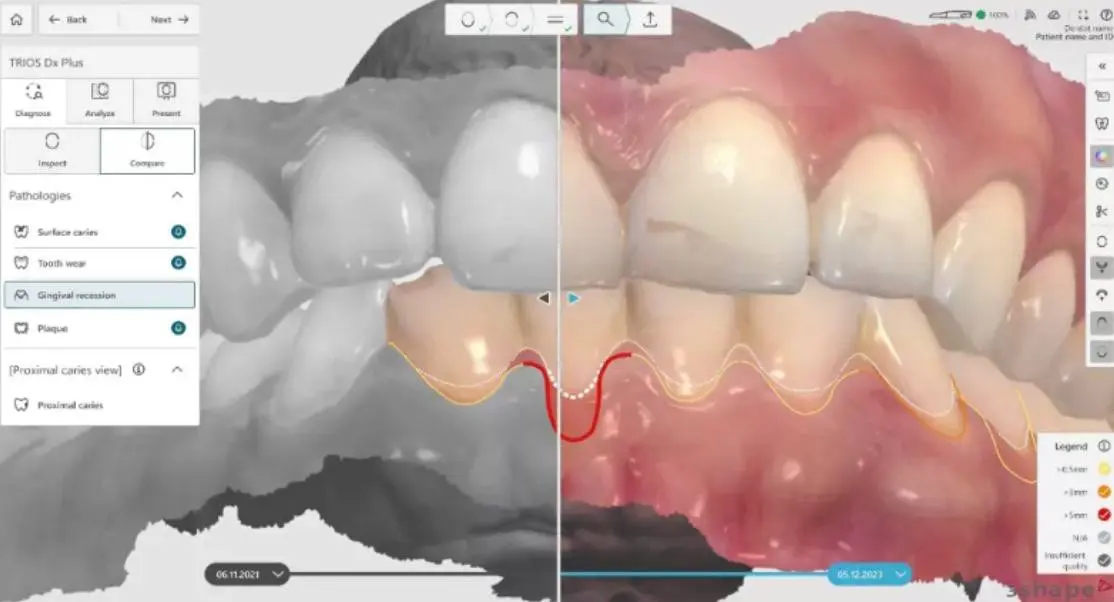
The scan taken today can be stored as a comparable reference in subsequent years. This allows you to monitor gingival retractions, microfractures, wear of the restorations or small anatomical variations with an objective starting point. In complex implant and prosthetic procedures, the digital archive supports maintenance checks and the possible need for partial remakes with greater information continuity compared to impressions preserved only as plaster models. Planning a potential implant path benefits from the data already acquired, avoiding repeated impressions when not clinically justified. Studio Buniato in Corso Francia 30, Principi d'Acaja metro stop, integrates intraoral scanning, CBCT and prosthetic flow in a single path, with an average rating of 5.0 on Google, on public and consultable reviews. For those facing complex rehabilitations, knowing the rationale for the diagnostic steps in advance reduces uncertainty and improves the quality of the decision.
For a personalized evaluation of your case, Dr. Buniato is available for one first specialist visit with complete diagnostic analysis.
Frequently asked questions
Is the intraoral scan painful or uncomfortable?
No, the scan is a non-invasive outpatient procedure. The scanner cannula is slid over the dental and gingival surfaces without impression materials, reducing the stimulus of the gag reflex and the sensation of pressure typical of the traditional impression tray technique.


his human warmth, helpfulness, courtesy, calm manner and ability to explain the various steps that would follow.
Show less
I did not know Dr Buniato and found him through an internet search. My old bite splint had broken, and I was looking for a practice that used cutting-edge techniques to make a new one. From the start, the doctor was very helpful and courteous and clearly explained the work he would need to do. Once the splint had been made, we had to meet several times so that he could adjust it to fit my teeth as well as possible. Now I have a splint that does its job perfectly. Above all, I greatly appreciated his human warmth, helpfulness, courtesy, calm manner and ability to explain the various steps that would follow. The reception staff are excellent too. The practice is clean, modern and well cared for. What can I say: these days, a doctor like this is almost a rarity. So I recommend him and thank him sincerely.
Does digital scanning completely replace the traditional impression?
No, not always. For single crowns, short bridges, aligners and many partial implant rehabilitations the accuracy is clinically comparable. For completely edentulous arches on implants, the literature indicates that the traditional technique is often preferable. The choice depends on the clinical indication of the individual case.

attentive and always willing to explain every stage of treatment.
Show less
I began treatment with Dr Gianluca Buniato to straighten my teeth as an adult — I am 40 — and I can say it was one of the best decisions I could have made. Thanks to a carefully planned course of orthodontic treatment lasting less than two years, I achieved results I would never have thought possible: my smile has changed completely and I finally feel confident showing it!
Dr Buniato is extremely precise, attentive and always willing to explain every stage of treatment. The entire team is also kind, welcoming and very well organised. The practice, on Corso Francia in Turin, is carefully designed down to the smallest detail and immediately gives you a sense of trust and calm.
Although I live quite far from the practice, the excellent reviews persuaded me to put my trust in the doctor, and I can confirm that it was the right choice.
I absolutely recommend this practice to anyone who wants to improve their smile with professionalism, technology and plenty of personal attention.
How long does an intraoral scanning session last?
The 2021 systematic review documented that scanning reduces procedure time compared to traditional impressions, for both quadrants and full arches. The actual duration varies based on the extension of the area to be detected and the complexity of the case, but in many clinical scenarios the reduction perceived by the patient is clear.

their kindness in welcoming patients and their helpfulness in arranging appointments.
Show less
Dr Buniato and his entire team stand out for their great professionalism and expertise, as well as for their kindness in welcoming patients and their helpfulness in arranging appointments. A dental practice I absolutely recommend!!
Is intraoral scanning suitable for planning implant treatment?
Yes. For partial implant rehabilitation, studies document three-dimensional accuracy comparable to that of the conventional technique. At our practice, we combine it with Planmeca CBCT when bone anatomy and prosthetic design need to be correlated. For full-arch implant rehabilitation, we assess each case individually using the clinical data and available literature.

From the very first appointment, I was impressed by the care and clarity with which solutions were proposed to me
Show less
I contacted Dr Gianluca Buniato’s dental practice for advice and a possible estimate to address my many complex dental problems. From the very first appointment, I was impressed by the care and clarity with which solutions were proposed to me, and I was soon able to see how effective they were. I feel I should thank Dr Buniato and his team not only for the professionalism with which they work in a dental practice using excellent technology, at very reasonable prices, but also for their ability to put patients at ease at all times.
Sources
- Ahlholm P, Sipilä K, Vallittu P, Jakonen M, Kotiranta U. Digital Versus Conventional Impressions in Fixed Prosthodontics: A Review. J Prosthodont. 2018. DOI: 10.1111/jopr.12527. PubMed
- Siqueira R, Galli M, Chen Z, Mendonça G, Meirelles L, Wang HL. Intraoral scanning reduces procedure time and improves patient comfort in fixed prosthodontics and implant dentistry: a systematic review. Clin Oral Investig. 2021. DOI: 10.1007/s00784-021-04157-3. PubMed
- Papaspyridakos P, Vazouras K, Chen YW, Kotina E, Natto Z, Kang K. Digital vs Conventional Implant Impressions: A Systematic Review and Meta-Analysis. J Prosthodont. 2020. DOI: 10.1111/jopr.13211. PubMed